
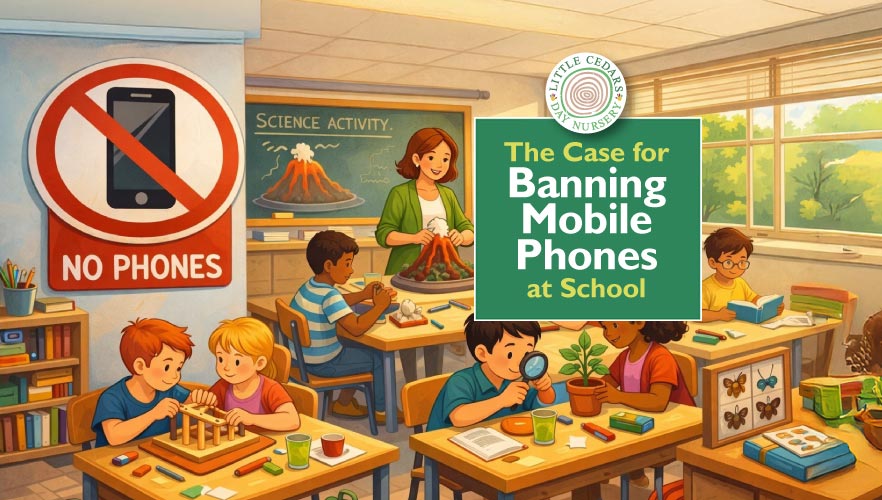
Babies and under-fives will be at school before we know it — those first few years go by so fast! With that in mind, there is a hot topic that parents of such little ones need to be aware of: the case for stopping children from accessing mobile phones at school. Much has been said in the press recently about the subject. However, what is the evidence that removing access to mobiles will improve children’s education and well-being? Well, according to a ban undertaken in schools in the Netherlands, there is some very good evidence. After two years of the Dutch mobile phone ban, we now have some clear findings. We’ll take a look at those and explore the issue in today’s topic: The Case for Banning Mobile Phones at School.
The Dutch Ban on Mobile Phones in Schools
It was more than a trial in the Netherlands; the Dutch government effectively banned* access to mobile phones by students in schools. The idea was to encourage better concentration in lessons, remove the distractions invariably caused by mobiles, and thereby improve academic performance and outcomes for the students. That mobile ban began 2 years ago. Subsequently, smartwatches and tablets were also added to the list of banned devices — smart devices are simply not allowed. Signage is typically displayed at school gates, announcing that any smartphones and devices must be stowed securely in children’s lockers from the moment they enter the school building. Better still, leave them at home!
* This wasn’t a new law, as such. Instead, it was an agreement between the Dutch government, schools, teachers, and parents, who all bought into the initiative. Such an approach got everyone on board and was far quicker to implement than waiting for a law to be passed — an innovative and, it turns out, effective approach.
What Are Teachers Saying?
Firstly, because the scheme is a buy-in by parents, teachers, school heads, and the government, teachers do not feel alone in the enforcement of the phone ban. It’s a multi-stakeholder initiative and, as such, attracts minimal friction, leaving teachers liberated from the need to significantly ‘police’ it.
The Dutch teachers believe the mobile phone ban in schools is a success. Children have better focus in lessons and while undertaking school work. Attention is significantly improved. Unsurprisingly, therefore, teachers are seeing an improvement in academic performance as a result.
What’s more, teachers have noticed that children are calmer and more relaxed. They no longer have to concern themselves with communications coming from all quarters, being photographed by peers, or images of them being posted to social media.
What the Data Says About The Dutch Ban
Such findings by teachers are backed up by data from the Dutch mobile ban. A study commissioned by the Dutch government found that about 75% of schools surveyed confirmed a significant increase in the levels of student concentration. A third showed clear improvements in children’s academic performance, and two-thirds experienced an improved social climate as a result of the mobile phone ban. Bullying levels were seen to drop in other similar studies.
“UNESCO called for smartphones to be banned from schools as evidence showed it was linked to reduced educational performance and that excessive screen time had a negative impact on children’s wellbeing.” — Gov.uk(∞)
What Are Students Saying?
Children inevitably had initial misgivings and perhaps mixed feelings when the ban first came into force. After all, mobile phones, particularly Internet-connected smartphones, are multifaceted and alluring pieces of kit that some may argue are even addictive. So, some children were inevitably anti-ban. However, children in Dutch schools are now finding themselves living more in the moment, whether socialising with friends, at play, or in the classroom. They are now more present. Some, who had expected school life without a smartphone to be a retrograde step, report that they went on to experience no downside at all. Furthermore, students are saying that they are not making up for lost smartphone time before or after school. They’re becoming more social in real life.
“By the age of 12, 97% of children have their own mobile phone, according to Ofcom. Using mobile phones in schools can lead to online bullying, distraction and classroom disruption which, in turn, can lead to lost learning time.” — Gov.uk
How Do the Provisions for Mobile Bans in Schools in England Compare?
While, as yet, there is no official government ban on mobile phones in schools in England, they are strongly discouraged via official guidance. That said, the government continues to explore the possibility of an outright ban and has updated its guidance for schools as recently as this year (2026).
While it’s guidance from the government for now, the majority of individual schools in England have already banned mobile phones in some way. Exact policies vary, but if brought to school, many require them to be handed in or locked away, for example, in lockers or special pouches. Some have even installed charging points within lockers as an incentive for kids to stow them inside.
“The Department for Education says phones ‘have no place in the classroom’, and that Ofsted will be judging the implementation of schools’ phone policies going forward.” — BBC
Is There a Downside to Banning Mobile Phones in Schools?
Safety-conscious parents may previously have used smartphones to track the whereabouts of their children, including at school. If the phone is in a locker, though, that’s not possible. However, this is easy to fix with something like a Bluetooth tracker. Various options and suppliers are available, using several different technologies for the tracking element. An Apple Air Tag is a well-known example. Like many of the other tracking devices, these are small enough to put in a child’s pocket or pencil case, or to attach to a backpack.
Another current downside in England, at least for now, is that a phone ban can be tricky to enforce. That’s not least because of the challenges of making a school phone-free without a legal ban. Some children may also simply hide phones, making them silent, or switching them off for stretches of time. A full, legal ban, however, may hold more weight against activities, as more people would buy into the rules by default. And, with all children following the same rules, there would no longer be a fear of missing out.
“Nearly a quarter of five-to-seven-year-olds now have their own smartphone, and nine out of 10 students own a mobile phone by the time they reach secondary school, according to Ofcom.” — BBC
What About Children Under Five?
Today’s post is timely because the Government released new guidance just this week (late March 2026), recommending that children under five should spend no more than one hour a day on screen time. The advice goes on to recommend that children aged under two should avoid screentime completely, except where it is shared with an adult as part of a bonding activity, interaction, or conversation.
Final Thoughts
There is no doubt that smartphones, and even so-called dumb phones, don’t belong in the classroom — or playground for that matter. And removing children’s access to them at school does seem to result in some very positive outcomes. That’s a fact that should come as no huge surprise, given what a distraction they can be. With that in mind, the UK government continues to tighten up guidance and further explore the possibility of a legal ban.
The debates and news around the use of smartphones by children continue to swamp the news this month. As we said near the start, it’s a very hot topic right now. Just this week, Meta and Google were both found to be liable by a U.S. jury for building addictive platforms that harm children’s mental health, according to the BBC and other news outlets. We may come back separately to the topic of screentime and use of social media by children in due course, so watch this space!
Little Cedars: a High-Quality Childcare Provider in Streatham
Year-Round Childcare Services in Streatham — Little Cedars Day Nursery

 We hope that today’s article from our comprehensive blog area is of interest to parents. For those with children under five living near Streatham, Little Cedars Nursery represents a wonderful choice for weekday childcare. We’re open virtually all year round and are conveniently located close to Streatham, Streatham Common, Streatham Hill, Streatham Park, Tooting, Furzedown, Balham, Norbury, and Colliers Wood. We offer fabulous facilities, wonderful staff, and a warm, homely environment for babies, toddlers and under-fives. Children at Little Cedars Nursery are given the very best start, as attested by our good Ofsted rating, and we support funded childcare places for eligible children.
If Little Cedars Day Nursery sounds of interest, please get in touch today to explore a possible nursery/preschool place for your baby or child under five:

 Except for Safeguarding, the new Report Card will show Ofsted’s evaluation of each of the assessment areas as one of the following:

 Concepts involving numbers and counting can sometimes be tricky for some preschoolers to grasp. Making sense of such concepts is important, though, because many aspects of children’s day-to-day lives will require an increasing understanding of numbers as time passes. Whether it’s knowing if a quantity of something is more or less than something else, how much of an ingredient is required in a mixture, or what change to expect from a purchase, children will need to grasp number-based concepts — and understand their real-world applications. What’s more, they’ll need to do this sooner rather than later if they’re to thrive, not least when they leave early years settings to begin school.
 Making ‘number cards’ with your child will be a fun and useful first step. These could be as simple as small pieces of paper or card, each having a single large number written clearly on them. Alternatively, your child could take the opportunity to get more creative. For example, you and your child could make the numbers bright and colourful, have patterned in-fills, or even be made to look like animals or number ‘characters’ that have eyes. For the very young, start with numbers up to 5, or go to 10 or even 20 for older and more advanced children. Size-wise, perhaps aim for cards sized at about A6 (a quarter of an A4 sheet) or even A7 (A4 divided into 8).
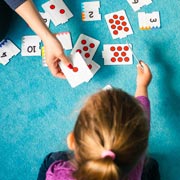 A more advanced form of the number cards could depict the correct number of dots (or other drawn objects) instead of — or as well as — the actual written number. So, for example, the ‘3’ card could show a column or row of 3 round dots or squares or even something like 3 drawn strawberries — whatever your child likes! In a way, it’s a bit like traditional playing cards where each has both a number and the right amount of hearts, diamonds, clubs or spades on it, to match the number.
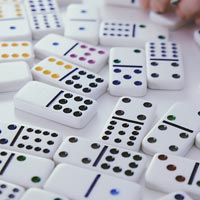 This next game will require a set of dominoes or, if you don’t have a set, they’re also easy enough to make in a similar way to the number cards. As you may know, each half of every domino has a number of dots, most commonly from 1 to 6. So, for example, there might be two dots on one end and five on the other, with the dot formations being rather like those you’d see on dice.
 Understanding whether a quantity of something is more or less than something else is an important concept for children to grasp. Similarly, being able to estimate a quantity is a useful and practical skill for little ones to master. Such concepts can easily be highlighted, and the skills mastered, using simple estimating games. Some examples follow.
 Pretending to be a shopkeeper or a shopper buying from one is a great next step for children. What’s more, they’ll naturally love playing shops having, no doubt, accompanied parents to real shops. This is where they can put all the things they’ve learned from the games above into practice. They can check they have the right quantities, weights or volumes or products, check they’re giving the shopkeeper the right amount of money, ensure that any change is correct — and so on! Playing shops is such a great way to master numbers, counting, estimating, weighing, addition, subtraction and more!


 In today’s guide, we outline a simple but powerful nature-based activity that will be both fun and educational for children and under-fives. This one is all about how to sow wildflower seeds. Once growing, these will bring beauty and wonder to any setting. The activity will also complement our recent
  Children benefit very much from spending time in nature, as we outlined in our article entitled
  Colour(s) — Children can help decide whether to grow wildflowers of just one colour, a limited 2- or 3-colour palette or perhaps multiple colours. If parents have an existing colour theme in their garden or plant area, they may wish to point children in a particular direction, so as to keep that colour theme going.
 Free wildflower seeds can be harvested from existing wildflowers — either from your own wildflowers if you have them, or from those found in the wild along hedgerows and similar (N.B. only do so in moderation and for personal use). Timing will, of course, be critical because seeds will only be available at certain times of the year, i.e. when the wildflowers have “gone to seed” at the end of their flowering period.
 Sowing seeds on existing lawns that you/your child want as a wildflower meadow is simply a case of scattering seeds on the lawn, ideally spaced out in such a way that they don’t have to compete with each other once they start growing. Then ensure that the area of lawn is kept moist by either rain or, if there is no rain, regular sprinkling from a watering can fitted with a sprinkling head (a.k.a. ‘rose head’). Children may need to remind adults not to cut the lawn thereafter, of course!
 Children will love it once the wildflowers begin to grow and later bloom. They’ll also love seeing bees, butterflies, and other insects visiting and the results of the activity may indeed give them a great sense of accomplishment. The whole process and the results are quite magical when you think about it.
 Following on from our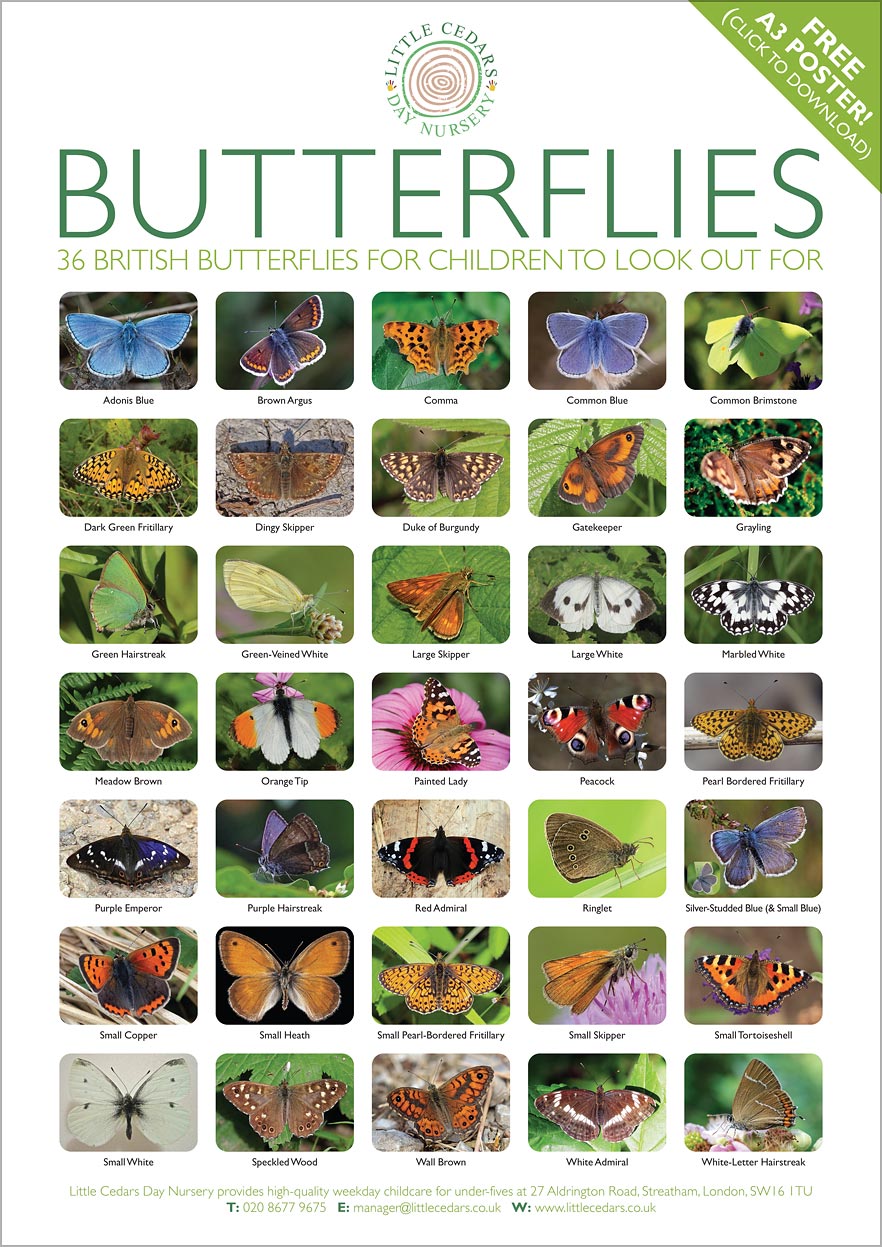
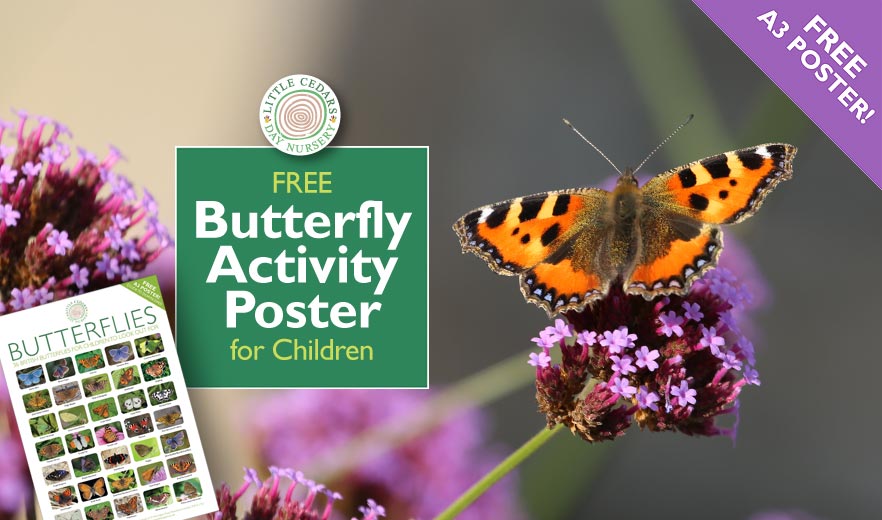
 We must also add that children should be encouraged to ‘look but don’t touch’ as butterflies are very delicate creatures. Children should not try to touch or catch them — they are best left in peace as every one of them is a little individual that simply wants to go about his or her day. They’re wonderful to watch, though, and our free poster should help children and adults identify many of the different types. Perhaps see how many different species can be spotted over the course of a year. Take photos too, and compare them with friends! Some butterflies visit gardens, floral window boxes and parks while others may only be found in wilder locations in the countryside. This activity is therefore a great excuse for families to get out and explore The Great Outdoors! Recording the date and location of each butterfly spotted will also help families work out where the best butterfly-spotting locations are for next time.
 With that in mind, why not take this activity a step further and get involved in the UK’s annual Big Butterfly Count? For 2024, it takes place between Friday the 12th of July and Sunday the 4th of August, which is when most butterflies are at their adult stage. All it takes is 15 minutes and children will love being little ‘citizen scientists’! The activity can be done in gardens, parks, school grounds or out in the countryside. Taking part will give children a real opportunity to help with butterfly conservation.
 Bilingual children have been shown to have better cognitive flexibility, focus and creativity. Studies have shown that this often leads to better decision-making, prioritisation and planning skills too. With such skills in place, bilingual children may also have a better ability to multitask and switch between separate tasks.
 Young bilingual children may sometimes mix their languages or use one language inappropriately in certain contexts. This is a normal part of the language acquisition process but can be a little confusing, at times, for both the child and their caregivers.
 Parents play a crucial role in supporting their bilingual children’s language development. To help your child become proficient in two different languages, it’s important to consistently speak both at home. Doing so can help children develop a particularly strong foundation in both languages.
 With Universal Free Childcare, children aged 3 or 4 can receive up to 570 hours of free childcare over the course of the year.
 With Extended Free Childcare, eligible 3- and 4-year-olds can receive up to 1140 hours of free childcare per year instead of only 570.
 Some disadvantaged children aged 2 can also receive up to 570 hours of free childcare over the course of the year.
 For those that are eligible, up to £2,000 in free childcare is available each year to children aged 11 or under* through the Tax-Free Childcare scheme.
 You can sacrifice up to £55 per week of your earnings, which will be free of National Insurance and Income Tax, to fund Childcare Vouchers.
 Following the Spring Budget 2023, childcare funding through Universal Credit is to be improved with nearly 50% more generous funding becoming available from July 2023.
 Those already claiming for childcare costs via Working Tax Credits may be able to obtain up to £122.50 for one or £210.00 for more than one child each week.
 2-year-olds may be eligible for the ’15 Hours’ scheme from April 2024.
 Up to 85% of childcare costs incurred by students may be claimed, up to a maximum of £188.90 per week for 1 child or £323.85 for 2 or more (correct for academic year 2023-2024).
 Up to £160 per child is available each week for those living outside London.
 While it’s not designed to fund childcare, it can be used to do so in some circumstances.