
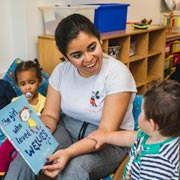
 Children and families, get ready for National Storytelling Week! For 2024, storytelling in the UK is officially celebrated from Saturday the 27th of January to Sunday the 4th of February. It’s a great opportunity for children and families to get creative and to entertain one another through the sharing of stories.
Storytelling is an ancient and important tradition across the globe and one that has many benefits for both the storyteller and the listener. As such, it’s something that should be encouraged amongst children of any age. Today, we take a closer look at some of those benefits and suggest ways that both kids and families can make the most of this wonderful, free activity.
Storytelling: the Perfect Antidote to Wintery Days
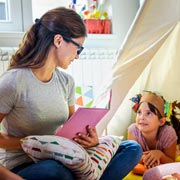 National Storytelling Week couldn’t come at a better time of year. As many across the UK have witnessed in recent weeks, January brings with it cold days, dull skies, and wintery weather. Even the daylight hours are short, limiting the number of activities children can undertake outdoors. With storytelling, however, families can be transported to any number of different locations, situations and climates, all in the blink of an eye. Indeed, storytelling can take children to places and scenarios that would simply not be possible in real life. Such is the power of this art form and the human imagination.
Some Benefits of Taking Part in National Storytelling Week
Whether storytelling is a simple verbal activity or dramatised in some way through acting or the use of props, it can be highly entertaining and captivating. There are also a significant number of additional benefits for both the storyteller and the listener, including:
 Stories stimulate imaginations;
- Storytelling enhances creativity;
- By showing what it’s like to be someone or even something else, stories nurture empathy;
- Storytelling can be a great way to relax;
- Storytelling helps to expand vocabulary and literacy;
- Storytelling helps to improve children’s speech and listening skills;
- Stories can be a great way to share new facts;
- Stories open up new worlds to children;
- Stories are a great vehicle for escapism, which is important, especially to those who have had a challenging day;
- Storytelling activities can even lead to careers involving writing or other creative jobs;
- Last but not least, storytelling is simply great fun!
 Stories stimulate imaginations;
So, all in all, there’s every reason for children and families to get involved in National Storytelling Week from Saturday the 27th of January to Sunday the 4th of February 2024. However, don’t stop there … storytelling is worthwhile any time of year!
How to Enhance Children’s Storytelling Sessions
If you’re an adult overseeing a storytelling session with children, perhaps start them off by telling them a short story yourself to get the ball rolling. They can learn from your example and then take turns to tell their story to the group. Making up brand new stories is beneficial (it will promote greater creativity) but it’s also OK for the youngest children to be influenced by existing stories they’re familiar with if they initially struggle to create something from scratch.
 Another great way to help children create new stories is to encourage them to be inspired by objects around them. For example, a teddy bear, toy character, or picture nearby may inspire them. This can be taken further by providing children with a basket of such props, for example, a toy animal, pine cone, toy crown, goblet, apple, and a rock. A ‘story scrapbook’ can be used by children in a similar way. Such things can significantly help children to become more creative and generate storyline ideas, sequencing, and plot twists.
Try encouraging questions and interaction from children who are listening. This will help to get them more involved and immersed in the storyline.
Another creative approach is to let them influence how the story should unfold by making suggestions along the way.
Hand or finger puppets can also be excellent, immersive tools to bring stories to life. Adding in some acting will add an extra layer of drama and entertainment to stories too, so encourage this. It can be taken to many different levels, perhaps with the use of different voices and accents, fancy dress to look like a character, introducing props and so on.
Why not set up a storytelling corner or nook? This can be used all year round and should be a quiet, comfortable space. Perhaps scatter cushions, blankets, and soft toys, and add fairly lights, props and, for young actors-in-the-making, costumes. A bespoke storytelling corner is sure to encourage children to come back to the activity throughout the year.
Such approaches are a recipe for a very entertaining, captivating and immersive storytelling session, which children will love! It’ll get them thinking deeply, stir their creative juices, boost their imaginations, and allow them to enter a different and magical reality for a short time. They’ll learn more about the world and gain improvements to skills like empathy and literacy along the way. Through the simple activity of storytelling, both the listener and storyteller will benefit in a myriad of ways. So — get children involved this National Storytelling Week and watch them blossom!
Little Cedars: Your Streatham Nursery & Preschool
A High-Quality Nursery in Streatham, near Furzedown, Tooting, Balham, Norbury & Colliers Wood


Are you searching for the perfect nursery or preschool for your child in or near Streatham? Little Cedars Day Nursery offers a high-quality home-from-home environment where babies, toddlers and preschoolers absolutely thrive. Rated as a Good Provider of childcare and early years education by Ofsted, Little Cedars represents a wonderful choice for families looking for the very best fit for their little ones. We also support a raft of free childcare funding schemes, making childcare more affordable for eligible families.
Get in touch today to find out about available childcare places, arrange a guided tour with your child, or ask any questions:
Our Streatham childcare nursery may also suit families living nearby in Tooting Common, Tooting, Streatham Hill, Streatham Park, Streatham Common, Furzedown, Tooting Bec, Tooting Broadway, Balham, Norbury and Colliers Wood.
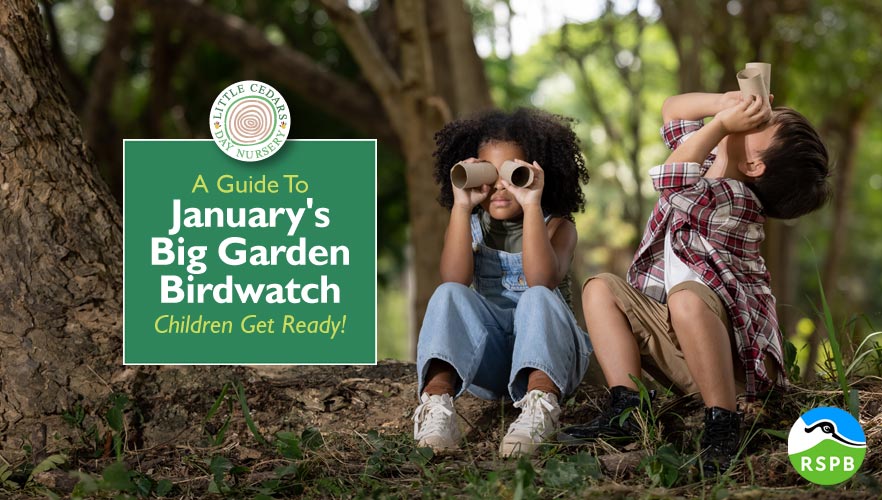
 Parents and children, don’t miss this year’s incredibly important birdwatching activity for the RSPB — and the planet — which occurs from Friday 24th to Sunday 26th January. The Big Garden Birdwatch only takes one hour, is free, and is an extremely worthwhile activity for children and families to take part in. It’s a great way to introduce children to the concept of conservation as well as getting them interested in spending time in and around nature. And, as we’ve reported before, nature is extremely good for children! In today’s post, we explain how easy it is to get your little ones involved and why taking part is a win-win-win for families, birds and nature.
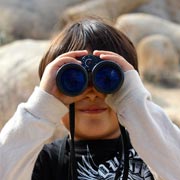 Monitoring populations of bird species every year allows the RSPB and other conservation organisations to see how the various types of garden birds are faring. Whether or not they’re doing well will be a barometer of the state of nature itself as well as that of the individual bird populations. If the RSPB and other conservation organisations can see a problem, they can then mobilise to try to do something about it. Likewise, if they see a particular bird species doing well, they can learn from that and better understand what measures are helping that particular bird population to thrive.
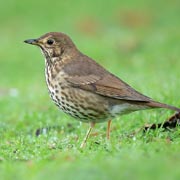 In 2023, the bird species spotted the most was the House Sparrow, followed by the Blue Tit in second place, Starling in third, Wood Pigeon in fourth and Blackbird in fifth.
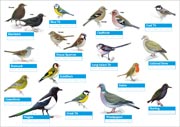 By registering you’ll also get a free guide to taking part in the event, which includes visual reference to the birds to look out for, as well as other perks like a discount on bird food and other bird feeding supplies available from the RSPB’s online shop.
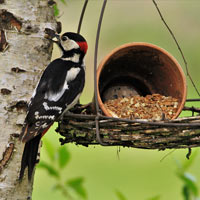 If you’re keen to attract as many birds as possible to your Garden Birdwatch count, the RSPB has you covered. As well as providing useful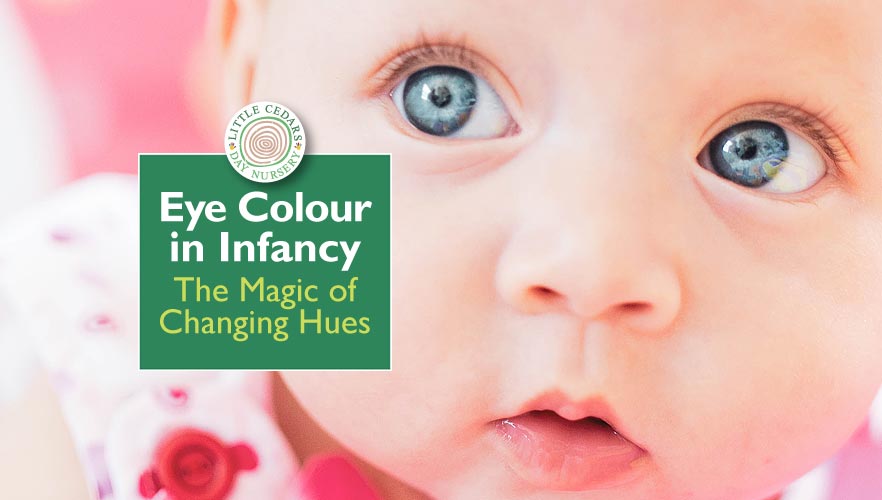
 Have you ever noticed that some babies are born with blue or grey eyes that later change to brown, green or hazel? It’s a magical metamorphosis that sometimes occurs in growing infants and it can be quite intriguing. Parents may indeed wonder whether their newborn child’s eyes are going to change or remain the same as they were at birth. The answer comes down to a combination of time, location, genetics and something called Melanin and today’s article explores this captivating phenomenon.
 When we talk about eye colour we are, of course, talking primarily about the colour of the irises of a human’s eyes. The iris is the circular muscle around the centre pupil and it is this muscle that governs how much light can pass into the eye by making the pupil larger or smaller. When there is lots of light around, the iris constricts the size of the pupil and, in contrast, makes it big when light levels are low.
 Melanin is a protein that’s secreted by special skin cells called melanocyte cells, which form colouration pigmentation in our bodies, including in the eyes, hair and skin. When it comes to the eyes, a lot of melanin pigment means the eye colour is more likely to be dark, for example brown. In contrast, those without much melanin eye pigmentation will have lighter eyes, for example, grey or blue. It is also those lighter colours that are most affected by the Rayleigh Scattering and Tyndall effects that we discussed in the last section.
 Melanin is a protective protein and, by having more melanin pigmentation, an eye has greater protection against harmful ultraviolet (UV) sun rays. That’s one of the reasons that populations from hot, sunnier countries are more likely to have brown or darker eyes — because those are better protected from the sun’s UV rays. Indeed, brown eyes are the most common eye colour in infancy, despite some common misconceptions. It is true, however, that blue or grey eyes are common in infancy in Northern Europe, where the sunlight is less strong.
 Genetics also play a part in the colour of the eyes and can be helpful when attempting to predict a newborn’s eye colouring. However, correctly predicting the colour of a baby’s eyes based solely on that of parents is not guaranteed. That’s because any inherited colouration may skip one or more generations. And, with a mix of different chromosomes and genes being passed down from parents, grandparents and beyond, skipping generations can sometimes result in completely unexpected eye colouring in infants. Genes will also control how much melanin will initially be present in a newborn’s eyes as well as affecting further production as the child ages and the eyes adjust to conditions.
 Heterochromia is a condition that affects less than 1% of the world’s population. Those affected may have two different coloured eyes or perhaps two colours present in one eye. The causes of heterochromia include physical injury, disease, genetics or sometimes the use of specific medications.
 Child Benefit is a financial support scheme, provided by the UK Government, that’s there to assist parents and guardians in covering the costs of raising children. It is an essential part of the social safety net in the United Kingdom and aims to help families with the financial responsibilities that come with bringing up children. Eligible families are free to spend Child Benefit however they like, whether that’s on children’s clothes, food, or something else.
 You can claim Child Benefit for all of your children who meet the eligibility criteria. It may surprise some to learn that there are no restrictions on the number of children you can claim for (unlike with some other types of Government child support), so each eligible child in your care can be covered under this benefit.
 Child Benefit can be affected by your or your partner’s individual income if either of you earns over £50,000 annually. In such cases, you may have to pay a ‘High Income Child Benefit Tax Charge’. This charge gradually reduces your Child Benefit entitlement if your income is between £50,000 and £60,000. Indeed, if your income exceeds £60,000, you’ll likely have to repay the entire amount through this tax charge. We’ll cover more of the detail in the next section below…
 Claiming Child Benefit is a straightforward process:
 In today’s guide, we take a close look at the incredible importance of outdoor play for children, including those under five. Outdoor play isn’t just about fun; it’s one of the cornerstones of childhood learning and development and has an immense number of benefits for little ones. So, in this comprehensive article, we’ll explore why outdoor play is so essential for our youngsters and how its effects can be transformative. Let’s take a look…
 For children, the outdoors represents a magical place where fun, exploration and real adventure can take place. Picture a world where a simple stick can become a wizard’s wand, or a puddle can transform into a treasure-filled lagoon, and you’ll soon understand how exciting the outdoors can be for children. Indeed, outdoor play is the realm of limitless imagination. It offers children a vast canvas in which to immerse themselves into adventures, fostering creativity and igniting their instinctive curiosity.
 The Great Outdoors serves as a natural classroom, with true hands-on learning experiences that provide numerous opportunities for children to acquire new skills and knowledge. Whether it’s
  Outdoor play engages all the senses and
  The outdoors serves as an exceptional classroom. When they’re playing outside, children effortlessly absorb knowledge about the world around them. In the open air, they will naturally learn about nature, seasons, different types of flora and fauna, and how the environment functions. It is true learning through discovery.
 The open spaces of the outdoors also serve as a wonderful canvas for creativity. Children’s imaginations run wild outdoors as they invent games, stories, and art inspired by the natural world. Outdoor play encourages them to think in new, innovative, ways and to truly embrace their creative potential.
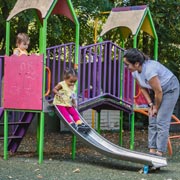 At Little Cedars Nursery, we really understand the profound impact that outdoor play has on early childhood development. With that in mind, our childcare practitioners ensure that children are given every opportunity to immerse themselves in a wide range of outdoor activities that help to nurture every child’s learning, growth, curiosity, and resilience. And let’s not forget one more important factor about outdoor play — it’s simply immense fun for children! As such, it is a perfect way to facilitate learning in the most natural way of all — through play.
 As parents and caregivers, we understand
  Boundaries create a sense of security. Ensure boundaries are understood and that play areas have clear markers. Guide children to understand and respect these boundaries to reduce the risk of children wandering away — and potentially becoming lost.
 Children are naturally drawn to water, but it can pose significant risks. Ensure that play areas are far from water bodies, and when near any water source, always provide direct and continuous supervision. Even shallow water can be dangerous for little ones.
 Although they’re young, children want to explore and will naturally want to climb as they get older. It’s therefore important to teach children a safe approach to climbing. This should include emphasising the importance of staying within safe heights to prevent falls, assisting with climbing technique and, of course, risk-assessing what they should and shouldn’t attempt to climb in the first place.
 While exploring nature is exciting, it’s essential to be aware of potential dangers. Educate your child about the dangers of poisonous plants and fungi or insects that could harm them. Encourage them not to touch or eat anything unfamiliar.
 Outdoor exploration sometimes involves contact with dirt and mud. Promote hygiene by ensuring handwashing facilities are readily available and teaching children the importance of cleanliness after outdoor play.
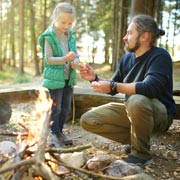 Campfire stories can be delightful and intriguing for children, but we must always prioritise fire safety. If you decide to expose them to it, children must be educated about the potential dangers of fire and always supervised during any fire-related activities. Fostering a responsible understanding around fire safety is paramount.
 Identification of a special educational need or disability is, of course, the first step in being able to properly support a child with SEND. For this reason, good early years providers like Little Cedars Nursery will, as a matter of course, watch out for signs of things that might be challenging for children. As prescribed by
  Support plans for suspected or confirmed special needs or disabilities are then discussed and custom-designed for the child. Such plans will be agreed between the child’s parents/caregivers, staff at the early years setting itself and any external specialists or professionals involved in the child’s care. Such programmes will be customised to suit the individual child’s specific needs and may include tailored activities, strategies, resources and so on. Formalisation of the support programme will allow all parties to pull in the same direction, working cooperatively for the benefit of the child.
 In parallel to the SENCo at the child’s early years setting, local authorities also have their own Special Educational Needs Coordinator, known as the Area SENCo. They will also be integral to a child’s SEND support plan, helping with coordination between the local authority, the various parties involved in supporting the child, and in relation to any special funding requirements. If approved, special funding might be required, for example, for an additional member of staff tasked with giving one-to-one support to the child, or to fund extra learning resources and activities for them.
 All 3- and 4-year-olds living in England are eligible for a minimum of 570 hours of free childcare per annum, irrespective of whether or not they have SEND. This is known as Universal Free Childcare or their Free entitlement and is typically taken as 15 hours of childcare each week over 38 weeks of the year, but how it is taken can differ.
 In today’s guide, we outline a simple but powerful nature-based activity that will be both fun and educational for children and under-fives. This one is all about how to sow wildflower seeds. Once growing, these will bring beauty and wonder to any setting. The activity will also complement our recent
  Children benefit very much from spending time in nature, as we outlined in our article entitled
 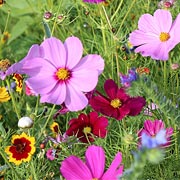 Colour(s) — Children can help decide whether to grow wildflowers of just one colour, a limited 2- or 3-colour palette or perhaps multiple colours. If parents have an existing colour theme in their garden or plant area, they may wish to point children in a particular direction, so as to keep that colour theme going.
 Free wildflower seeds can be harvested from existing wildflowers — either from your own wildflowers if you have them, or from those found in the wild along hedgerows and similar (N.B. only do so in moderation and for personal use). Timing will, of course, be critical because seeds will only be available at certain times of the year, i.e. when the wildflowers have “gone to seed” at the end of their flowering period.
 Sowing seeds on existing lawns that you/your child want as a wildflower meadow is simply a case of scattering seeds on the lawn, ideally spaced out in such a way that they don’t have to compete with each other once they start growing. Then ensure that the area of lawn is kept moist by either rain or, if there is no rain, regular sprinkling from a watering can fitted with a sprinkling head (a.k.a. ‘rose head’). Children may need to remind adults not to cut the lawn thereafter, of course!
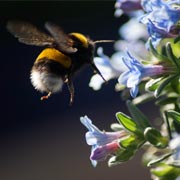 Children will love it once the wildflowers begin to grow and later bloom. They’ll also love seeing bees, butterflies, and other insects visiting and the results of the activity may indeed give them a great sense of accomplishment. The whole process and the results are quite magical when you think about it.
 A wonderful way to
  Combine with our Bird-Spotting Activity
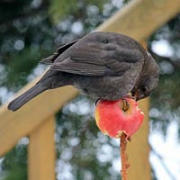 The fastest and easiest bird feeder for children/families to make is simply an apple. This can either be hung with string from a tree branch, bush, or similar, or the apple can be ‘spiked’ on the pointy end of a tree branch, a strong twig or something like a bamboo pole embedded in the ground (so long as it’s tall enough to keep birds safe* from predators). Easy! We suggest stripping some of the apple skin off to expose the flesh. Apples are a particular favourite of blackbirds and bluetits, amongst others.
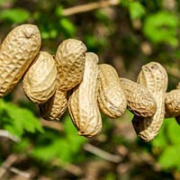 This is also a very easy bird feeder for children/families to make. All you need is some string and some monkey nuts* (peanuts still in their outer husk). A supervising adult will need to make some small holes in one end of each husk and then string can be threaded through to form a kind of chain (like a necklace). Monkey nuts can be threaded on to form the right length and then this can be tied between the branches of a tree, or similar. See our note about safely locating* them, though.
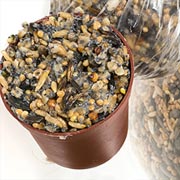 Home-made seed cakes are another type of bird feeder that is both easy and fun for children to make. Basically, they consist of lots of seeds mixed into a ‘cake’ made from either suet* or lard*. The seeds are mixed in when the lard or suet is melted, so parents/adults will need to help with that part as it’s done by heating it in a saucepan. Once melted, the seeds can be added and mixed in. Once cool enough to be safe, the children can take over to make most of the feeders. First, a piece of string can be tied from the centre of the base of something like a flower pot or yoghurt pot (parents should make the hole, if needed). Then the child can mould the seed cake into the pots, or other similar plastic containers. Once cooled, the seed cakes will harden and can then be suspended from the branches of a tree, bush, fence post or under the eaves of a house or outbuilding. Bluetits, great tits, starlings and robins will usually be the first to try out the new cakes.
 Your choice of seeds directly affects the success – or otherwise – of your bird feeders. While many commercially-available seed mixtures contain several different types of seed, we have found that birds ignore some of them, so they go to waste. Our own bird feeders have been far more popular when they use more sunflower ‘hearts’ (the sunflowers without the other case) and less of the wheat and barley type seeds. Crushed peanuts* are also popular, but see our notes below about the safety of both baby birds and children when it comes to nuts.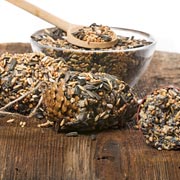
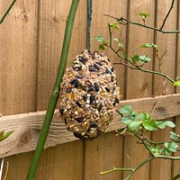 Another type of bird feeder that is both fun and easy to make is a pine cone feeder. All you need is a big pine cone, ideally with the cone splines open, a birdseed mixture and either peanut butter*, suet* or lard*. All your child needs to do is paste the peanut butter (or suet or lard that’s been safely warmed to soften it) all over the pine cone, including into the open splines. Then the whole thing can be rolled over your seed mixture, so the seeds stick all over the pine cone. Once complete, the pine cone feeder can be hung with a piece of string in an appropriate place outside. Even better: hang several together so the birds can’t miss them. The birds will love pecking them when they’re hungry.
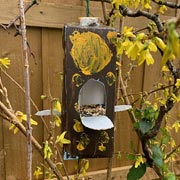 Bird feeders made from recycled cartons can be great fun, fairly easy and can be quite creative. All you need is an empty milk or juice carton, by which we mean the card ‘Tetra Pak’ type, plus some bird seed/food and some string. Parents will need to help younger children safely attach the string to the tops of the cartons and cut flaps/openings into the sides of the carton. These can be folded down, as shown in the photo, and suspended outside somewhere suitable for the birds. For extra creative fun, children can first paint patterns, designs or even faces on the cartons. This type of bird feeder is great because it not only holds the bird food but also potentially gives birds somewhere safe to land while feeding. As they were originally for holding liquid, they can alternatively be used to hold drinking water for birds — or perhaps children can make one for food and another for drinking water.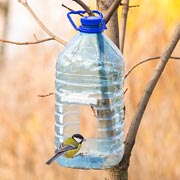
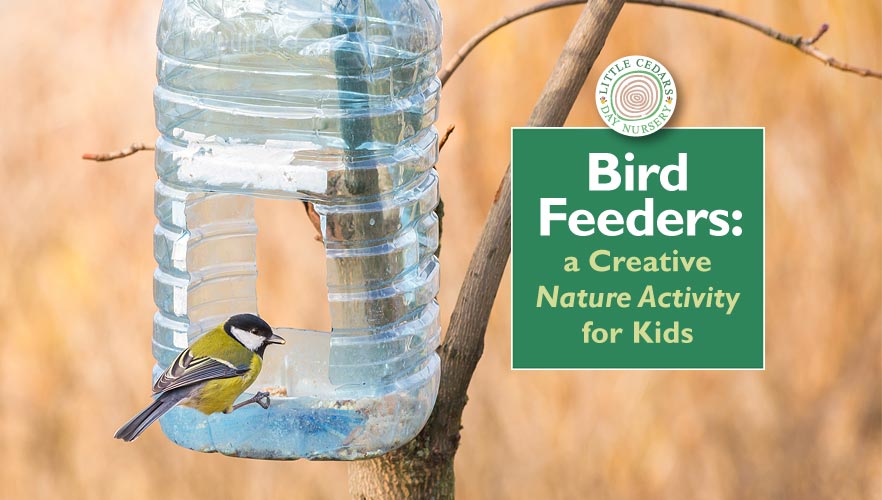
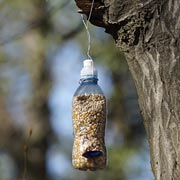
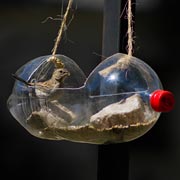 In a similar way, clear plastic bottles can be used as bird feeders or for water. The same approach can be used but flaps are not advised as they’re trickier for children to fold and also plastic bottles will have sharper edges than the carton approach above. So, this particular type of bird feeder needs extra supervision from a parent or adult. Take a look at the photos to see what’s possible, though. One photo (the first small image at the start of this article) even shows a plastic spoon that’s used as a landing platform and seed dispenser, all in one. Once finished, plastic bottle feeders tend to last a long time, so long as they’re regularly cleaned and refilled.