
What is National Offer Day in the UK?
National Offer Day is the day that parents receive confirmation of which school their child has been offered for the next academic year. For those with preschoolers who require primary school places starting in the September term, over 92% (2023: 92.5%) will typically get an offer from their first choice and over 98% (2023: 98.6%) usually receive an offer from a school within their top 3 choices. Out of 568,600 primary school applications made last year for the academic year 2023/24, only 8,000 (1.4%) didn’t receive offers for one of their preferred primary schools (statistics are lower for secondary school places).
In today’s guide, we outline how and when parents of under-fives should apply for primary school places, how places are allocated, what to expect on National Offer Day (a.k.a. Primary School Offer Day for preschoolers), and what your options are if you do not receive an offer for your preferred school.
When Will Your Child Receive Their Primary School Offer?
National Offer Day for primary school places falls on the 16th of April (for secondary school places it is the 1st of March). On the ‘offers’ day, those who applied for places online will receive an email* from their local council to confirm the offer. There are lots for the council to send out, so the time of day the email arrives with you will vary from location to location. Also note that, in years when those dates coincide with a Bank Holiday or a weekend, the offers will instead be sent during the next working day.
* Some local authorities also allow parents to view offers through the council’s admissions portal/system.
When is Compulsory School Age?
Although most children begin school in the September following their fourth birthday, they have the option to start a little later if preferred. Compulsory School Age, which is the age they must be when they begin full-time education by law, is whichever comes first of the 31st of December, March or August following their fifth birthday. In practice, though, most children in the UK begin school at the age of four and reach five during their first year at school.
When to Apply for Your Child’s Primary School Place
For primary school places, you must apply in advance when your child is 3 or has just turned 4 at the time of application, even for those wishing to start school later.
Applications for September Reception year primary or infant school places should usually be made no later than 15 January that year but can be made as early as September of the previous year.
Example:
For a child starting primary school at the age of 4 in September 2024, apply any time from 1 September 2023 to 15 January 2024.
‘In-Year’ Applications:
For one reason or another, for example after moving house, some families may have to apply for a primary school place for their child after the school year has started. Such ‘in-year’ applications will obviously not follow the usual dates outlined above and, once an offer has been received, the child will usually begin at the agreed primary school at the start of the next full term.
What If Your Application is Late?
“Your child is less likely to be offered a place at their chosen schools if you miss the deadline for applications.” (Gov.uk)
It’s worth noting that applications may not be processed until some time in May if they are received late. As May is long after the processing of all those that were received on time has occurred, the odds of getting a school place at your first choice are potentially reduced if you’re late. In other words, if you want to stand a better chance of getting your preferred school for your child, don’t be late with your application! Late applications may also require the use of a separate ‘late application’ form.
How & Where to Apply
Families should apply for school places for their children through their local council even if they are applying for a school in a different area. They should also still apply if they are applying for a school that’s linked directly to their child’s existing nursery/setting. When applying, you’ll be able to list your preferred schools in order and, subject to available places, this order will be taken into consideration when your application is being processed.
Applications for primary school places can be made online (start here) or via your council’s paper application form. Note, however, that those applying via a paper form may receive the outcome of their application a little later, probably via 2nd Class post, if they didn’t include an email address as part of their application.
Criteria for School Offers
As well as the timing criteria outlined above, other factors will influence how likely you are to receive an offer for your preferred primary school, although the exact factors vary from school to school. They may include how close your child lives to the preferred school, whether your child has a sibling there already, whether you as a parent have worked at the school for 2 or more years, whether it’s a faith school that matches your faith, plus other potential factors.
Accepting Offers for Primary School Places
Be warned that the offer you receive for your child’s primary school place will include a deadline and you will need to accept the offer by that deadline in order to secure your child’s place. If you do not accept it in time, the primary school place may instead be offered to another child.
What If Your Child Is Not Offered a Place at Your Preferred School?
For one reason or another, a small percentage of families (2023: 1.4%) will not receive an offer from a school within those they selected as ‘preferred’ during their application. If your local council is unable to offer your child a place at any of your preferred schools, the council will need to offer you a place at an alternative primary school. Usually, this will be the nearest primary school that has a place available.
Appealing Your Child’s Primary School Offer
If you do not receive an offer for one of your preferred schools for your child, you can appeal the decision if you so wish. The offer letter will give more details about how to do so. More information about the appeals process can be found here.
Note, however, that it may be wise to first accept the offer your child was originally given so that you have something to fall back on should your appeal be unsuccessful. Doing so does not, apparently, adversely affect your appeal. The same is true if you decide to ask to go on a waiting list for a preferred school, and we’ll come to that next.
Primary School Waiting Lists
In the unlikely event that no primary school place is available, or if you do not receive an offer at your preferred school for your child, you can apply for your child to be put on a waiting list. This would be done through your local council although you can also contact the school itself to enquire. Interestingly, you can also put your child’s name on a preferred school’s waiting list even if you have already received and accepted an offer elsewhere.
Good Luck!
We hope this guide has been useful and wish you good luck with your primary school applications. We hope that you receive the choices you hoped for once the primary school offers day arrives.
Little Cedars Nursery, Streatham
A High-Quality Nursery & Preschool in Streatham, near Tooting, Furzedown, Balham, Norbury & Colliers Wood

 Little Cedars is a high-quality nursery and preschool in Streatham, SW16. Rated by Ofsted as a ‘Good Provider’ of early years childcare and education, children under our care receive a first-class start to life in our warm, loving, home-from-home environment. At Little Cedars, we bring out the best in every child to help them become school-ready by the time they leave us to begin school in their fifth year.
Get in touch today to learn more about a nursery place for your child at Little Cedars:
 Getting children interested in nature, and spending time around it, is extremely good for them as we’ve reported before —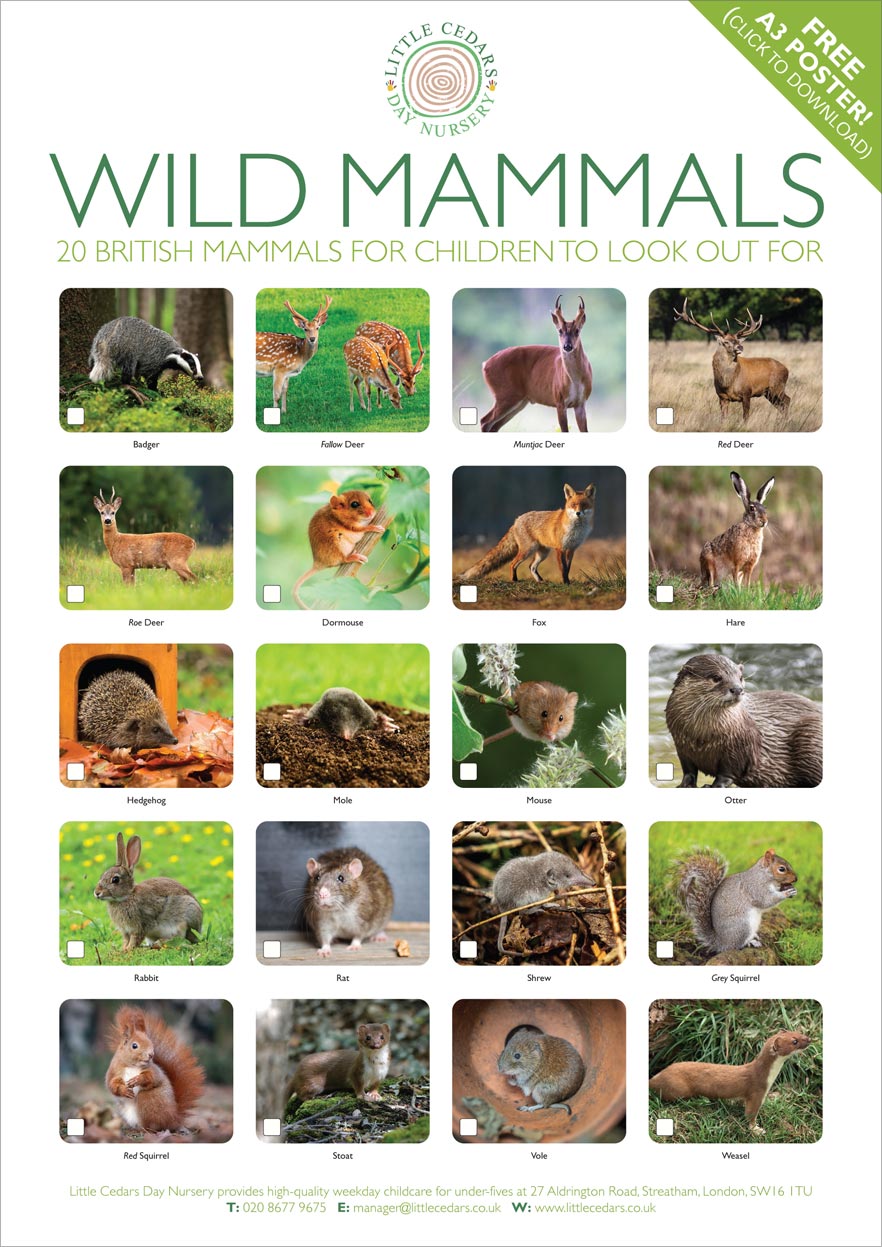
 World Wildlife Day celebrates the world’s flora and fauna. It happens on the 3rd of March each year and is a way to raise awareness of the need to protect nature. That can be achieved by reducing harmful emissions, pollution, habitat loss, and the loss of biodiversity. By introducing children to the beautiful wildlife around them, children will naturally be more empathetic towards other creatures and even progress to learning about conservation matters and the impact of humans on the planet. In this way, little ones can grow into young stewards of the planet and have an active interest in protecting it going forward. Get them started today by downloading our free Wild Mammals poster — who knows where it could lead!
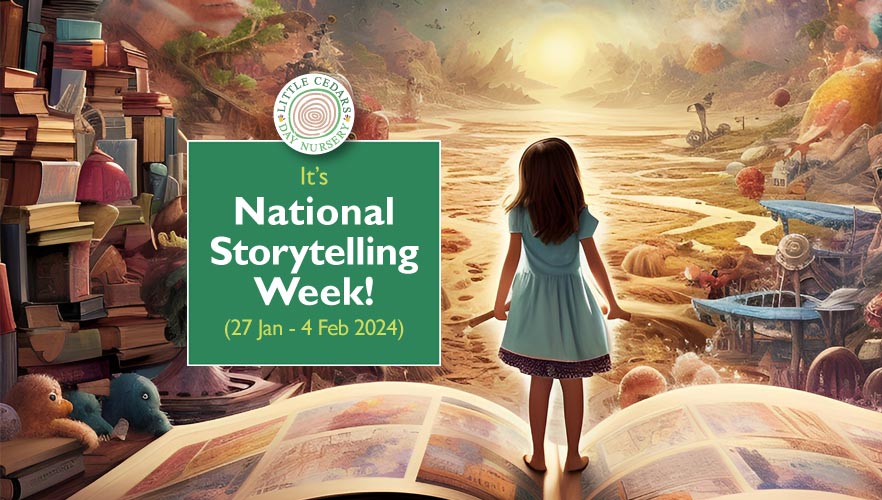
 Children and families, get ready for National Storytelling Week! For 2024, storytelling in the UK is officially celebrated from Saturday the 27th of January to Sunday the 4th of February. It’s a great opportunity for children and families to get creative and to entertain one another through the sharing of stories.
 National Storytelling Week couldn’t come at a better time of year. As many across the UK have witnessed in recent weeks, January brings with it cold days, dull skies, and wintery weather. Even the daylight hours are short, limiting the number of activities children can undertake outdoors. With storytelling, however, families can be transported to any number of different locations, situations and climates, all in the blink of an eye. Indeed, storytelling can take children to places and scenarios that would simply not be possible in real life. Such is the power of this art form and the human imagination.
 Stories stimulate imaginations;
 Another great way to help children create new stories is to encourage them to be inspired by objects around them. For example, a teddy bear, toy character, or picture nearby may inspire them. This can be taken further by providing children with a basket of such props, for example, a toy animal, pine cone, toy crown, goblet, apple, and a rock. A ‘story scrapbook’ can be used by children in a similar way. Such things can significantly help children to become more creative and generate storyline ideas, sequencing, and plot twists.
 Parents and children, don’t miss this year’s incredibly important birdwatching activity for the RSPB — and the planet — which occurs from Friday 24th to Sunday 26th January. The Big Garden Birdwatch only takes one hour, is free, and is an extremely worthwhile activity for children and families to take part in. It’s a great way to introduce children to the concept of conservation as well as getting them interested in spending time in and around nature. And, as we’ve reported before, nature is extremely good for children! In today’s post, we explain how easy it is to get your little ones involved and why taking part is a win-win-win for families, birds and nature.
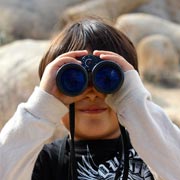 Monitoring populations of bird species every year allows the RSPB and other conservation organisations to see how the various types of garden birds are faring. Whether or not they’re doing well will be a barometer of the state of nature itself as well as that of the individual bird populations. If the RSPB and other conservation organisations can see a problem, they can then mobilise to try to do something about it. Likewise, if they see a particular bird species doing well, they can learn from that and better understand what measures are helping that particular bird population to thrive.
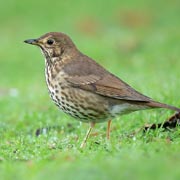 In 2023, the bird species spotted the most was the House Sparrow, followed by the Blue Tit in second place, Starling in third, Wood Pigeon in fourth and Blackbird in fifth.
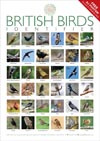
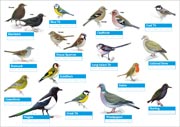 By registering you’ll also get a free guide to taking part in the event, which includes visual reference to the birds to look out for, as well as other perks like a discount on bird food and other bird feeding supplies available from the RSPB’s online shop.
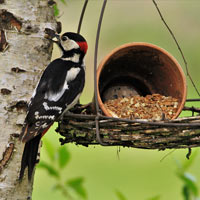 If you’re keen to attract as many birds as possible to your Garden Birdwatch count, the RSPB has you covered. As well as providing useful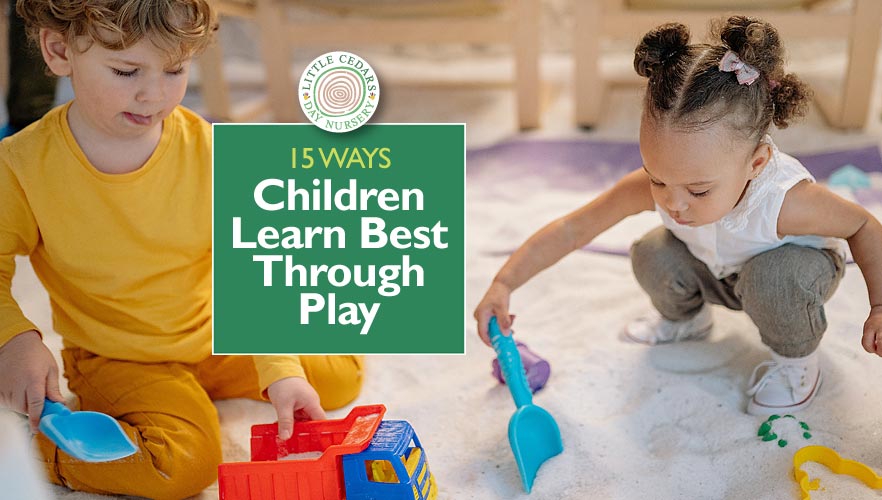
 Watch any infant, toddler or preschooler for just a few minutes and you’ll see that one thing comes naturally to them; play. Indeed, it’s as if they’ve been programmed that way, with the need to play coming instinctively to youngsters, whatever their species. Aside from it simply being great fun, there are a multitude of very good reasons for that — play teaches them an enormous amount about each other, themselves, other living things, cause and effect, and the world around them. It also allows them to learn and fine-tune a whole swathe of new skills as they grow older, play new games, and become more experienced. Add in some careful steering and nurturing during that play from Mum or Dad and they have a real recipe for success. With that in mind, we look today at the key ways in which learning through play profoundly benefits children.
 Play and creativity go hand-in-hand. Whether making up a new game, role-playing, constructing, or playing in a den, children will naturally create both scenarios and physical items as part of their play. Such activities teach them how to use their imaginations and to be creative — in a myriad of ways.
 Different play activities require different types of movement and physical interaction from children. Indeed, this is a fundamental aspect of play. Whether jumping and running with large movements or carefully constructing with small items like building blocks, children will naturally hone both fine and gross motor skills during play. Such physical skills are essential to their ability to navigate and interact with the world around them and, in the most natural of ways, play is at the heart of enhancing those abilities.
 Social skills are also improved through play. Children naturally play with other children and, by so doing, will soon pick up social skills as they begin to better understand social protocols that allow them to succeed both as individuals and in groups. Decent manners, saying please and thank you, cooperation, teamwork and closer bonding are all examples of social skills that can benefit through group play. Other examples include conflict resolution, better sharing, negotiation and communication, which we’ll come to next.
 Through all this play, children will be communicating with each other and with any adults that are supervising. As such, play is a great facilitator of communication. Indeed, good communication is essential to most games and, through it, children can cooperate and achieve in ways that will help them in both the short term and into adulthood. Improving communication skills is also a fundamental way to improve success when you think about it.
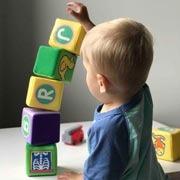 Mathematics is often embedded into games and pastimes. Children can learn, for example, about adding, subtracting, multiplication and division through games. Even dividing group play into teams requires some fundamental maths to ensure teams are equal in size. Building towers out of blocks is another great example where children can count how many blocks they can stack into a tower before it falls over. They can try to beat their own maximum, or even compete against one another to see who can use the most blocks.
 Play comes in a vast array of different forms, shapes, and sizes. Through so doing, it introduces children to countless scenarios, situations, and challenges. By immersing children into such widely differing environments, they learn huge amounts about the world around them, and everything within it. Whether it’s newfound knowledge about a new object, material, place, culture, activity, or something else, play is an amazing conduit to new knowledge and the need to learn new skills. Play is the ultimate educator and the incredible thing is that children may be unaware that they’re learning — they’re having too much fun!

 Child Benefit is a financial support scheme, provided by the UK Government, that’s there to assist parents and guardians in covering the costs of raising children. It is an essential part of the social safety net in the United Kingdom and aims to help families with the financial responsibilities that come with bringing up children. Eligible families are free to spend Child Benefit however they like, whether that’s on children’s clothes, food, or something else.
 You can claim Child Benefit for all of your children who meet the eligibility criteria. It may surprise some to learn that there are no restrictions on the number of children you can claim for (unlike with some other types of Government child support), so each eligible child in your care can be covered under this benefit.
 Child Benefit can be affected by your or your partner’s individual income if either of you earns over £50,000 annually. In such cases, you may have to pay a ‘High Income Child Benefit Tax Charge’. This charge gradually reduces your Child Benefit entitlement if your income is between £50,000 and £60,000. Indeed, if your income exceeds £60,000, you’ll likely have to repay the entire amount through this tax charge. We’ll cover more of the detail in the next section below…
 Claiming Child Benefit is a straightforward process: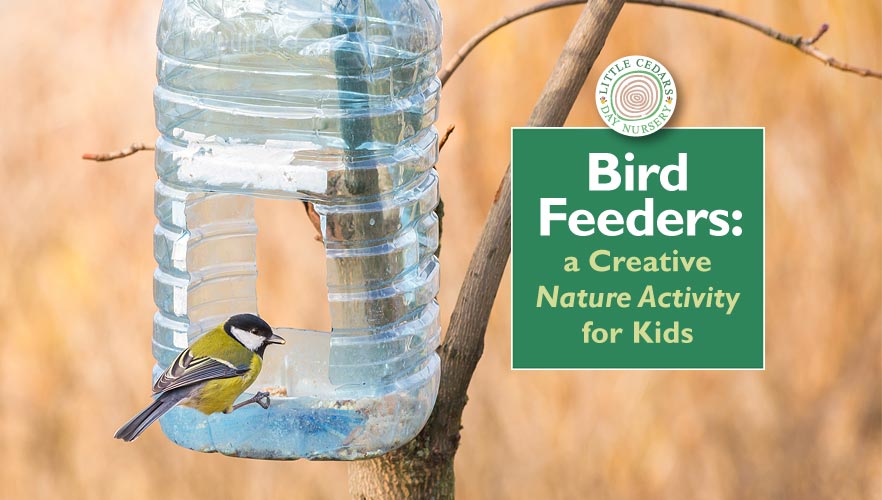
 A wonderful way to
  Combine with our Bird-Spotting Activity
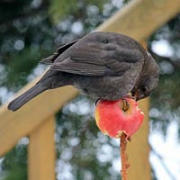 The fastest and easiest bird feeder for children/families to make is simply an apple. This can either be hung with string from a tree branch, bush, or similar, or the apple can be ‘spiked’ on the pointy end of a tree branch, a strong twig or something like a bamboo pole embedded in the ground (so long as it’s tall enough to keep birds safe* from predators). Easy! We suggest stripping some of the apple skin off to expose the flesh. Apples are a particular favourite of blackbirds and bluetits, amongst others.
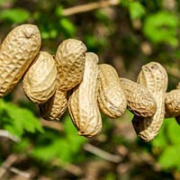 This is also a very easy bird feeder for children/families to make. All you need is some string and some monkey nuts* (peanuts still in their outer husk). A supervising adult will need to make some small holes in one end of each husk and then string can be threaded through to form a kind of chain (like a necklace). Monkey nuts can be threaded on to form the right length and then this can be tied between the branches of a tree, or similar. See our note about safely locating* them, though.
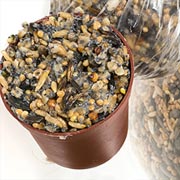 Home-made seed cakes are another type of bird feeder that is both easy and fun for children to make. Basically, they consist of lots of seeds mixed into a ‘cake’ made from either suet* or lard*. The seeds are mixed in when the lard or suet is melted, so parents/adults will need to help with that part as it’s done by heating it in a saucepan. Once melted, the seeds can be added and mixed in. Once cool enough to be safe, the children can take over to make most of the feeders. First, a piece of string can be tied from the centre of the base of something like a flower pot or yoghurt pot (parents should make the hole, if needed). Then the child can mould the seed cake into the pots, or other similar plastic containers. Once cooled, the seed cakes will harden and can then be suspended from the branches of a tree, bush, fence post or under the eaves of a house or outbuilding. Bluetits, great tits, starlings and robins will usually be the first to try out the new cakes.
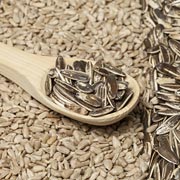 Your choice of seeds directly affects the success – or otherwise – of your bird feeders. While many commercially-available seed mixtures contain several different types of seed, we have found that birds ignore some of them, so they go to waste. Our own bird feeders have been far more popular when they use more sunflower ‘hearts’ (the sunflowers without the other case) and less of the wheat and barley type seeds. Crushed peanuts* are also popular, but see our notes below about the safety of both baby birds and children when it comes to nuts.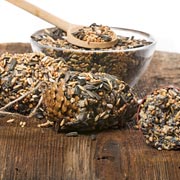
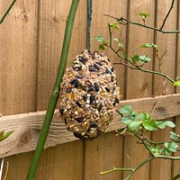 Another type of bird feeder that is both fun and easy to make is a pine cone feeder. All you need is a big pine cone, ideally with the cone splines open, a birdseed mixture and either peanut butter*, suet* or lard*. All your child needs to do is paste the peanut butter (or suet or lard that’s been safely warmed to soften it) all over the pine cone, including into the open splines. Then the whole thing can be rolled over your seed mixture, so the seeds stick all over the pine cone. Once complete, the pine cone feeder can be hung with a piece of string in an appropriate place outside. Even better: hang several together so the birds can’t miss them. The birds will love pecking them when they’re hungry.
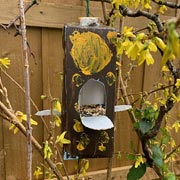 Bird feeders made from recycled cartons can be great fun, fairly easy and can be quite creative. All you need is an empty milk or juice carton, by which we mean the card ‘Tetra Pak’ type, plus some bird seed/food and some string. Parents will need to help younger children safely attach the string to the tops of the cartons and cut flaps/openings into the sides of the carton. These can be folded down, as shown in the photo, and suspended outside somewhere suitable for the birds. For extra creative fun, children can first paint patterns, designs or even faces on the cartons. This type of bird feeder is great because it not only holds the bird food but also potentially gives birds somewhere safe to land while feeding. As they were originally for holding liquid, they can alternatively be used to hold drinking water for birds — or perhaps children can make one for food and another for drinking water.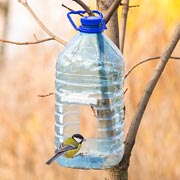
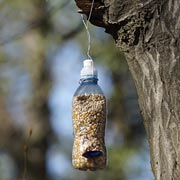
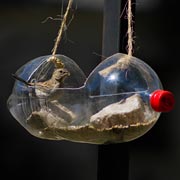 In a similar way, clear plastic bottles can be used as bird feeders or for water. The same approach can be used but flaps are not advised as they’re trickier for children to fold and also plastic bottles will have sharper edges than the carton approach above. So, this particular type of bird feeder needs extra supervision from a parent or adult. Take a look at the photos to see what’s possible, though. One photo (the first small image at the start of this article) even shows a plastic spoon that’s used as a landing platform and seed dispenser, all in one. Once finished, plastic bottle feeders tend to last a long time, so long as they’re regularly cleaned and refilled.