If you’re choosing a nursery or pre-school for your child in or around Streatham, Furzedown, Tooting or Balham, making your final choice may not be as hard as you think. Take a look at 18 compelling reasons to choose Little Cedars Nursery below. You’ll soon see why we’d make an unbeatable choice for the childcare of under-fives in the area.
1. Superb Parent Feedback
 Independent feedback from other parents is worth its weight in gold. In the last five years, Little Cedars has received only 5-star reviews on Google and Facebook. That’s top marks, consistently for 5 years running.* Comments that accompanied these independent reviews were equally compelling — here are just a few examples:
“Amazing nursery! Our daughter loved it here and all the staff are fantastic!”
“[The] team are amazing in every way, with the attention and time they give to the children. Very good knowledge on childhood illnesses and allergies.”
“With the new management this nursery is better than ever. Well done Maggie!”
“Lovely nursery, great team and an amazing outdoor space — they have animals which is fantastic. Amazing management team …”
“I just love the friendly vibes, the lovely facilities (including resources, grand garden and animals!). Maggie, the manager, has been just wonderful and you can see her deep commitment as she often supports her team in the rooms! [A] hands-on manager that will always give you time to talk about your child is a recipe for a success! Highly recommended!”
Ofsted also remarked that parents gave them wonderful feedback about the nursery in their recent Ofsted inspection.
2. Rated as a “Good Provider” of Childcare by Ofsted
In Ofsted’s recent appraisal, they consistently rated Little Cedars Day Nursery as “Good” — in every category. The Ofsted report sang our praises across the board. Here’s how they rated each of the core, specific areas in their opening synopsis:
 Quality of education is rated as ‘Good.’
- The quality of leadership & management is rated as ‘Good.’
- Behaviour & attitudes are rated as ‘Good.’
- Opportunities for personal development are rated as ‘Good.’
Learn more about the excellent Ofsted report for Little Cedars Day Nursery, here.
3. A Home-From-Home for Under-5s
Little Cedars is a warm, welcoming and nurturing environment. To the babies and children, it very much becomes a home-from-home where they feel safe, valued, cared for and all with wonderful, close relationships with both peers and our childcare professionals. It’s also a place of immense fun where little ones are happy, stimulated and nurtured in order to bring out the best in them.
4. Exceptional Resources, Equipment & Facilities
Little Cedars Nursery is extremely well resourced and equipped, both inside and out. Take a look at our photo gallery to see the high quality equipment outside to give you an idea. We have an amazing array of facilities that children will love, as they play and learn. They will have immense fun while also learning in the most natural of ways. We have multi-sensory areas, carefully-chosen reading materials, interactive toys and equipment and specially designed areas for each specific age group.
5. Affordable Childcare Fees
For those childcare hours that are not covered by Government schemes, our nursery and pre-school fees are very good value. What’s more, prices are discounted for children attending all five week days each week. Siblings attending at the same time also receive a 13% discount, making childcare services at Little Cedars Day Nursery even more affordable.*
6. Free Childcare Funding Schemes for Eligible 2-Year-Olds
If your 2-year-old is eligible for the Government’s free childcare scheme for this age group, rest assured that Little Cedars Day Nursery supports them and this can potentially give your little one 15 free hours of childcare per week for as many as 38 weeks of the year. That’s 570 free childcare hours per year for your 2-year-old!
7. 15-30 Hours of Free Childcare Per Week for Eligible 3 & 4-Year-Olds
We also support the free, Government-funded childcare schemes for eligible 3 and 4-year-olds, giving them 15 to 30 free childcare hours per week over 38 weeks of the year. That’s 570 to 1140 hours of free childcare each year if they’re eligible. The good news is that all 3 and 4-year-olds living in England are eligible for the 15 free hours per week as a bare minimum.
Check out our Rough Guide to Free Childcare Funding in England for more details.
8. Free Childcare Vouchers Accepted
Little Cedars Day Nursery accepts recognised and valid childcare vouchers, which can really help with affordability. That’s never been more important and useful for families.
9. Great Support for Children with Additional Needs
If your child has additional special needs, choosing the right nursery/pre-school for them is an even harder task. However, Little Cedars Day Nursery has that covered too. Here’s what the independent Ofsted inspector had to say about the topic in their recent visit:
“Children who have additional needs are making good progress from their starting points. Managers and staff offer highly effective support and work closely with parents and other agencies … enabling targeted support that helps children reach their full potential.”
10. Healthy, Balanced Meals & Snacks
Our in-house chef prepares healthy meals for the children each day, along with healthy snacks. Only fresh, high quality ingredients are used to produce the children’s healthy, balanced meals and all special diets are catered for.
Food and snacks are included in our standard fees with the exception of 3 and 4-year-olds receiving Government funding for their nursery places. For those alone, there is a small fee for meals because those are not covered by Government funding. There is, however, no fee for food for 2-year-old funded places.*
11. A Key Person Assigned to Every Child
A Key Person is assigned to each child at Little Cedars Nursery. This is an early years practitioner who ensures that the child’s needs are being catered for and that their care at the setting is tailored to them as an individual. They help children settle in when they first join the nursery and build strong relationships with both the child and the parents. They are therefore usually the natural and key point of contact at the nursery.
12. A Learning & Development Programme Tailored to Your Child
A totally bespoke learning and development programme is developed for each individual child at the setting. This is designed to bring out the very best in them — in every area. So, areas where they’re naturally gifted are made even stronger and any areas where they need extra focus are identified, with appropriate measures introduced as required — including in any areas of special need. In this way, children achieve personal bests across the board and their potential outcomes are absolutely maximised.
13. A Progress Journal for Every Child
The early years practitioners at Little Cedars are so much more than childminders and Little Cedars should not be thought of as just a crèche. Our childcare professionals facilitate the early learning of children and constantly monitor their progress. Indeed a progress journal is maintained for every child as a continuous record of their learning journey. Parents/carers have access to this at any time and are also encouraged to add to it, using its findings to aid the continuation of the child’s learning and development programme even when at home. It’s all an integral part of ensuring that each child thrives in every area of their learning and development.
14. Hand Picked, High Quality Staff
We have a very special team at Little Cedars Nursery. Every one of them has been hand picked to ensure they are the perfect fit for the nursery and for the children therein. They’re warm, natural carers who will form wonderful relationships with children and bring out the very best in them. They become the children’s safe, familiar and friendly faces at the setting as well as facilitating top-notch learning and early years education. They also ensure every child is happy and is having fun whilst under our care.
15. Everything Has a Purpose at Little Cedars Nursery
At Little Cedars nursery/pre-school, everything has a purpose. Whether it’s a hand-picked book or piece of equipment, an interactive game or a particular activity the children are undertaking, it is there for a specific reason and is there to benefit each child in a particular way. An awful lot of thought goes into every little detail at Little Cedars in order to give children the tools to fulfil their utmost potential.
16. A Complete, All-Round Early Years Education
At Little Cedars we do so much more than simply look after babies, toddlers and under-fives. We educate and nurture them too. In fact, we ensure that our little ones achieve personal bests in all 7 areas of the Early Years Foundation Stage (EYFS). This is a high quality, all-encompassing learning and development framework that covers communication and language, physical development, personal, social and emotional development, literacy, mathematics, understanding the world and expressive arts and design. It pretty much covers everything children need to blossom and thrive.
17. We Prepare Under-Fives for Starting School
One of the key goals at Little Cedars Day Nursery and pre-school is to prepare the children for when they transition to school at the age of five. That’s a key milestone in their lives and we ensure that their transition goes as smoothly as possible. This includes a good early years education, as well as the fostering of good physical and mental skills, independence, good social skills and suchlike. When they leave us for school, they leave as the very best version of themselves, fully equipped to absolutely hit the ground running.
18. Safety is Always Paramount
The safeguarding of all babies and children under our care is of paramount importance to Little Cedars Nursery. Ofsted recognise this too, commenting in their recent report that our arrangements for safeguarding are effective, with risk assessments and appropriate procedures all being in place. So, as a parent or carer, you can rest easy in the knowledge that your baby, toddler or under-five child is in very safe hands — and that’s even independently verified by the experts.
Apply for a Place at Little Cedars Nursery & Pre-school
A nursery place for your child in Streatham, near Furzedown, Tooting, Balham, Norbury & Colliers Wood
 We hope you can now see all the benefits of sending your baby, toddler or preschooler to Little Cedars nursery/pre-school. If you are looking for a good nursery/pre-school in Streatham, or high quality childcare near Streatham Hill, Streatham Park, Streatham Common or Furzedown, Little Cedars Nursery would make an excellent choice. We’re also close by if you live or work near Tooting, Tooting Bec, Tooting Broadway, Tooting Common, Balham, Norbury or Colliers Wood. Contact us today to get started with your child’s nursery application or to arrange a visit, so you and your little one can see it for yourselves. Please choose a button to get started:
* Correct at time of writing (mid-August 2022).


 Improving Education for Disadvantaged 3- & 4-Year-Olds
 Improving Education for Disadvantaged 3- & 4-Year-Olds
 To be eligible for the EYPP funding, a child must meet certain criteria:
 After checking eligibility, interested families or guardians can either contact their local authority or contact an eligible childcare provider. (If you are in Streatham, contact Little Cedars Nursery using one of the coloured buttons below). Either way, ask about the EYPP funding and the process for applying for it. You will then be guided through the application process and will be provided information about any documentation that is required. The approval process can take some time, so parents should be patient while they wait for a decision. Once the application is approved, the provider will start using the EYPP funding to provide additional support and resources to the child.
 Little Cedars Nursery provides high quality nursery and pre-school places for under-fives in Streatham, London SW16. We support all Government schemes for free childcare for eligible children aged from 3 months to five years and would be happy to discuss options with parents/guardians.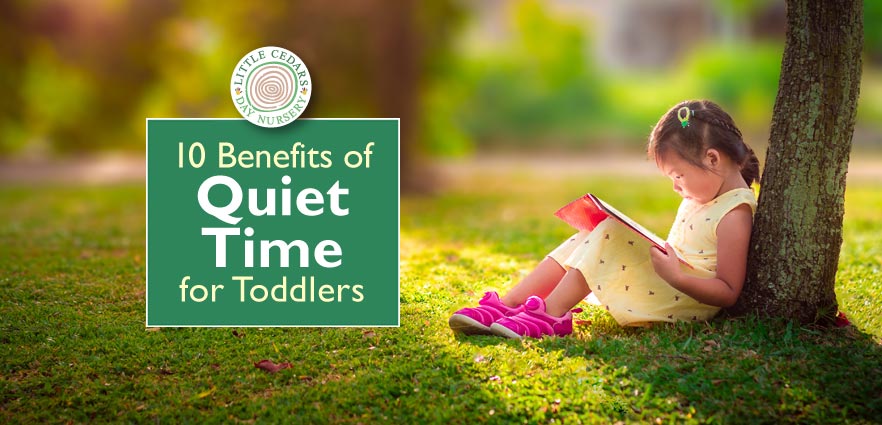
 In today’s post, we look at the importance and benefits of periods of ‘quiet time’ for toddlers and children under five. Toddlers are busy little people, often rushing around, going from one toy or activity to the next. They’re at a stage where they realise the world is an exciting place and often want to experience it all at once. However, when they are so ‘on-the-go’, playing and learning from everything and everyone around them, their brains and body have a lot to take in and process. It can be extremely tiring! So, this is where some much-needed quiet time often comes in, bringing with it a whole range of benefits. Studies also back this up.
 With so much going on around them, children’s young senses of sight, hearing, touch and smell are experiencing a full-on assault. Their minds are also being challenged with learning new skills. This can all be very tiring for our youngsters, so a period of quiet time will give them a break, to allow them to breathe and unwind.
 After prolonged activity or concentration on the part of the child, a well-earned nap may well be on the agenda. As well as giving the toddler a chance to re-charge their batteries,
  Quiet time provides an opportunity for children to develop their own, natural creativity. During quiet time, they have the opportunity to make up a game or activity, without intervention from others. This time is totally unstructured too, so children can be as free as they like to explore and adapt the game or activity. They can create their own little environment and immerse themselves in their own new world. Their imaginations are set free and opportunities to be creative will come naturally.
 As we can see above, during quiet time, children can engage in activities that they have chosen for themselves. This can greatly help them to become more independent and self-reliant. That’s a great skill for them to develop as they approach the time to transition to school. There, they will need to rely much more on such skills.
 When you first introduce quiet time to your child, start slowly and begin with short periods each day. This can be increased as your little one gets used to it.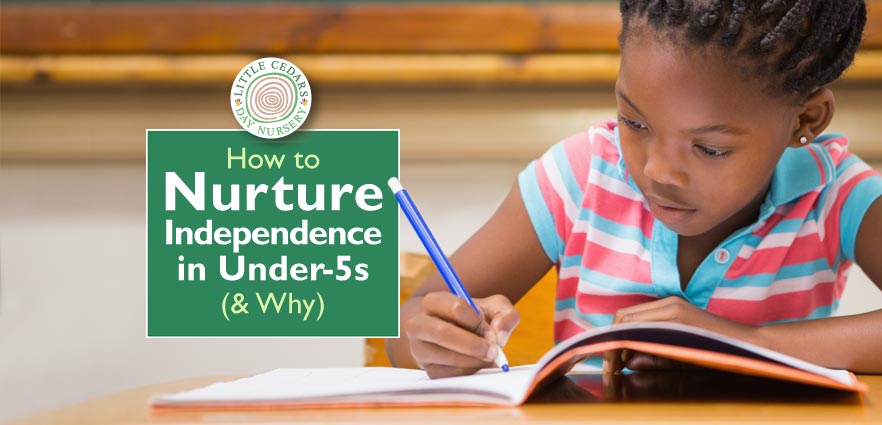
 It’s easier and often quicker for adults to take the lead in getting toddlers and under-five children dressed, fed, washed and suchlike. However, at some point, our little ones have to become confident and self-sufficient at doing these – and many other things – themselves. After all, they won’t have Mum or Dad around when they’re starting at school. So, today, we look at the ways we can help children under five help themselves and become more independent, including in their learning. First, though, let’s look at the many benefits of encouraging their independence.
 Increased self-esteem: Children feel a sense of accomplishment when they are able to do things on their own. This can give a healthy boost to their self-esteem.
 Better self-management skills: Children who are used to taking care of themselves and making their own decisions are better able to manage their own learning and behaviour. This is important, particularly once they move on to a school setting. Studies published in the Journal of Educational Psychology have highlighted better grades and higher levels of achievement in this regard.
 A greater sense of responsibility: Children who are able to do things independently may more easily learn to take responsibility for their own actions and decisions. Learning from one’s own mistakes is also one of life’s most important lessons.
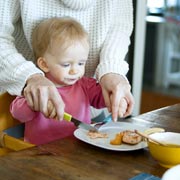 Encourage self-care skills: Help children learn how to dress themselves,
  Provide opportunities for children to make their own decisions: Give children small choices and let them choose what they want to do. This helps them feel a sense of control, encourages independence and builds confidence. A good example is allowing them to choose what they want to wear.
 Set realistic expectations: Children are still developing their skills and abilities, so be realistic about what they can do independently.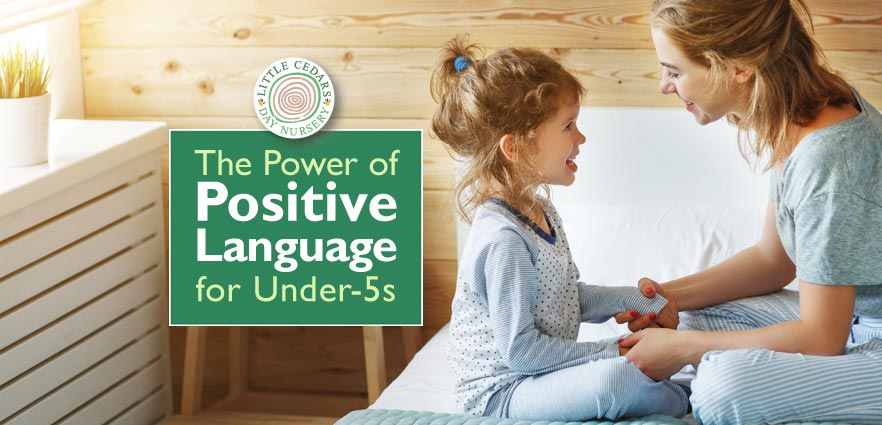
 In today’s post, we explore the benefits of using positive language around under-fives. All too often, it’s tempting to say ‘No!’, ‘Stop that!’ or even ‘Don’t Eat That!’ and similar around little ones. This is particularly true when you want them to cease the offending activity urgently or are simply exhausted if it’s been a challenging day. There are good reasons for such negative commands, of course, not least that of their safety in many cases. However, such commands can sound stern and cause stress for the little ones. What’s more, if a child hears too much negative language and cannot understand why they’re not allowed to do a particular thing, problems can begin to arise and, indeed, the issue can become insidious. It may even result in worsening behaviour. Let’s explore, therefore, the issues around negative language and the simple solution that’s available in the form of positive language.
 Sometimes, though, constantly hearing ‘no’ can spark tantrums, particularly if a child doesn’t understand the reason they are not allowed to do something. They can feel particularly frustrated when they receive a succession of negative commands and, in the end, may feel they simply can’t do anything right. This can lead not only to stress for them, but also to possible low self-esteem. Furthermore, if they hear ‘no’ and other negative language too often, they can begin to ‘tune out’ to it. They could then go on to develop challenging behaviour due to this, their confusion and frustration. Stress levels can then rise for the parent too, the infant can pick up on this and it can become a real vicious circle. It doesn’t have to be that way, though …
 Stop shouting!
 Please use a much softer voice.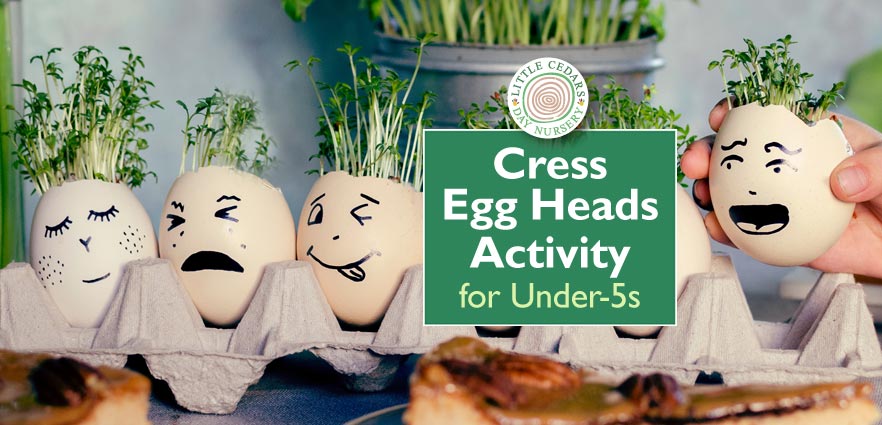
 A nature-based, food-related activity that young children can enjoy indoors at any time of the year is cress growing. Today we outline how it can be made even more fun and creative for kids by growing the cress as little ‘egg heads’. These come complete with comical faces and amusing hairstyles made of green cress shoots! Children will absolutely love it when they end up with little egg faces with spouting hairstyles that each have real character. And, they’ll even be able to eat the results!
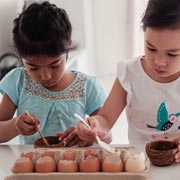 Cress is Easy to Grow, & Tasty!
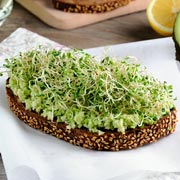 Growing Cress for Small Kids and Big Kids
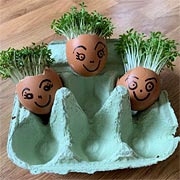
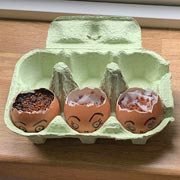 Next, find a vessel to prop the egg shells up in. This could simply be an egg cup or even an egg carton, like that shown in the photo. Then, decide what to fill the empty egg shells with. Children can choose either damp kitchen roll or damp compost/soil to grow the cress seeds on. Carefully fill the empty egg shells almost to the top with the chosen filler. (We tried both and each grew well. Interestingly, the cress seeds grown on kitchen roll tissue paper grew a little faster and therefore taller than those grown on compost. They therefore looked a bit more ‘wild’ — it was quite a surprise and had an amusing impact on the egg-people’s hairstyles).
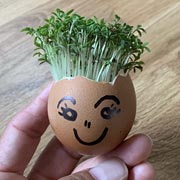 Make sure you or your child add some funny faces on the shells — maybe even give them names. The faces can be drawn simply using a marker pen (Sharpies are ideal) or you can get even more creative using coloured paints. Children may find drawing the faces easier if they are shown some visual reference and perhaps they can practise first on paper. If too young to draw suitable faces, a parent or creative older sibling may be able to help.
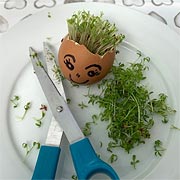 Within a week or so, the little egg heads should begin to sprout green ‘hair’ shoots!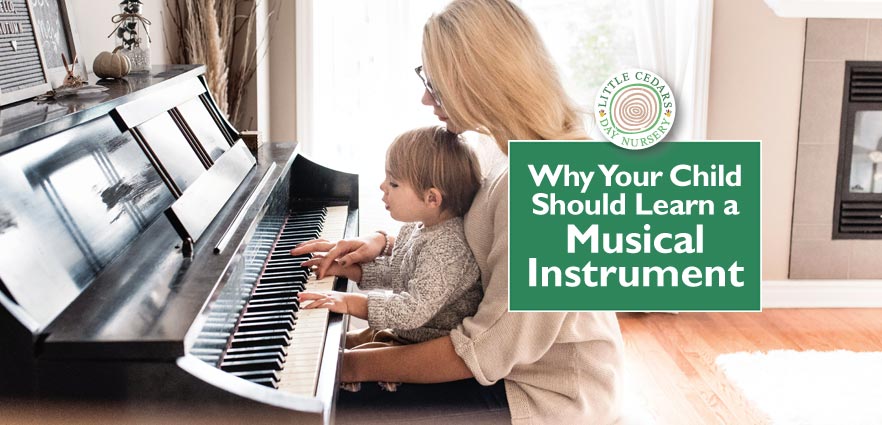
 Both children and adults have a natural affinity with music. It’s one of life’s simple pleasures that just about everyone seems to enjoy in one way or another. Children will naturally start to move, dance, join in or even learn songs that they hear — such reactions seem instinctive to them. Learning to play a musical instrument is therefore a natural next step for them. Indeed, it’s one that parents, guardians and carers should consider encouraging, particularly given how beneficial such an endeavour will be to their child. Learning to play a musical instrument is not simply fun; it profoundly benefits children’s learning and development. With that in mind, we take a look today at the incredible array of benefits that learning a musical instrument poses for children, including under-fives.
 Studies have also shown that learning an instrument or learning how to read music develops the left side of the brain. This area is responsible for processing language and reasoning. Hand-eye coordination skills are also aided when learning to play a musical instrument and reading music. As children’s playing and reading become more advanced, it requires the brain to work at a range of speeds, which is also great exercise for the brain.
 Music gives children a really flexible way of expressing themselves. For instance, the way they choose to bang on a drum, shake a tambourine or strum a guitar can allow them to show happiness, anger, frustration, calmness and many other emotions. Playing a musical instrument gives them a real freedom of expression, even at a very young age. Then, if they reach a point where they are able to make up their own melodies and arrangements, music can become an almost immeasurably powerful tool for self-expression and communication.
 Although playing an instrument is creative, music and maths are very much intertwined. Beats, rhythms and scales are all based on maths and children naturally need to work out some maths in order to understand the song and any sheet music. This will naturally help them to better grasp mathematics and illustrate a real-world example of how it underlies many things.
 Whether your child is listening to a tutor, teacher, friend or relative, listening skills are very important. Music is a natural way to encourage listening and that’s even more true when children learn to play music themselves. Doing so in their early years will help them to follow instructions, listen out for smaller details as well as the bigger picture. Working together on a piece of music is also a fantastic way to hone group listening skills and teamwork and to encourage collaboration.
 Indeed, music helps to support all 7 focus areas of
  When children master a song, no matter how basic, they get an enormous sense of achievement and even more so if they are praised by adults and peers. Such praise also encourages the child to progress further, of course. Boosting self-esteem and self-confidence in their early years is important for their future wellbeing too. Achieving something through learning, patience and practising regularly also teaches them that persistence and effort will help them overcome challenges. That’s a very important lesson in life.
 Little ones can first practise keeping in time to music or a beat that an adult is demonstrating, perhaps. Maracas are also good starter instruments although, again, anything that makes a shaking sound can be made at home at zero cost. For instance using an empty carton or plastic container securely sealed with dried rice, pasta or lentils inside. Once they get the hang of such percussive or shaker-style instruments, you can consider transitioning them to more advanced instruments like recorders, ocarinas, keyboards, stringed instruments and so on. Often, children will be more than willing to give such instruments a try and some encouragement and guidance from knowledgeable adults or older children will always be helpful. And, who knows, they could end up being maestros and even stars in the making!
 A childcare nursery should not be thought of only as a crèche, playgroup, or simply somewhere that looks after babies and children while parents go to work. Good nurseries and pre-schools like Little Cedars are so much more than that. It’s incredible just how much they benefit under-fives, families and society as a whole once you take a closer look at everything they do — and that’s exactly what we’re doing today…
 What’s more, staff at childcare settings like Little Cedars will form close bonds with little ones. Studies show that
  Good Ofsted-registered nurseries/pre-schools like Little Cedars also give under-fives a full early years education. That’s important to know. Through a learning and development programme that’s customised to each individual child, we ensure they achieve their own personal bests in all areas of the statutory
  Part of children’s personal, social and emotional development comes through active play with other children that they meet and get to know at the nursery. This is firstly great fun, of course, and that’s a hugely important part of any happy childhood. However, they’ll also learn many things through play. Without socialising with others, it would be more difficult to improve social skills, for example. Only by being around other children will they learn to account for the feelings of others, learn to respect one another and ultimately form close bonds, trust and friendships. Many such friendships will indeed continue long afterwards, as children move to schools at the age of five.
 Another key aim of good early years childcare provision is to prepare children thoroughly for school. Why? Because
  It’s almost as if children are super-charged for success — the benefits of a good early years education are surprisingly long lasting. Some studies even show that the benefits last into people’s working lives, improving salaries (
 Working so closely with babies, toddlers and preschoolers allows us to continually monitor their individual progress. In so doing, we are in a prime position to spot any issues early and to make appropriate arrangements to mitigate them if needed. For example, we may spot that a child is finding reading challenging. If so, we can put extra effort and time into improving the situation for the child. On occasion, that may even include talking to parents about the possible intervention of a specialist of some kind, or it could simply be that they need to practise specific activities to overcome the issue. The earlier challenges or any special educational or developmental needs are spotted, the sooner the child in question can be helped.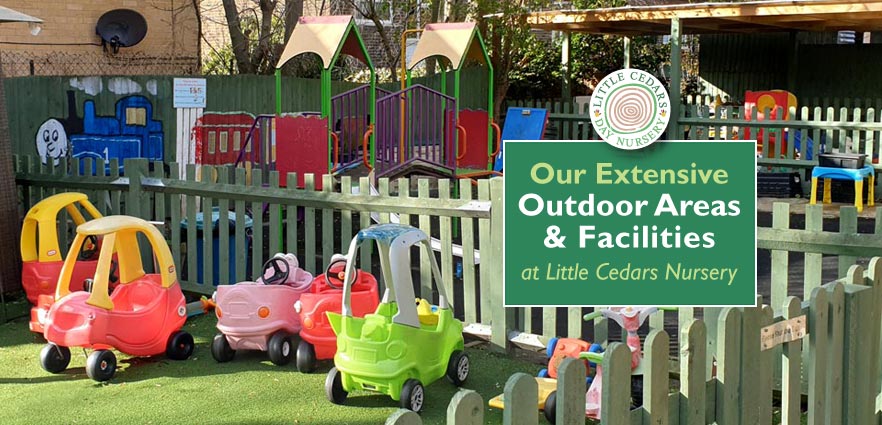
 We have a huge outdoor area for children at Little Cedars Nursery, Streatham. Parents express their surprise when they first see it, regularly commenting that it’s much larger than the outdoor areas of other nurseries and pre-schools in the area. Our extensive outdoor play areas are also packed full of fun, educational play equipment and facilities that our under-five children absolutely adore. That includes areas and facilities set up especially for particular age groups.
 The outdoor ‘mud kitchen’ is a particular hit with children at the nursery. They can enjoy creating in the sand play and water play areas too. These are fun and educational activities —
 As you can see from some of the photographs, the nursery’s extensive outdoor areas include both open-air and undercover areas. That means children can play and explore whatever the weather. Outdoor play is good for children, teaching them some things that simply can’t be taught indoors, so it’s wonderful that many of the outdoor facilities can be used all-year-round.
 Outdoor play at Little Cedars Nursery also supports the Early Years Foundation Stage (EYFS) curriculum. Learning through outdoor play teaches children so much and in a natural way. Outdoor play supports such areas as communication & language, physical development, personal, social and emotional development and understanding the world. Many such lessons come naturally as children play with one another and interact together via outdoor activities.
 Such staff will continuously identify the individual interests and needs of each child and ensure that the learning and development activities they access will benefit them in the optimum ways. The idea is to further strengthen existing areas where children are strong, while bolstering children’s skills in areas that may require extra focus.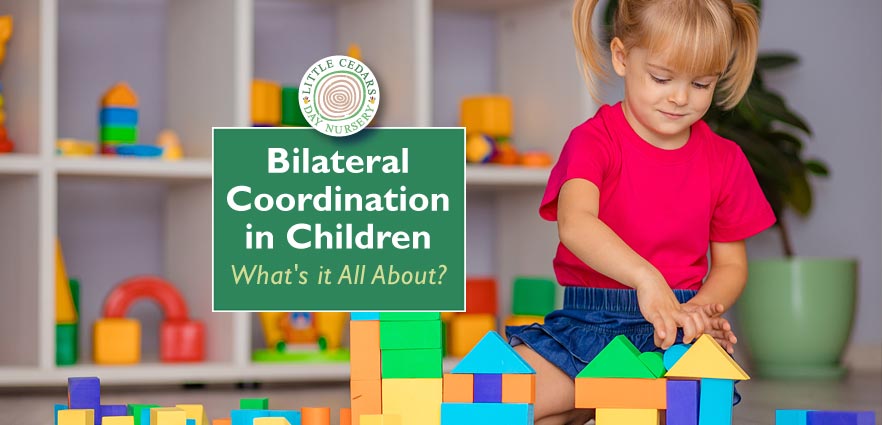
 Bilateral coordination is an important skill for children to master and is something that parents should look out for as children develop in their early years. Today we look at the topic, explaining what it is, why it’s important and how mastery of the skill benefits little ones.
 You may also hear reference to the phrase crossing the midline and this is also linked to bilateral coordination. It refers to a person reaching across their body, from one side to the opposite side, in order to complete a task. An example would be a child reaching with their right hand, across their body, to pick up a toy that’s to their left. Crossing the midline in such a way is a significant step because it demonstrates that infants have progressed from naturally using the side of their body nearest the object to using a dominant or preferred side. This may be the first indication parents have of whether their child is going to be left- or right-handed.
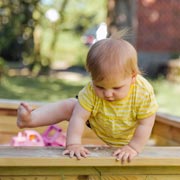 uncoordinated and will struggle with a variety of physical tasks.
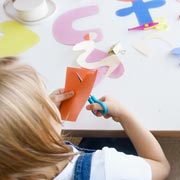 Reciprocal bilateral coordination: this is where both sides of the body form a rhythmic motion but the movements on each side alternate. Examples include walking, swimming and cycling.
 Mastery of bilateral coordination requires children to develop and fine-tune three types of motor skill:
 Threading beads on a string, or string through holes punched though paper or card;
 Play-doh — squeezing and rolling it, including use of tools to shape it;
 These are just a few examples. Any age-appropriate game or activity is likely to help improve bilateral coordination so long as it requires precise, measured movements and coordination of both sides of the body. It’s a case of the child practising over time, often through play, until a particular physical outcome has been mastered. Progress is particularly easy to see in babies and infants as they gradually become more physically able, dextrous, strong and coordinated.
 Independent feedback from other parents is worth its weight in gold. In the last five years, Little Cedars has received only 5-star reviews on Google and Facebook. That’s top marks, consistently for 5 years running.* Comments that accompanied these independent reviews were equally compelling — here are just a few examples:
 Little Cedars is a warm, welcoming and nurturing environment. To the babies and children, it very much becomes a home-from-home where they feel safe, valued, cared for and all with wonderful, close relationships with both peers and our childcare professionals. It’s also a place of immense fun where little ones are happy, stimulated and nurtured in order to bring out the best in them.
 Little Cedars Nursery is extremely well resourced and equipped, both inside and out.
 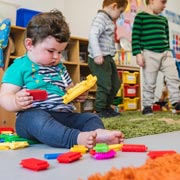 If your 2-year-old is eligible for the Government’s free childcare scheme for this age group, rest assured that Little Cedars Day Nursery supports them and this can potentially give your little one 15 free hours of childcare per week for as many as 38 weeks of the year. That’s 570 free childcare hours per year for your 2-year-old!
 A Key Person is assigned to each child at Little Cedars Nursery. This is an early years practitioner who ensures that the child’s needs are being catered for and that their care at the setting is tailored to them as an individual. They help children settle in when they first join the nursery and build strong relationships with both the child and the parents. They are therefore usually the natural and key point of contact at the nursery.
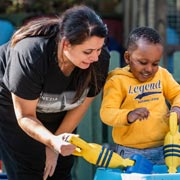 We have a very special team at Little Cedars Nursery. Every one of them has been hand picked to ensure they are the perfect fit for the nursery and for the children therein. They’re warm, natural carers who will form wonderful relationships with children and bring out the very best in them. They become the children’s safe, familiar and friendly faces at the setting as well as facilitating top-notch learning and early years education. They also ensure every child is happy and is having fun whilst under our care.
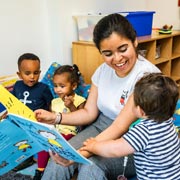 At Little Cedars we do so much more than simply look after babies, toddlers and under-fives. We educate and nurture them too. In fact, we ensure that our little ones achieve personal bests in all 7 areas of