
 Autumn is a magical time filled with vibrant colours, falling leaves, and a wonderful quality to the air. With rustling leaves covering the ground in a myriad of hues, it’s the perfect season to engage children with the wonders of a composting activity. Composting is fun, worthwhile, and educational. It not only teaches kids about the importance of recycling and sustainability but also provides an exciting outdoor activity that connects them with nature. In today’s article, we’ll explore the joy of composting with an autumn twist, where children can harness the abundance of fallen leaves to create a rich and fertile compost for the garden. Children of all ages will love this nature-based outdoor activity and it’s a win-win in every sense — for children, nature’s flora and fauna, and the garden itself.
Leaves, Learning & Fun!
The Magic of Autumn Leaves
 Autumn leaves are rather like nature’s confetti and they play a crucial role in composting. Perhaps explain to children how leaves provide essential carbon and nutrients that are key ingredients for a successful compost pile. Encourage them to collect a variety of leaves in different colours and shapes, so this activity becomes a stimulating treasure hunt too.
No garden? No worries; composting needs as little as a corner somewhere and the final product is just as good for indoor plants.
Creating a Compost Bin
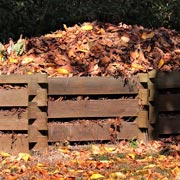 Guide children in setting up a compost bin or, in its most basic form, it could take the form of a simple pile in the garden if you have one. If not, an undisturbed corner somewhere outside will suffice. Emphasise the importance of a balanced mix of green (nitrogen-rich) and brown (carbon-rich) materials. Leaves are a fantastic source of carbon, balancing out the kitchen scraps and other green materials that you and your child may soon start to add.
Layering the Good Stuff
Help your little one understand the layering process of composting. Start with a layer of autumn leaves, add kitchen scraps like fruit leftovers, vegetable peels, and crushed eggshells, and then sprinkle a bit of soil if you have access to some. Repeat this process, creating a compost ‘lasagna’ that will eventually turn into nutrient-rich soil.
Turning the Pile
Composting is not just a one-time activity; it’s an ongoing process. Show children how turning the compost pile every few weeks helps speed up decomposition. This is a great opportunity for them to get their hands dirty (under supervision) while learning about the science behind composting.
Observing the Changes
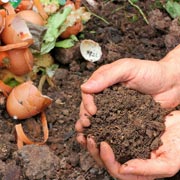 As the compost pile transforms, involve children in observing the changes. Discuss how the compost becomes darker and richer over time. Point out the minibeasts that’ll no doubt move in and, of course, teach them to be gentle around them, to nurture their sense of responsibility and empathy. You can also use composting as an opportunity to talk about the importance of recycling and reducing waste.
Using Compost in the Garden
Once the compost is ready, involve children in spreading it in the garden. Or, if you have no garden or outdoor plant areas, the compost is just as beneficial to indoor potted plants. Explain how the nutrient-rich soil that they have generated will help plants grow strong and healthy. This hands-on experience connects them with the entire cycle of composting, from collecting leaves to seeing the positive impact on plants.
Autumn Composting Activities
 To make composting even more enjoyable, you and the children could incorporate other autumn-themed activities. For example, they could create leaf art while waiting for the compost to develop, they could decorate the compost container through painting, or they could take part in an autumn treasure hunt for different types of leaves and seasonal seeds. This all adds an extra layer of fun to the composting process.
Composting is Fun, Worthwhile & Educational
Composting in autumn is not only a practical way to manage organic waste but also a delightful and educational activity that gets children outdoors and brings them closer to nature — and that is good for them! The vibrant colours of fallen leaves, the earthy smell of compost, and the satisfaction of creating something valuable from nature’s bounty make this experience both educational and enjoyable. So, encourage them to gather those leaves and embark on an autumn composting adventure together!
Your Streatham Nursery & Preschool
High-quality Weekday Childcare in Streatham

 Little Cedars is a wonderful nursery and preschool in Streatham. As well as providing weekday childcare for children under five, we also provide them with a high-quality early years education. This is all done by childcare professionals in a lovely home-from-home setting away from the busiest part of Streatham, close to Tooting Common, in Aldrington Road. At Little Cedars, we nurture every child so they achieve personal bests in all areas of their learning and development, ensuring they are school-ready by the time they leave us at the age of five. All the main Government-funded childcare schemes are also supported for eligible families.
Get in touch to ask any questions, to arrange a guided visit, or to enrol your child for a childcare place. We can’t wait to meet you and your child!
Little Cedars Day Nursery is based in Streatham, close to Tooting Common, Tooting, Streatham Hill, Streatham Park, Streatham Common, Furzedown, Tooting Bec, Tooting Broadway, Balham, Norbury and Colliers Wood.
Safeguarding Note
Children, particularly the very young, will require adult supervision and oversight when playing or exploring outdoors. Please do your own risk assessments as well as teaching children to be mindful of hazards, stranger danger, health and safety. Our safety tips for outdoor play should help to get you started.
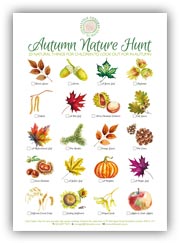 Autumn is a time of the year when magical colour changes occur across gardens, parks and landscapes. Leaves can be seen in a multitude of different colours before falling along with seeds, ripening fruits and berries. In autumn, nature shows us a wonderful metamorphosis and it’s a time of beautifully crisp air and clear distant views. It’s all incredible to behold and also offers children some unique seasonal activity opportunities.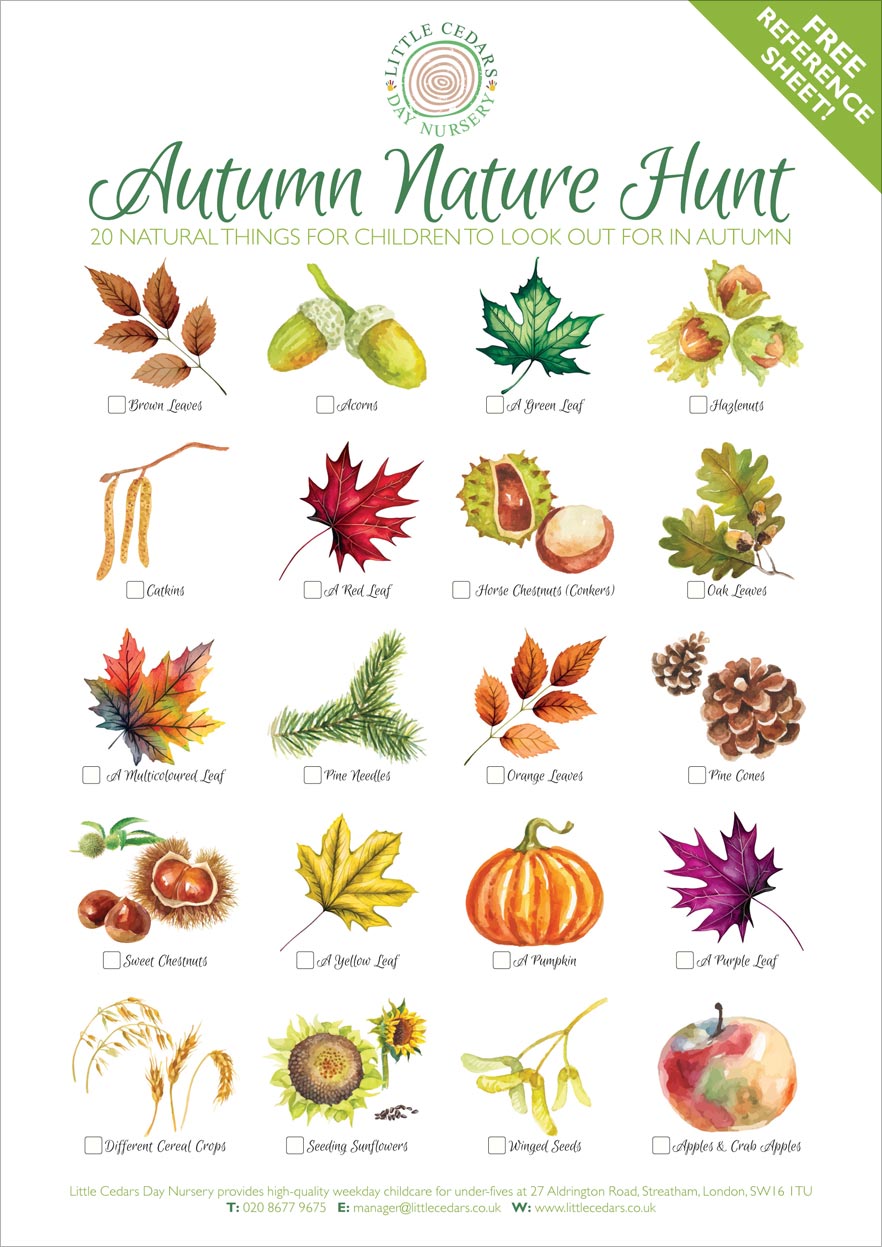
 As parents and caregivers, we understand
  Boundaries create a sense of security. Ensure boundaries are understood and that play areas have clear markers. Guide children to understand and respect these boundaries to reduce the risk of children wandering away — and potentially becoming lost.
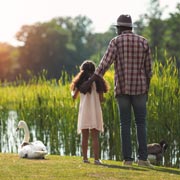 Children are naturally drawn to water, but it can pose significant risks. Ensure that play areas are far from water bodies, and when near any water source, always provide direct and continuous supervision. Even shallow water can be dangerous for little ones.
 Although they’re young, children want to explore and will naturally want to climb as they get older. It’s therefore important to teach children a safe approach to climbing. This should include emphasising the importance of staying within safe heights to prevent falls, assisting with climbing technique and, of course, risk-assessing what they should and shouldn’t attempt to climb in the first place.
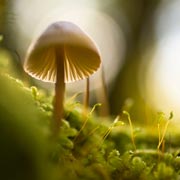 While exploring nature is exciting, it’s essential to be aware of potential dangers. Educate your child about the dangers of poisonous plants and fungi or insects that could harm them. Encourage them not to touch or eat anything unfamiliar.
 Outdoor exploration sometimes involves contact with dirt and mud. Promote hygiene by ensuring handwashing facilities are readily available and teaching children the importance of cleanliness after outdoor play.
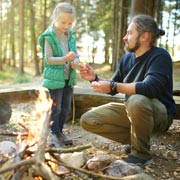 Campfire stories can be delightful and intriguing for children, but we must always prioritise fire safety. If you decide to expose them to it, children must be educated about the potential dangers of fire and always supervised during any fire-related activities. Fostering a responsible understanding around fire safety is paramount.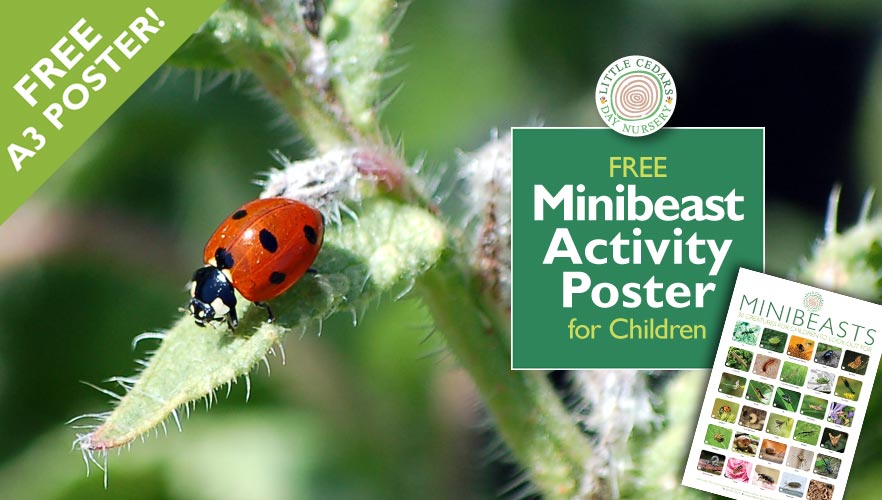
 Today’s minibeast-spotting activity is the third in a series of nature-based children’s activities and, like the others, comes with a free poster. As with the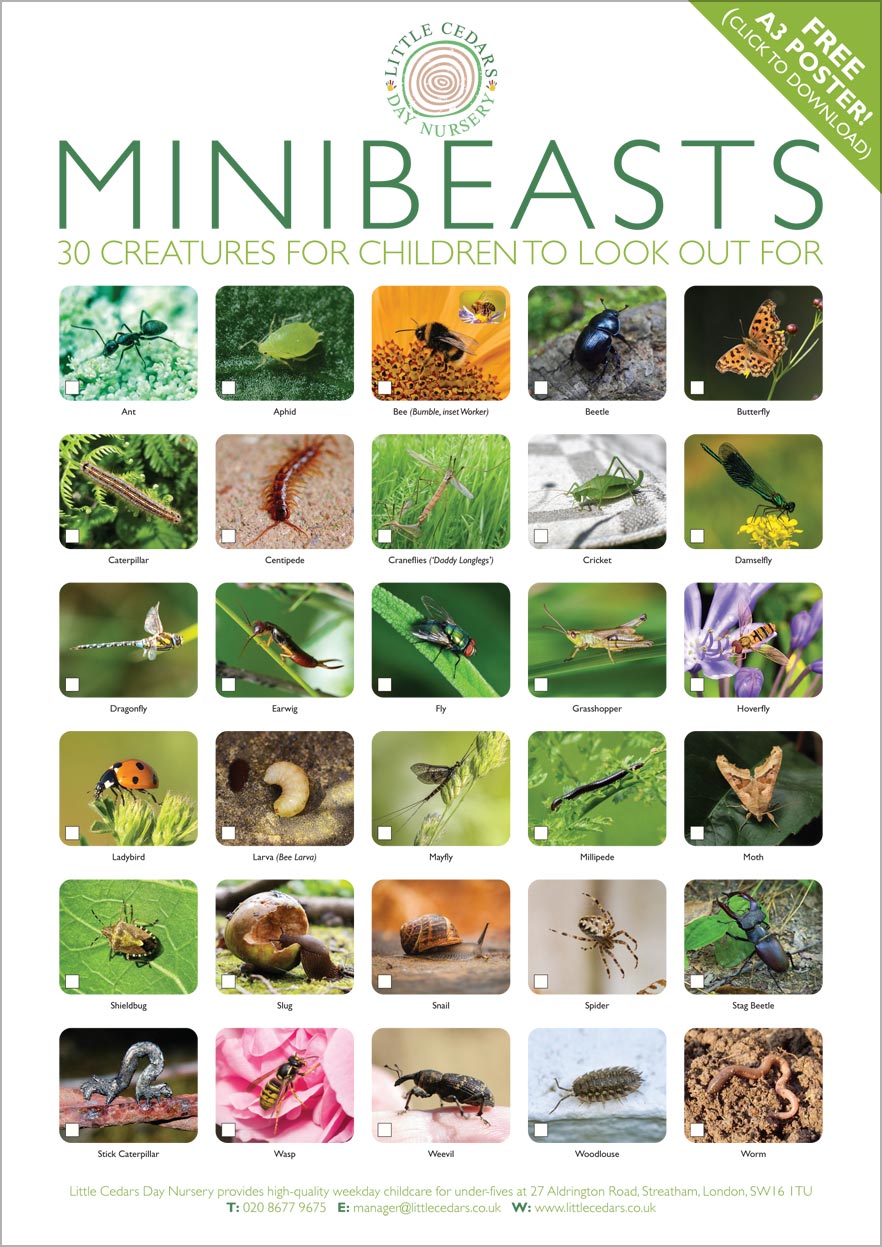
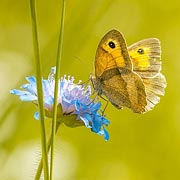 In today’s guide, we outline a simple but powerful nature-based activity that will be both fun and educational for children and under-fives. This one is all about how to sow wildflower seeds. Once growing, these will bring beauty and wonder to any setting. The activity will also complement our recent
 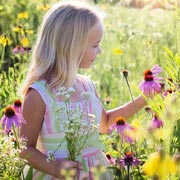 Children benefit very much from spending time in nature, as we outlined in our article entitled
 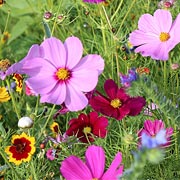 Colour(s) — Children can help decide whether to grow wildflowers of just one colour, a limited 2- or 3-colour palette or perhaps multiple colours. If parents have an existing colour theme in their garden or plant area, they may wish to point children in a particular direction, so as to keep that colour theme going.
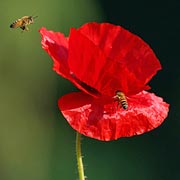 Free wildflower seeds can be harvested from existing wildflowers — either from your own wildflowers if you have them, or from those found in the wild along hedgerows and similar (N.B. only do so in moderation and for personal use). Timing will, of course, be critical because seeds will only be available at certain times of the year, i.e. when the wildflowers have “gone to seed” at the end of their flowering period.
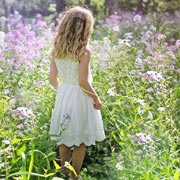 Sowing seeds on existing lawns that you/your child want as a wildflower meadow is simply a case of scattering seeds on the lawn, ideally spaced out in such a way that they don’t have to compete with each other once they start growing. Then ensure that the area of lawn is kept moist by either rain or, if there is no rain, regular sprinkling from a watering can fitted with a sprinkling head (a.k.a. ‘rose head’). Children may need to remind adults not to cut the lawn thereafter, of course!
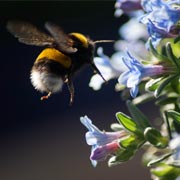 Children will love it once the wildflowers begin to grow and later bloom. They’ll also love seeing bees, butterflies, and other insects visiting and the results of the activity may indeed give them a great sense of accomplishment. The whole process and the results are quite magical when you think about it.
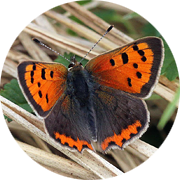 Following on from our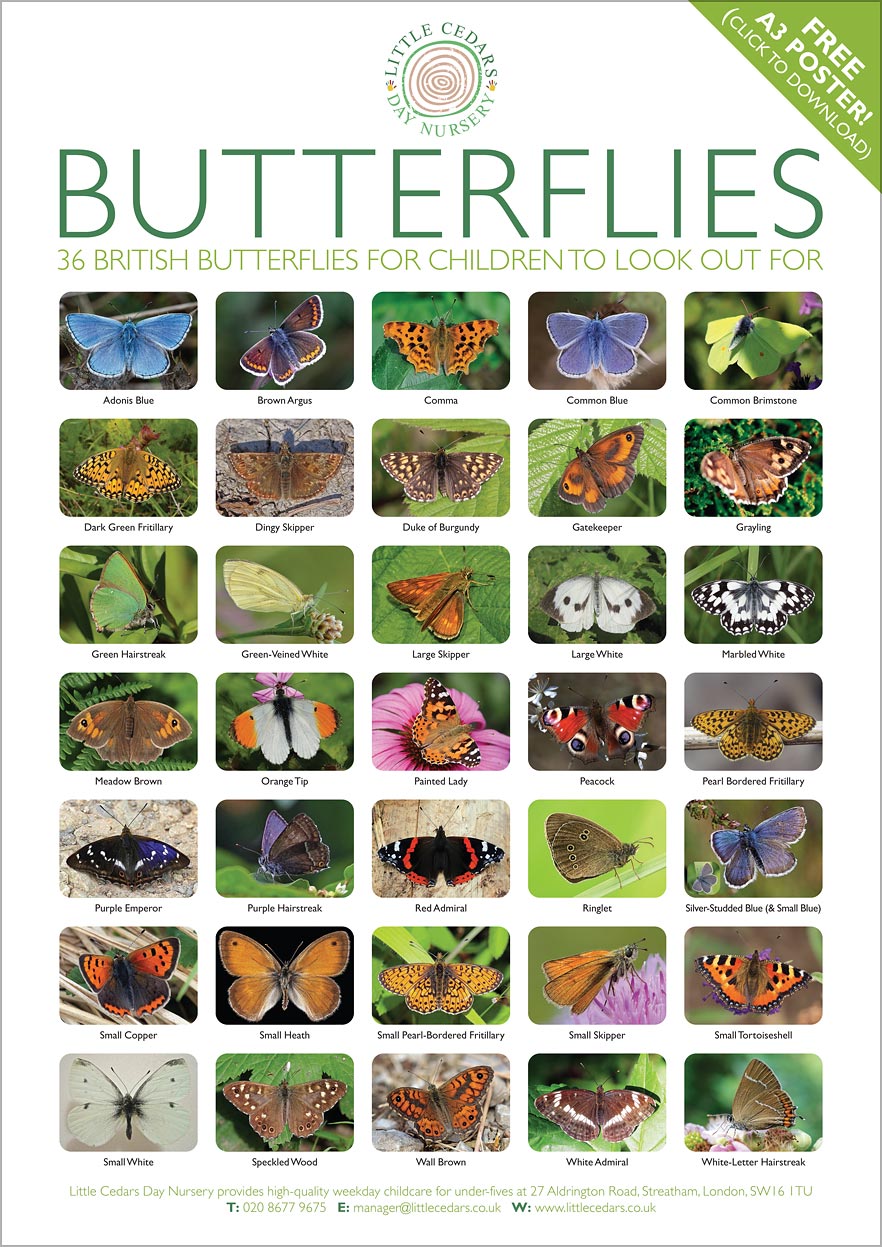
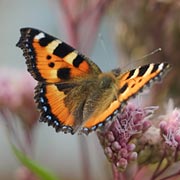 We must also add that children should be encouraged to ‘look but don’t touch’ as butterflies are very delicate creatures. Children should not try to touch or catch them — they are best left in peace as every one of them is a little individual that simply wants to go about his or her day. They’re wonderful to watch, though, and our free poster should help children and adults identify many of the different types. Perhaps see how many different species can be spotted over the course of a year. Take photos too, and compare them with friends! Some butterflies visit gardens, floral window boxes and parks while others may only be found in wilder locations in the countryside. This activity is therefore a great excuse for families to get out and explore The Great Outdoors! Recording the date and location of each butterfly spotted will also help families work out where the best butterfly-spotting locations are for next time.
 With that in mind, why not take this activity a step further and get involved in the UK’s annual Big Butterfly Count? For 2024, it takes place between Friday the 12th of July and Sunday the 4th of August, which is when most butterflies are at their adult stage. All it takes is 15 minutes and children will love being little ‘citizen scientists’! The activity can be done in gardens, parks, school grounds or out in the countryside. Taking part will give children a real opportunity to help with butterfly conservation.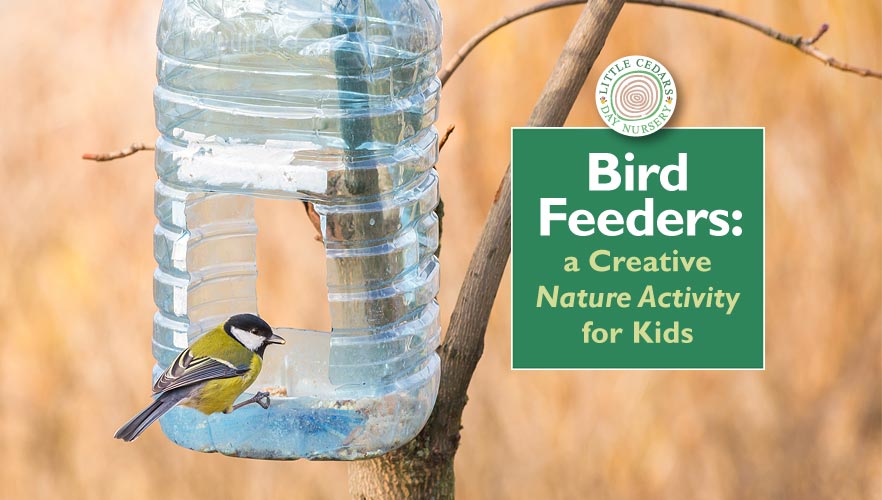
 A wonderful way to
 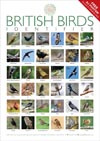 Combine with our Bird-Spotting Activity
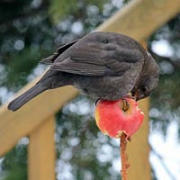 The fastest and easiest bird feeder for children/families to make is simply an apple. This can either be hung with string from a tree branch, bush, or similar, or the apple can be ‘spiked’ on the pointy end of a tree branch, a strong twig or something like a bamboo pole embedded in the ground (so long as it’s tall enough to keep birds safe* from predators). Easy! We suggest stripping some of the apple skin off to expose the flesh. Apples are a particular favourite of blackbirds and bluetits, amongst others.
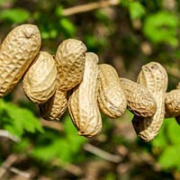 This is also a very easy bird feeder for children/families to make. All you need is some string and some monkey nuts* (peanuts still in their outer husk). A supervising adult will need to make some small holes in one end of each husk and then string can be threaded through to form a kind of chain (like a necklace). Monkey nuts can be threaded on to form the right length and then this can be tied between the branches of a tree, or similar. See our note about safely locating* them, though.
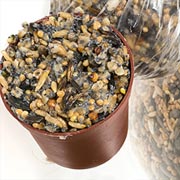 Home-made seed cakes are another type of bird feeder that is both easy and fun for children to make. Basically, they consist of lots of seeds mixed into a ‘cake’ made from either suet* or lard*. The seeds are mixed in when the lard or suet is melted, so parents/adults will need to help with that part as it’s done by heating it in a saucepan. Once melted, the seeds can be added and mixed in. Once cool enough to be safe, the children can take over to make most of the feeders. First, a piece of string can be tied from the centre of the base of something like a flower pot or yoghurt pot (parents should make the hole, if needed). Then the child can mould the seed cake into the pots, or other similar plastic containers. Once cooled, the seed cakes will harden and can then be suspended from the branches of a tree, bush, fence post or under the eaves of a house or outbuilding. Bluetits, great tits, starlings and robins will usually be the first to try out the new cakes.
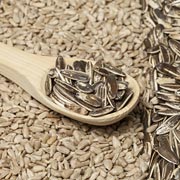 Your choice of seeds directly affects the success – or otherwise – of your bird feeders. While many commercially-available seed mixtures contain several different types of seed, we have found that birds ignore some of them, so they go to waste. Our own bird feeders have been far more popular when they use more sunflower ‘hearts’ (the sunflowers without the other case) and less of the wheat and barley type seeds. Crushed peanuts* are also popular, but see our notes below about the safety of both baby birds and children when it comes to nuts.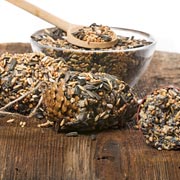
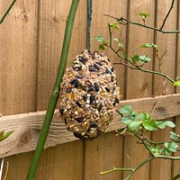 Another type of bird feeder that is both fun and easy to make is a pine cone feeder. All you need is a big pine cone, ideally with the cone splines open, a birdseed mixture and either peanut butter*, suet* or lard*. All your child needs to do is paste the peanut butter (or suet or lard that’s been safely warmed to soften it) all over the pine cone, including into the open splines. Then the whole thing can be rolled over your seed mixture, so the seeds stick all over the pine cone. Once complete, the pine cone feeder can be hung with a piece of string in an appropriate place outside. Even better: hang several together so the birds can’t miss them. The birds will love pecking them when they’re hungry.
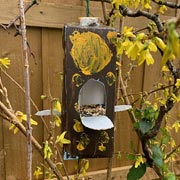 Bird feeders made from recycled cartons can be great fun, fairly easy and can be quite creative. All you need is an empty milk or juice carton, by which we mean the card ‘Tetra Pak’ type, plus some bird seed/food and some string. Parents will need to help younger children safely attach the string to the tops of the cartons and cut flaps/openings into the sides of the carton. These can be folded down, as shown in the photo, and suspended outside somewhere suitable for the birds. For extra creative fun, children can first paint patterns, designs or even faces on the cartons. This type of bird feeder is great because it not only holds the bird food but also potentially gives birds somewhere safe to land while feeding. As they were originally for holding liquid, they can alternatively be used to hold drinking water for birds — or perhaps children can make one for food and another for drinking water.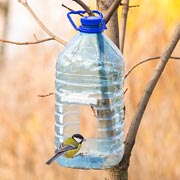
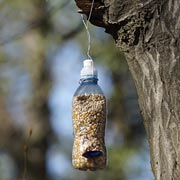
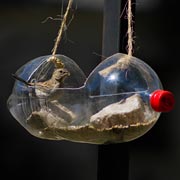 In a similar way, clear plastic bottles can be used as bird feeders or for water. The same approach can be used but flaps are not advised as they’re trickier for children to fold and also plastic bottles will have sharper edges than the carton approach above. So, this particular type of bird feeder needs extra supervision from a parent or adult. Take a look at the photos to see what’s possible, though. One photo (the first small image at the start of this article) even shows a plastic spoon that’s used as a landing platform and seed dispenser, all in one. Once finished, plastic bottle feeders tend to last a long time, so long as they’re regularly cleaned and refilled.