
A new approach to Ofsted ratings officially launched in November 2025, as part of a new Education Inspection Framework. Parents of children attending early years settings, schools, and further education, will therefore soon begin to see the new-style Ofsted ‘Report Cards’ that will be published following inspections. These are designed to replace — and improve upon — the previous one-word Ofsted rating system, which had become controversial∞. Gone will be what became known as the “single word judgements” on settings (previously a choice between Outstanding, Good, Requires Improvement, or Inadequate). Instead, parents will see a much more detailed ‘Report Card’ that combines at-a-glance headline information with multiple sub-section details. The idea is to give parents a more comprehensive view of how schools and settings measure up across a broad range of performance metrics, as well as providing important context. In essence, parents will be able to easily and quickly identify areas of strength, as well as those that require development. In today’s post, we take a look at Ofsted’s new Report Card and explain how it works.
The New Performance Metrics
The single ‘Overall Effectiveness’ grade has now been retired. Instead, Ofsted will assess settings across a range of key areas and confirm their evaluation of each one separately on the new Report Card. For each, they will use a 5-point scale, with the exception of Safeguarding, which we’ll come to separately in a moment.
The 5-Point Assessment Scale
 Except for Safeguarding, the new Report Card will show Ofsted’s evaluation of each of the assessment areas as one of the following:
- Exceptional — the highest quality provision (indicated in blue);
- Strong standard (indicated in dark green);
- Expected standard (indicated in bright green);
- Needs attention (indicated in orange); or
- Urgent improvement (indicated in red).
The Report Card will use colour-coding, as indicated above in brackets.
Key Areas of Assessment
For Early Years SettingsFor early years settings, Ofsted will evaluate the following areas of provision:
|
For SchoolsFor schools* inspected by Ofsted, they will evaluate a slightly different list of key areas:
|
* Early years and/or sixth form education will also be assessed if schools provide them. In parallel to the above, independent schools will also continue to be assessed against the ‘independent schools standards’.
For Further Education & Skills ProvidersThe list of key areas of assessment for further education settings and skills providers is longer still. As today’s guide pertains to younger children, however, such a list can be viewed separately here. |
Safeguarding
Because the safety and welfare of children is paramount, Ofsted’s assessment of a setting’s Safeguarding features separately in the new Ofsted Report Card. That’s for all types of settings, whether they’re early years providers, schools, further education, or skills providers.
How will that look? The new Report Card will show the result for the assessment of Safeguarding clearly as either Met (with a green tick) or Not Met. More detail will be available by opening a drop-down ‘show/hide’ selector and sub-link (shown below).

More Details on the Ofsted Report Cards
As well as assigning a finding of either Met or Not Met to the Safeguarding element and rating each of the other key areas using the 5-point scale, Ofsted will provide extra narrative to explain each of the findings in more detail. In tandem with this, additional commentary will provide contextual information, such as any relevant SEND, demographic, or other factors that may explain the story behind the grades. Additional narrative providing an overview of what it’s like to attend the setting will also be included. These expandable narrative sections will be displayed below the more prominent colour-coded assessment grid and Safeguarding section.

Final Thoughts
The new Ofsted report cards intend to give families both an at-a-glance snapshot and more comprehensive details that outline strengths — and any areas that require development — for educational settings like nurseries, schools, colleges, etc. By showing their evaluation of a whole raft of key areas in this way, Ofsted is aiming to give parents a clearer picture of each setting. That’s in stark contrast to the historical “single word judgements” that we’ve been used to – until now. It does make sense — after all, no single word can ever tell the whole story or sum up a unique and complex service.
Not everyone is convinced the changes go far enough. However, Sir Martyn Oliver, His Majesty’s Chief Inspector for Education, Children’s Services and Skills, has said that the new system should be fairer and better for parents, while also providing tangible and financial support to any settings in difficulty. The government expects the new system to raise standards for children, which is incredibly important — and what it’s all about at the end of the day. Learn about the new education inspection framework in more detail here.
Little Cedars Nursery – a Good Provider
Looking for a High-Quality Nursery/Preschool in Streatham?

 We haven’t yet been graded using the new Ofsted rating system, so we don’t yet have one of the new-style ‘report cards’. However, Ofsted rated us as a Good Provider in their most recent report, so you know your little one is in safe hands if you send them to Little Cedars Nursery, Streatham. If you’d like to explore a possible nursery or preschool place for your child at this wonderful setting close to Streatham Common, Streatham Hill, Streatham Park, Tooting, Furzedown, Balham, Norbury, and Colliers Wood, get in touch — or start your application today. We’d love to show you and your child around and answer any questions. We also support funded childcare places for eligible families.







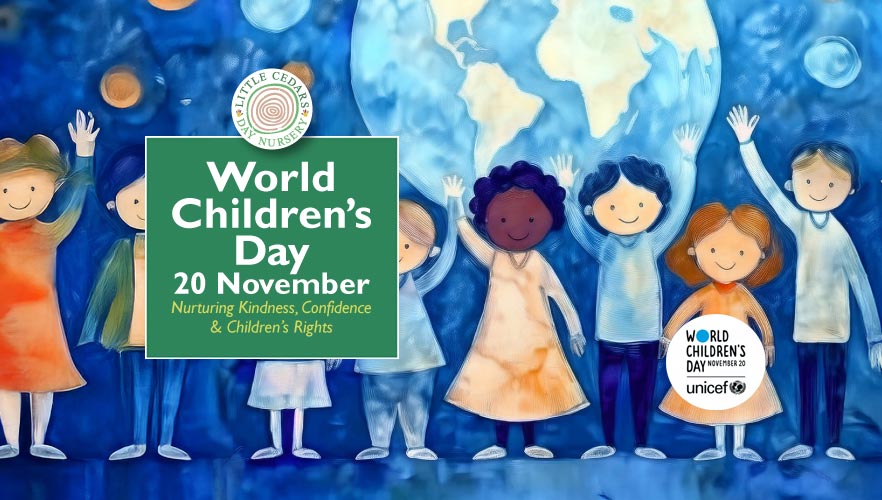
 Each year on 20 November, families, nurseries, and schools around the world mark World Children’s Day — a global celebration of children and a reminder that every child deserves to be safe, loved, and heard.
 At Little Cedars Nursery, we believe childhood should be filled with discovery, laughter, and a sense of belonging. Each day presents countless opportunities for children to explore their world, build friendships and develop confidence in who they are.
 The values behind World Children’s Day are deeply woven into the early years. When children feel valued and respected, they learn to value and respect others. Through play, they develop empathy — comforting a friend who feels sad, or cheering when someone else achieves something new.
 Even the youngest children have ideas, preferences, and opinions — and part of our role is to listen carefully to them. That might mean noticing a baby’s cues and interests, or responding when a toddler points out something new they’ve discovered.
 While World Children’s Day falls just once a year, its spirit is something we celebrate every day. Each time a child is encouraged to speak up, to show kindness, or to follow their curiosity, they’re practising the values that shape a fair and caring world.
 Childhood passes so quickly — a blur of breakfast times, nursery drop-offs, and bedtime stories. Yet every so often, something extraordinary happens: a moment that will light up a child’s eyes and linger in their memory for years to come. These are the magical moments that they never forget. They’re also moments that help shape how children see the world, their place within it — and sometimes even themselves.
 Psychologists tell us that children build their sense of self through experiences that stir strong, positive emotions — especially awe, wonder, joy, and belonging. These feelings act as emotional anchors, shaping how safe, capable, and loved a child feels. When parents or caregivers create a moment that makes a child’s heart race or eyes widen with joy or wonder, they’re not just giving them a fun memory — they’re helping to build emotional security that lasts well into adulthood.
 Magical childhood memories do not require grand holidays or costly toys. They’re far more likely to spring from connection, surprise, wonder, and imagination.
 On a clear night, gently wake your child and wrap them in a blanket to watch a meteor shower or count shooting stars. Tell them about the Northern Lights, how they can wish on a star, how astronauts are planning to travel vast distances to Mars, and give them inspiration for their dreams. The quiet awe of the night sky will stay with them forever.
 Leave a tiny note or drawing from the “garden fairies” or “forest pixies” thanking your child for something kind they’ve done — perhaps watering houseplants or helping a friend or sibling. It’s a simple act that blends imagination with a message of kindness and care. Perhaps take it a step further and encourage little ones to make mossy beds for the fairies, and a little home-made miniature shelter for them to sleep in. Take photos of them as a memento for your child.
 Create small rituals that return every year — picking flowers in springtime to display around the home, having a “summer-solstice supper” in the garden, or putting out biscuits and carrots on Christmas Eve for Santa’s reindeer — be sure to show your little one how the carrots have been nibbled on Christmas morning! Such traditions will give children a comforting rhythm and a sense that life’s changes can be filled with fun and joy.
 Pause for half an hour to watch the sunrise or sunset together, make wishes while blowing dandelion seeds into the breeze, or follow a butterfly in the park to see where it leads. These small acts teach children that magic is woven through the everyday world — they just have to stop a while and notice it sometimes.
 As adults, those memories often become emotional landmarks: the glow of torchlight in a tent, the spectacle of a meteor streaking across the sky, the distinctive smell of campfire food being carried on the wind, and telling stories beneath a blanket. Such recollections help shape optimism and emotional well-being long after childhood ends. They are also the moments that, years later, children will recall fondly and still talk about.
 Sleepless nights are something most parents expect when a new baby arrives. But sometimes those broken nights can stretch on for months, through into toddlerhood, or even beyond. For affected families, bedtime can become a battle every night, and soon the exhaustion can build up and take its toll.
  A sleep consultant works with families to understand a child’s sleep patterns and suggest gentle, practical ways to improve things. They spend time learning about a child’s routine, feeding habits, daily schedule, and sleep environment before creating an improvement plan that feels realistic for the child’s family. The idea isn’t about handing parents a rigid set of rules, but about working together to find an approach that feels the most suitable and fits in with the family’s values.
 Working with a sleep consultant often begins with a thorough conversation about your child’s routine — what time they go to bed, how they fall asleep, how they feed, and what happens during the night. From there, the consultant will create a personalised plan that involves tailored changes. These might be small adjustments, such as introducing a calmer wind-down before bed, or they could involve gradually teaching your child to settle with less help. It may also include strategies for how you respond when your child wakes in the night.
 Costs for hiring a sleep consultant vary. Depending on the consultant contacted, a one-off initial consultation can often be an affordable first step — and one that will allow families to explore the potential of proceeding with a full plan. However, a full package with several weeks of guidance can often be several hundred pounds. In-home, overnight support is potentially at an even higher end of the scale — but, again, it varies from consultant to consultant. Many families find that online or phone-based support from a sleep consultant is more affordable, and sometimes just as effective.
 At Little Cedars Nursery, we understand that sleep — or the lack of it — has a huge impact on family life. Sleep consultants may not be a quick fix, but for families who are reaching their limit, they can offer a real lifeline. Success usually comes from finding someone whose approach aligns with your parenting style, sticking with the plan for long enough to see improvements, and feeling supported along the way.





 Tantrums are a common part of life with toddlers and under-fives, but when they happen, they can be very challenging! Whether it’s a meltdown at dinner time or a dramatic on-the-floor outburst in the middle of the supermarket aisle, they can test even the most patient of parents and carers. However, it’s important to understand that tantrums aren’t a sign that something is wrong — they’re actually a normal, healthy stage of child development.
 In their early years, children are still learning how to manage big emotions. There’s a mismatch, though; their brains are developing rapidly, but they haven’t yet mastered language, impulse control, or emotional regulation. So, when they’re tired, hungry, overstimulated, or frustrated, it can all become too much for them.
  When a tantrum starts, staying calm yourself is key. Your child will take emotional cues from you, their trusted adult. If you can remain steady, even if you’re feeling flustered inside, you send the message that you’re in control—and that they’re safe.
 Avoid reasoning or explaining too much during a tantrum. When a child is overwhelmed, they’re unlikely to take much in. It’s often best to wait it out and stay close so they know they’re not alone. For some children, a gentle touch or hug might be helpful. Others may need a bit of space before they’re ready for comfort.
 Offering limited choices — like “Would you like to wear the red jumper or the blue one?” — can also give them a sense of control without overwhelming them.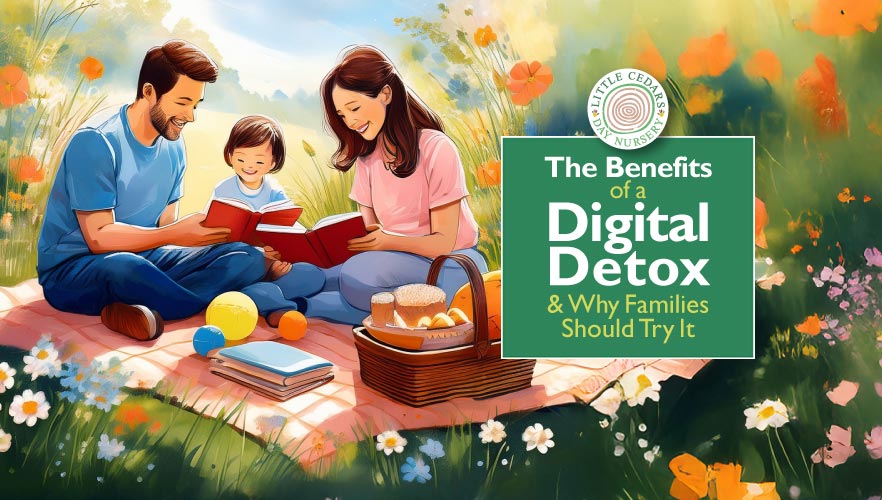
 In today’s world, electronic screens are everywhere — from TVs and smartphones to tablets and games consoles. Even our youngest children are growing up in increasingly digital environments. While technology brings many conveniences, intentionally unplugging can offer profound benefits for little ones and their families. Whether it’s for a day, a weekend, a holiday, or even longer, the value gained from a ‘digital detox’ may surprise even the most dubious amongst us. Today’s post investigates.
 Research consistently shows the positive effects of stepping away from our screens. Studies report that a digital detox can lead to decreased stress and anxiety, improved mood and well-being, and even better physical health through healthier, less sedentary, lifestyles. Pausing the use of electronic screens can even help reset our perception of time, making days feel longer, fuller, and more engaged.
 When families go screen-free, the benefits extend well beyond the individual. Removing screens often rekindles face-to-face interactions and facilitates more laughter and unfiltered conversations within the family. Parents who’ve tried it report a renewed sense of connection and deeper engagement with their children. Even short periods of unplugging can turn into lasting changes—more shared stories, more creative play, and more real presence.
 Better sleep for everyone with children tending to drop off more easily and adults feeling more rested.
 Begin by designating screen-free boundaries, such as bedrooms or mealtimes, and/or set a daily screen-free hour in the evening.
 The evidence clearly shows: families who have periods free of electronic screens will benefit. A digital detox enriches and elongates days. It enhances sleep quality for children and adults by facilitating their natural rhythms. Days feel more spacious and calm without digital distractions and imaginative play soon steps in and thrives. In the absence of screens, children are also likely to get outdoors more often — and benefit from everything nature and outdoor play have to offer. Mental health and even academic grades are also likely to improve when this happens.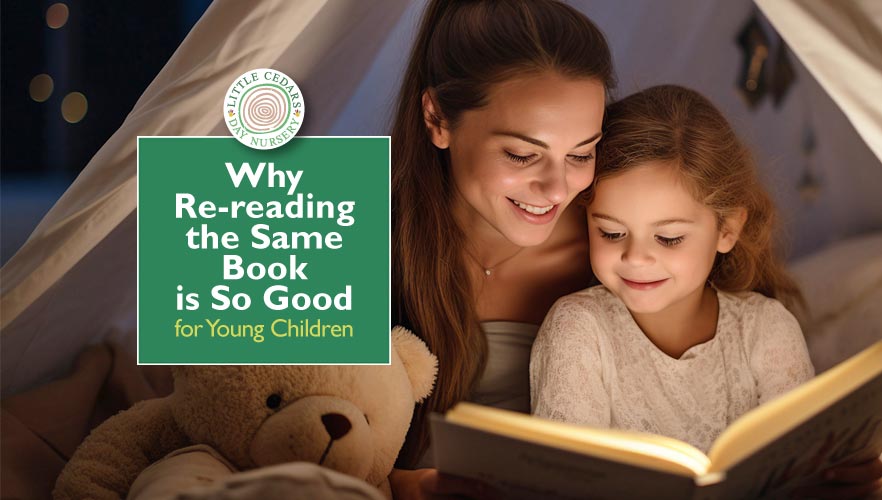
 At first glance, this devotion to a single story might seem puzzling. As adults, we crave novelty and variation, and it’s tempting to encourage children to explore new titles or gently steer them towards something ‘different’. But this desire for repetition is not only entirely normal for infants, toddlers and preschoolers — it’s actually a sign of healthy development. In fact, there’s a great deal happening beneath the surface every time your child requests a beloved book for the umpteenth time.
 There is also an emotional component to repeated reading. When a child hears a favourite story in the voice of a parent or trusted adult, it creates a strong sense of connection. The warmth, tone and rhythm of familiar words spoken by someone they love reinforce a feeling of safety and belonging. For many children, this shared experience becomes part of their routine, and returning to a much-loved story can offer comfort in moments of transition, tiredness or uncertainty.
 One of the clearest benefits of repeated reading is vocabulary development. Hearing the same words and phrases over time helps children internalise them. This is especially important when books introduce new or more complex language than a child might hear in everyday conversation. By encountering those words again and again in a familiar context, children begin to understand them more deeply and even start to use them in their own speech. The rhythm and rhyme found in many favourite books further support this by making the language more memorable and easier to imitate.
 At home, parents or carers can support this by continuing to follow a child’s lead. If your child keeps choosing the same book, that’s a good thing — it means they’re connecting with it. You can enhance the experience by reading with enthusiasm, pausing to let your child fill in familiar lines, or asking gentle questions like “What happens next?” or “How do you think they feel here?” If your child wants to tell you the story instead, even better — this kind of role reversal strengthens memory, language, and storytelling abilities.
 Eventually, children do move on. When they’ve had their fill of a particular book, they’re often ready to explore new stories with a richer set of skills in place. The comfort and confidence gained from repeated readings help them approach unfamiliar books with greater interest and less frustration. So rather than seeing repetition as a rut, it’s helpful to view it as a bridge — a way for children to move steadily from the familiar to the new.
 Our practitioners are skilled at making repeated reading feel fresh and interactive, even when the story is already very familiar. By using expressive voices, gestures, and encouraging children to join in with key words or sounds, we help bring the story to life each time. Children are often invited to take on the role of storyteller themselves, turning pages, pointing to pictures, and even “reading” aloud from memory. These small but powerful moments help build confidence and strengthen communication skills in a way that feels natural and joyful.