

 Whether or not you’ve finished choosing a nursery or pre-school, you’ll need to prepare your little one in the run-up to attending. After all, going from spending all their time with parents/guardians to attending nursery or pre-school is a big step — it’s a massive change for them. In a worst case scenario, they’ll suddenly be in a new, unfamiliar place, surrounded by children and adults that they simply don’t know — and you won’t be there. However, there are a number of things that you can do to make the transition stress-free and even enjoyable for them. Today’s guide shows you exactly how to prepare your little one for nursery or pre-school.
Forewarn & Reassure Them
Well ahead of their nursery/pre-school start day, forewarn them regularly that that’s where they’ll be spending their days in the coming weeks. If you mention it reasonably often, they’ll come to accept the plan and they’ll be more mentally prepared once they start.
Explain why the change will happen too, in terms they’ll understand. For example, you could say it’s so that they can make new friends, play with exciting toys and have fun on amazing equipment you just don’t have at home.
Always be positive about it. Listen to any misgivings they may have too — and don’t let on if you have any yourself, otherwise they may pick up on those and it could worry them. Reassure them that nursery/pre-school is going to be huge fun. And, of course, answer any questions they may have, in a suitably reassuring way. Always take time to talk it over with them if they ask about it.
Help Little Ones With Independence
 In the weeks or even months before their first day, toddlers and preschoolers will also benefit from becoming more independent. You can help to encourage this. For example, you could help them with toilet training, help them learn to dress themselves, encourage them to deal with personal hygiene, cleaning their hands and so on. Can they pack their own backpack? Do they know how to hang their coat up? Helping them to master all such skills will make them more confident and relaxed once they begin at nursery/pre-school.
Synchronise with the New Routine
Once you have chosen and been accepted by a nursery/pre-school, you’ll easily be able to clarify opening times, lunch times and so on. Using this, you can introduce equivalent timings to your child’s home life, so their body clock gets used to the same timings. This can include timing of snacks, meals, any morning or afternoon naps, but also include bedtime and timing of getting up and dressing in the morning. If your child’s body clock is already synchronised to the daily routine they’ll have at nursery/pre-school, then they’ll be far less likely to become tired once they make a start at the setting. That’s even more true if, of course, they are getting enough sleep. All such factors need to be built into the new routine well ahead of them actually starting. It should then be plain sailing and they’ll arrive at the setting alert and energised, ready for the exciting day ahead.
Take Your Child for a Pre-Visit!
 Any good nursery or pre-school will be more than willing to show you and your child around the setting — more than once if required. At Little Cedars Nursery, this is commonplace and it gives parents and children the opportunity to see the setting actually ‘in action’. They can ask questions, see all the amazing facilities, equipment and toys, speak to the childcare professionals and see if they feel at home. Settling-in sessions are also an option, prior to fully joining.
A Friendly Face
 Such sessions and visits are also a great way for children to get to know other children at the setting, or even to discover that an existing friend already attends. Knowing someone who will be at the same nursery or pre-school will help them settle straight in, being a friendly face to greet them from the moment they start. Getting to know the childcare practitioners ahead of starting is also going to help, of course, so they feel at home, secure and looked after by someone familiar, right from the word go.
The Day They Start
Be positive on the day they start. Be enthusiastic about them starting and remind them what good fun and how exciting it will be. Remember too, not to pass on any anxiety or misgivings you may have to your child – it will not help them to remain relaxed and positive if you’re giving negative signals.
 Being fully prepared is a big part of the success of this important milestone. However, there are a few things parent/carers can do for children on the actual day they start nursery or pre-school.
- Pack you child’s bag or backpack the evening before, so it’s not done in a rush on the day.
- Ensure that everything is labelled with your child’s name.
- If your child doesn’t yet know anyone at the nursery/pre-school, perhaps pop their favourite cuddly toy or comforter into their bag, so it’s there if they need it.
- Make sure you’re already familiar with the route and then, on the day, set off in good time. Doing so will ensure that, traffic issues permitting, it’s not a rush. And don’t be late — it will only stress both you and your child out on this critically important day.
 When you drop your child off, don’t make too much of a fuss about being apart from your child. Also, remind them that you’ll be seeing them later when it’s time for them to come home again. This will all reassure them. And, if you can, see if you can pair them up with a friend for them to go in with. Chances are, they’ll then hardly be able to contain themselves with excitement and will not even look back!
Starting at Little Cedars Nursery & Pre-school, Streatham
 Babies, toddlers and preschoolers will always get a warm welcome at Little Cedars Nursery in Streatham. Our childcare professionals are all adept at putting children at ease from the moment they start. They’ll settle them in and ensure they are happy, safe and enjoying themselves right from the start.
If you are looking for the best nursery or pre-school in Streatham, do consider Little Cedars Nursery. We give children an amazing start in life, bringing out the very best in them in every area. We offer a first class childcare service in Streatham, just a stone’s throw from Streatham Hill, Streatham Park, Streatham Common and Furzedown and also conveniently close to Tooting, Tooting Bec, Tooting Broadway, Tooting Common, Balham, Norbury and Colliers Wood. To contact us, arrange a visit, apply for a place or simply ask a question, please use one of the buttons below and we’ll be happy to help.
 In our last post, we asked
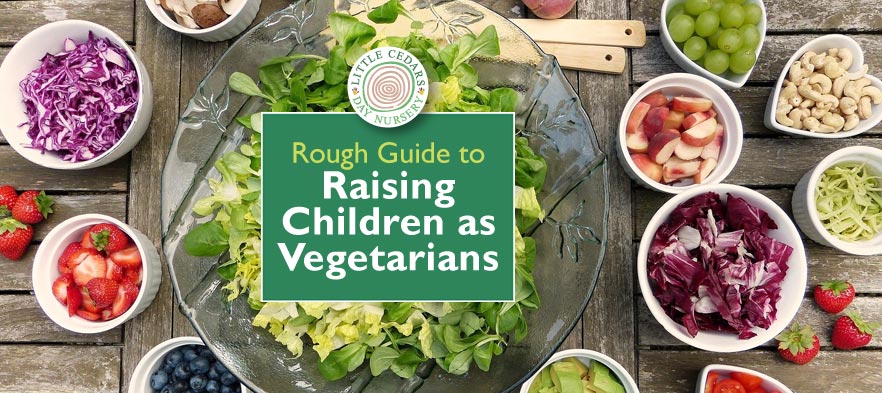
  For those on dairy-based formula milk, it’s pretty much plain sailing too. Because vegetarians — as opposed to vegans — are OK eating dairy-based food, formula milk is generally fine for them. The most popular types are based on cows’ milk, although several other animal milks are also available. So long as dairy-based formula milk is high quality, given in the right quantities, consumed at the right intervals and is age appropriate for the child, it contains all the nutrients and vitamins needed. That’s without the need to give additional supplements too.
 Fruit and vegetables are really a given because they pack so much goodness, including many vitamins, minerals like potassium and also fibre. Fresh vegetables and fruit are ideal but, failing that, frozen, tinned and even dried varieties are also OK.
 Tofu, also known as bean curd, which is made from soy.
 any pulses, seeds or grains should be sprouted, cooked or soaked before consumption (as appropriate);

 Let’s first take a look at the benefits of vegetarianism …
 is linked to a reduction in symptoms for those with asthma;
 Scientific studies conclude that switching to a vegetarian diet will help the planet enormously. That’s because significantly less greenhouse gas is produced in growing crops compared to raising livestock. What’s more, scientists believe that the necessary reduction in green house gas emissions will be achieved far more swiftly through a widespread switch to vegetarianism than through what’s currently just a gradual shift away from the burning of fossil fuels. Growing crops rather than animals also causes far less pollution in waterways and oceans and also uses significantly less water. The benefits of vegetarianism to the planet are simply enormous.
 Is a Vegetarian or Vegan Diet Safe for Children?
 Back in April last year, we wrote an article about
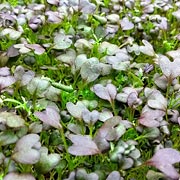
  Microgreens are great fun and extremely easy for children to grow. Once ready, they can be used rather like salads and garnishes. They are very tasty and are extremely nutritious.
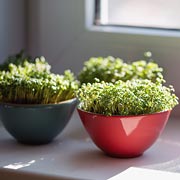 Microgreens are traditionally grown in shallow seed trays, which are inexpensive to buy. However, at home, they can just as easily be grown in flower pots, used yoghurt pots, empty egg cartons, the trays from ready-meals or even cut-down cardboard cores from kitchen rolls. So long as water is allowed to drain from them and they can support at least a shallow depth of compost, these can all be suitable. Plastic cartons will need a few holes punched in the bottom to allow for drainage, so parents might need to organise that in order to avoid their children hurting themselves. Other than that, it’s plain sailing for supervised children to do themselves.
 Suitable seeds include: rocket, a type of strongly-flavoured lettuce; beetroot, with their lovely red stems and mild, earthy taste; spinach, which also has a mild flavour and is full of goodness; red cabbage, which is also rich in a variety of vitamins and minerals; fennel, which will have a distinctive aniseed flavour; broccoli, which will grow into sprouts that have a slightly spicy taste; radish seeds, which also grow into leaves that taste a little fiery; and also mustard seeds (for children who are OK with even more hot, spicy flavours).
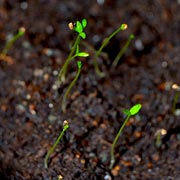 First, your child should fill the seed trays, flower pots or equivalent, almost to the top, with some compost.
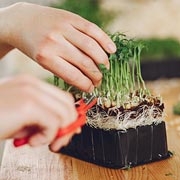 As as shoots begin to appear (usually after just a few days), remove any covering if used and continue to ensure that the compost is always kept moist, but not over-watered.
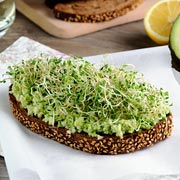 Once harvested, they should be rinsed to get rid of any stray compost. They are delicious to eat and, depending on the seeds grown, have a huge variety of tastes and colours. Children and parents alike can benefit from the nutritious and tasty shoots as part of a variety of meal types. Full of vitamins and minerals, they can be used in salads, as pizza toppings, garnishes, toppings for risottos, soups and pastas, as fillings in sandwiches, sprinkled on top of baked potatoes or into burgers and much more. They’re very adaptable and, with their distinctive tastes and textures, will make any meal really special.
 In today’s guide, we answer frequently asked questions (FAQs) about Dyscalculia, particularly in relation to children, including preschoolers. Around 5% of children of school age are thought to have dyscalculia.
 A few of the possible signs of dyscalculia include:
 They may also continue to use fingers to count long after their contemporaries have moved on to mental counting;
 Just as with dyslexia, there is no cure for dyscalculia. However, there are many ways to help children cope with its effects. It’s also worth bearing in mind that children with dyscalculia can be very gifted in other areas, for example creativity, strategic thinking, problem solving, practical abilities and often great intuition.
 They can also benefit when important words and numbers are highlighted (to draw attention to their importance);
 Being let loose with coloured paints, art materials and creative opportunities is sure to bring a smile to their faces and a sense of enormous fun, creativity and discovery. No doubt too; they’ll be proud to show others their creations!
 As well as being enormous fun, messy play allows children to express themselves in unbounded creative ways. That’s important. Self-expression and creativity will help children to gain a sense of achievement and, through this subtle way, a greater sense of self-worth and confidence.
 Hand-eye coordination will also benefit, of course.
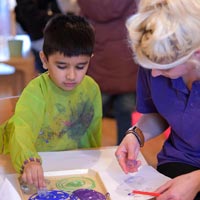 We fully understand the many benefits of messy play at Little Cedars Nursery, of course. Indeed, it’s part of the curriculum. Under-fives are encouraged to learn through messy play using an enormous wealth of resources, equipment and materials at the setting. That’s both indoors and in our outside play areas. From paint and paper indoors to sandpits and water play outside, toddlers and preschoolers have a wonderful time with messy play at Little Cedars, all in a safe, structured, fun and educational environment.
 Recent studies show that use of connected screens and devices by children, including under-fives, is growing fast. The pandemic appears to have increased kids’ screen use too, as children have spent more time indoors and less time playing ‘in person’ with friends.
 Over 75% of children under five have access to a connected device, with up to 60% of preschoolers actually owning their own.
 “Parents have always played a huge role in curating what [under-fives] consume and how their time is spent, but toddlers are now confidently navigating digital platforms for themselves, and using touchscreen devices with purpose and determination.” (Childwise)
 that the ‘RF wireless radiation’ emitted by Wi-Fi connected screens and devices may carry potential health risks particularly, they argue, for pregnant women, their unborn foetuses and the young. The very young, of course, have brains that are still at a critical development stage. For this reason, the experts concerned advocate that access to devices like mobile phones should be limited, removed from children’s bedrooms at night or, at the very least, placed in Flight Mode when possible. Using devices wired instead of using Wi-Fi apparently reduces risks. Use of them in hands-free mode is another useful approach, so that the devices are not so close to youngsters’ heads. We’re not experts ourselves, but these measures seem like sensible precautions.
 While time spent by children on connected screens and devices is rising, it’s not all bad news. The pandemic has also seen an increase in the time that parents have been spending with children, including on shared screen viewing as well as on other pastimes like baking, crafts and family activities. At the end of the day, it’s all about a healthy balance and, of course, adult supervision to ensure children’s wellbeing at all times.


 In April last year, we published a compelling article about
  Reading with children also makes the task less daunting, particularly for the youngest children. Reading together also makes it more interesting and more fun. When it’s more interesting and more fun, the child is going to enjoy it more and naturally want to read more often — eventually independently — and all of that is priceless as part of their education and general knowledge going forwards. Reading can also bring parent and child closer through the time spent together. It can be great fun for the adult too, particularly when the child gets older and adults are exposed to classic children’s books that perhaps they were not, themselves, exposed to when they were young.
 The Nuffield Foundation’s mission is to advance social wellbeing and educational opportunity. In a partnership with the University of Newcastle, the foundation funded a deep study
 It will come as no surprise, therefore, to learn that we put all of the above into practice at Little Cedars Nursery in Streatham. Getting closely involved in children’s reading, using a huge variety of reading material in an interactive way, gives our nursery children the very best start in life. Indeed, our childcare professionals prepare them thoroughly for school by the time they leave us. They take with them reading, writing, literacy, language, vocabulary and self-expression skills in the process — and all this accomplished at least in part through guided reading.