
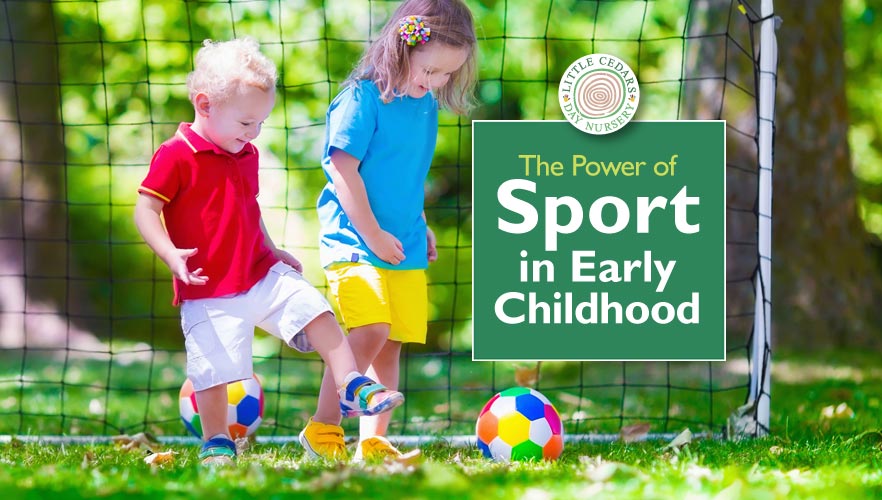
Whether they’re naturally sporty or require a bit of practice, most children enjoy sports of one type or another at some point in their young lives. Some may take to a specific sport right away while others may identify a sport that they see potential in much later on. Two things are certain with sport though: firstly children can only discover a sport they enjoy if they try a few out for size and, secondly, sport of any kind is likely to benefit them in a number of ways. With the latter in mind, today’s article investigates some of the ways that sport benefits children in their early years.
Some of the Benefits of Sport in the Early Years
“Sport has such an incredible power to have a hugely positive impact on children’s lives. It increases their physical and mental well-being, helps them achieve at school and teaches important life skills such as working as a team, developing the confidence to try new things and taking leadership.” (Minister for Sport and Civil Society, 07/19)
Sport Offers Something for Everyone
One of the good things about sport is that it comes in so many different forms. Examples include anything from skateboarding, hockey and water sports to football, table tennis, gymnastics and squash. These examples are all very different and that’s a good thing. Essentially, it means there is generally a sport to suit everyone — it’s just a case of trying out several to see which is the best natural fit. With that goal in mind, encouraging young children to sample a wide range of different sports, ball games and sporty leisure activities is highly recommended. Once a child finds a sporting activity they love, it can potentially open up a whole new world to them.
Levelling the Playing Field
That wide range of different sports is a great leveller. With there being some kind of sport for most children, they’ll have something that gives them enjoyment, a sense of achievement and the feeling that they belong. For those children who previously felt a bit different and perhaps an ‘outsider’, including those with special educational needs, that feeling of belonging is important.
Improving Social & Interpersonal Skills & Communication
The above brings us nicely to another benefit of sport; that of improving social skills. When a child plays a sport with other team members or even opponents, they will naturally learn to improve communication and, through doing so, also hone skills like teamwork, leadership, critical thinking, strategy, and cooperation. These are skills that will stand them in great stead as they grow towards their teenage years and ultimately adulthood.
What’s more, of course, taking part in sports and being part of a team is a fabulous way to make deeper bonds with peers, form long-term friendships, and build an expanding friendship circle. Having decent bonds with others will enrich children’s lives and is a major key to childhood happiness.
Life Skills
It’s also important for children to learn from both success and failure in sports (and in life). Learning skills like good sportsmanship, winning or losing gracefully, resilience, and perseverance are highly useful life skills to master. Similarly, sports and being a part of a team can help instil discipline, responsibility, punctuality, and the importance of playing by the rules. All such skills and lessons will be important and useful throughout life as well as academically.
Cognitive Development
The strategic thinking, communication, teamwork, cooperation and problem-solving aspects of sport will also help children to develop cognitively. As well as being a workout for the body, sports can often also be a workout for the brain. As such, children’s mental agility will also increase. This can only be positive in the classroom and in daily life. Indeed, studies show that memory, concentration and academic performance are all significantly improved when children take part in regular physical activity.
Improving Health, Fitness, Agility & Mobility
Some of the more obvious benefits of taking part in sports, including in the early years, include improved fitness, improved strength and stamina, improved motor skills, and better coordination and balance. All these things will, in turn, improve the lives of children in their daily activities as they grow older.
An active lifestyle and regular active play during sports sessions will also help children maintain healthy bones, muscles, and even weight. With childhood obesity rates now at alarming levels, sport is a simple, fun, and easy activity that will help in the fight against such an important issue.
“The UK Chief Medical Officers recommend that children do at least 60 minutes of moderate to vigorous physical activity every day, yet just 20% of boys and even fewer girls (14%), are meeting this target, despite 95% of children saying that they enjoy being active.” (Public Health England)∞
Better Sleep
There’s nothing quite like the exertion of physical energy to tire little ones out. Letting them play sports, ball games and run around is therefore a sure-fire way to help them sleep well at night and, if applicable, during daytime naps. And, as we know, high-quality sleep is incredibly important for children and adults alike, allowing the body and mind to recharge in many different ways.
Sports Activities are Great Fun!
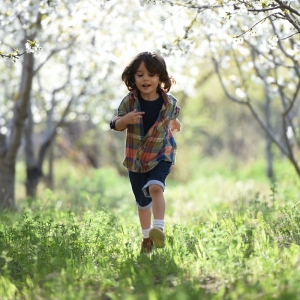
Let’s not forget the most obvious but perhaps overlooked benefit of sports — they are great fun for children. Running, playing in teams, and getting involved in a wide variety of energetic activities etc. are an intrinsic part of any happy childhood. Sports allow children to play in incredibly active ways, often over wide spaces that give them a feeling of immense fun and freedom.
Good for Mental Health & Well-Being
Letting off steam through sport and active play will also act as a healthy stress-buster. Letting loose on a sports field and running free will lift spirits and help children shake off any anxiety they may have felt in the classroom or at home. As children’s sporting skills improve over time, they will also get a better sense of self-esteem, accomplishment, and confidence. These, too, are important for their mental health and well-being.
“Evidence shows that children and young people who are more active have more confidence, higher self-esteem, less anxiety and stress and better social skills – attributes that can help them deal with the challenges they face in daily life. Positive attitudes towards physical activity have also been associated with children being happier.” (Public Health England)
A Possible Career in Sport
Those children who excel at or learn deeply from sport also get additional opportunities from the activity; a possible career in sport. Opportunities include anything from coaching and physiotherapy to places in professional teams that get featured on TV and radio. And, of course, the most talented may even end up winning gold at the Olympics! Indeed, many of the sports stars that we hear about began their interest at a young age. The career potential of sport is simply immense.
Little Cedars Nursery, Streatham
High-Quality Childcare Near Furzedown, Tooting, Balham, Norbury & Colliers Wood

 Streatham boasts many opportunities for sport as children grow. From sports clubs, an ice skating rink, and the world-class Crystal Palace sports and athletics complex, to the famous football stadium at Selhurst Park, many centres for sport are located just a stone’s throw from our Streatham nursery. For children who get into sports at an early age, such venues offer incredible opportunities for both leisure and even possible future careers. Given some encouragement and the right opportunities, perhaps even some of our own little ones could end up as future sporting stars!
If you would like to explore a possible nursery or preschool place for your child at Little Cedars Nursery, please get in touch today. You can apply for a place, request a guided visit, or ask any questions using the options below:
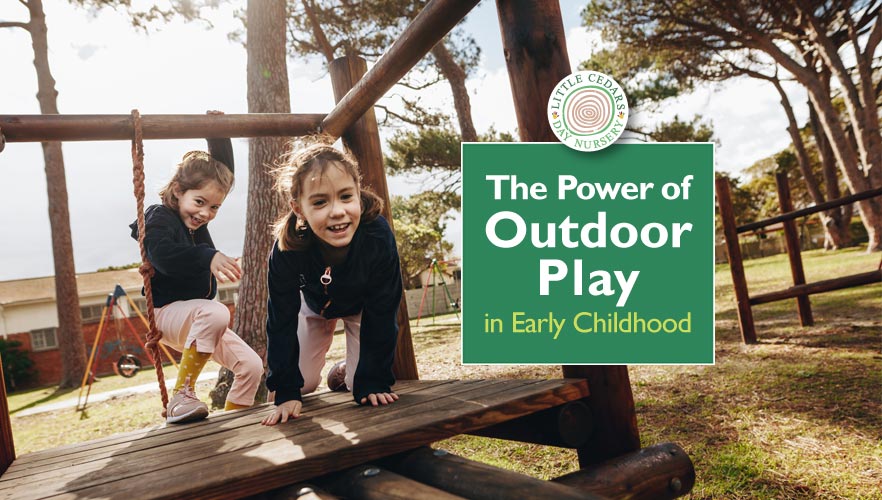
 In today’s guide, we take a close look at the incredible importance of outdoor play for children, including those under five. Outdoor play isn’t just about fun; it’s one of the cornerstones of childhood learning and development and has an immense number of benefits for little ones. So, in this comprehensive article, we’ll explore why outdoor play is so essential for our youngsters and how its effects can be transformative. Let’s take a look…
 For children, the outdoors represents a magical place where fun, exploration and real adventure can take place. Picture a world where a simple stick can become a wizard’s wand, or a puddle can transform into a treasure-filled lagoon, and you’ll soon understand how exciting the outdoors can be for children. Indeed, outdoor play is the realm of limitless imagination. It offers children a vast canvas in which to immerse themselves into adventures, fostering creativity and igniting their instinctive curiosity.
 The Great Outdoors serves as a natural classroom, with true hands-on learning experiences that provide numerous opportunities for children to acquire new skills and knowledge. Whether it’s
  Outdoor play engages all the senses and
 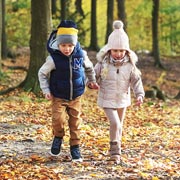 The outdoors serves as an exceptional classroom. When they’re playing outside, children effortlessly absorb knowledge about the world around them. In the open air, they will naturally learn about nature, seasons, different types of flora and fauna, and how the environment functions. It is true learning through discovery.
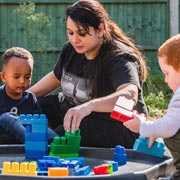 The open spaces of the outdoors also serve as a wonderful canvas for creativity. Children’s imaginations run wild outdoors as they invent games, stories, and art inspired by the natural world. Outdoor play encourages them to think in new, innovative, ways and to truly embrace their creative potential.
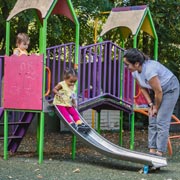 At Little Cedars Nursery, we really understand the profound impact that outdoor play has on early childhood development. With that in mind, our childcare practitioners ensure that children are given every opportunity to immerse themselves in a wide range of outdoor activities that help to nurture every child’s learning, growth, curiosity, and resilience. And let’s not forget one more important factor about outdoor play — it’s simply immense fun for children! As such, it is a perfect way to facilitate learning in the most natural way of all — through play.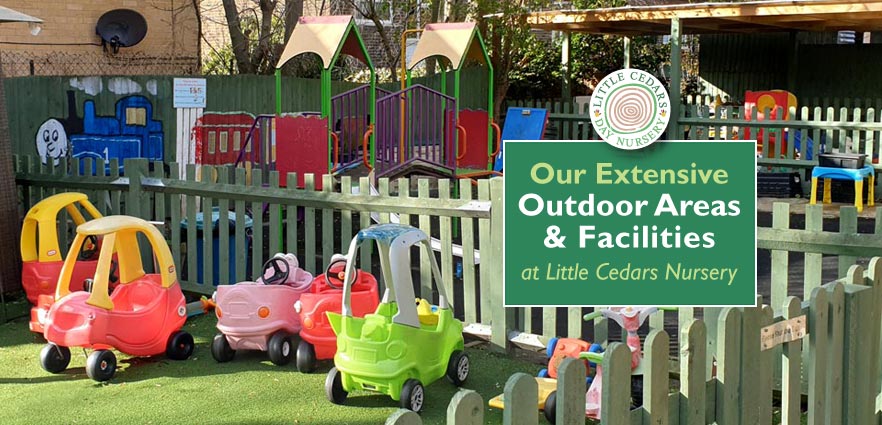
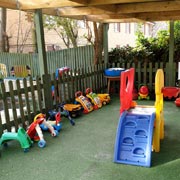 We have a huge outdoor area for children at Little Cedars Nursery, Streatham. Parents express their surprise when they first see it, regularly commenting that it’s much larger than the outdoor areas of other nurseries and pre-schools in the area. Our extensive outdoor play areas are also packed full of fun, educational play equipment and facilities that our under-five children absolutely adore. That includes areas and facilities set up especially for particular age groups.
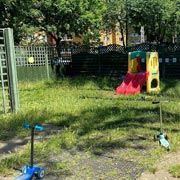 The outdoor ‘mud kitchen’ is a particular hit with children at the nursery. They can enjoy creating in the sand play and water play areas too. These are fun and educational activities —
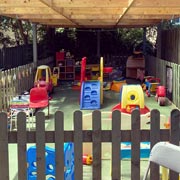 As you can see from some of the photographs, the nursery’s extensive outdoor areas include both open-air and undercover areas. That means children can play and explore whatever the weather. Outdoor play is good for children, teaching them some things that simply can’t be taught indoors, so it’s wonderful that many of the outdoor facilities can be used all-year-round.
 Outdoor play at Little Cedars Nursery also supports the Early Years Foundation Stage (EYFS) curriculum. Learning through outdoor play teaches children so much and in a natural way. Outdoor play supports such areas as communication & language, physical development, personal, social and emotional development and understanding the world. Many such lessons come naturally as children play with one another and interact together via outdoor activities.
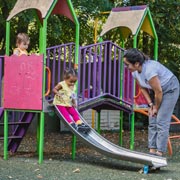 Such staff will continuously identify the individual interests and needs of each child and ensure that the learning and development activities they access will benefit them in the optimum ways. The idea is to further strengthen existing areas where children are strong, while bolstering children’s skills in areas that may require extra focus.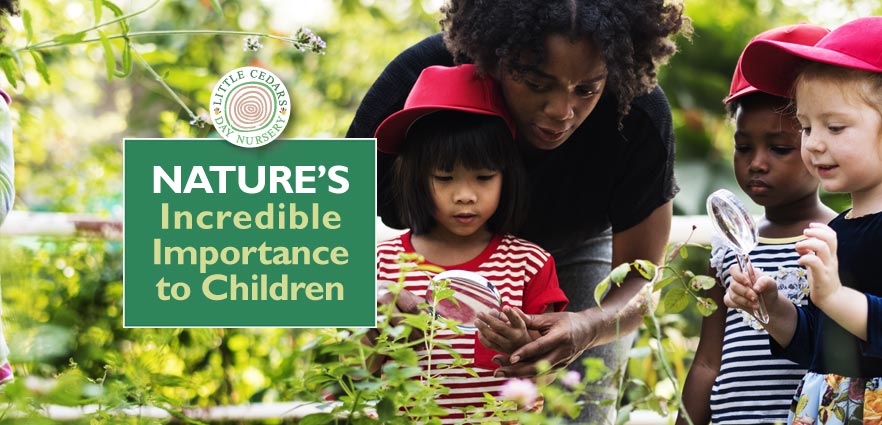
 It’s amazing how much nature benefits children, particularly in their early years when they’re finding out about the world around them — and also learning about themselves. There have been many studies into the importance of nature, to youngsters in particular, and the studies all reach a similar conclusion — nature is incredibly important and beneficial to children. Today we’ll explore the topic and learn why children should regularly access the natural world.
 Stress is also reduced on both a mental and physiological level through exposure to a natural environment. In studies, stress hormone and blood pressure levels both improved after exposure to nature, helping children both physically and emotionally. Nature seems to be a great way to recharge children’s batteries and lower stress and anxiety, as well as improving attention, engagement and academic performance. That includes improvements in important skills like reading, writing and mathematics.
 Improved social skills and even wider circles of friends due to the opportunities offered through outdoor play and adventure.
 The new skills, knowledge and freedom that nature gives children also helps them to become more self-confident and independent individuals.
 Even in built-up cities like London, immersion in nature is possible via gardens, parks, commons or, if you’re lucky to have them near you, nature reserves and nature gardens. There are many of these dotted around London, including
 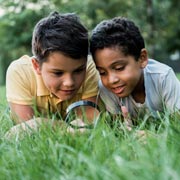 If you’re searching for
 Welcome to our quick guide to Tummy Time. One of the most important things for babies during their earliest development is to build strength, muscles, motor skills and coordination. In particular, learning to lift and safely move their heads is one of the most crucial skills at this young age. Strength and muscle coordination in their neck is therefore very important. That’s not easy when they’re newborns in their first few weeks because their head is comparatively large and heavy compared with their little bodies at that age. Building upper body strength in arms, shoulders, core and back will also greatly help them in their physical development and mobility, essentially helping them to perform and survive safely as humans. Tummy Time is a key tool in learning to accomplish all of these goals — and many more.
 What is Tummy Time?
 It helps to stop the development of deformations in the skull. ‘Positional plagiocephaly’ (or ‘Flat Head Syndrome’) might otherwise occur if the baby is only positioned in a limited number of positions, i.e. mostly on its back. Bear in mind, of course, that at this young age the baby’s skull bones are far more flexible than those of an adult, so such deformations are more likely if the baby’s head is always lying in the same position.
 Making sense of sensory stimuli is also aided by the positive results of Tummy Time, as babies can better explore and gain improved sensory perception of everything in their immediate vicinity.
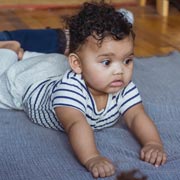 Try putting the baby in a prone position (i.e. on their tummy) on, say, a clean blanket or rug. Lie down on your tummy too and face them, encouraging them to stay on their tummies by use of a game like peek-a-boo. If you can, try to get them to raise themselves onto their arms or, eventually, hands. Move yourself around a little, so they move too and strengthen their muscles. If they’re finding it too difficult initially, a rolled-up blanket underneath their chest may help to start them off. Don’t worry if at first they can only push themselves up on their arms or hands only for fleeting moments; they will gradually improve as they try more and more.
 After 6 months, they should start to be able to support their weight on their arms in a raised, kind of ‘press-up’ position. This can be encouraged with some support (and play) from you and they’ll get the hang of it with practise. Soon enough, they’ll also be able to roll sideways in either direction and get themselves back into the prone position when they want to. They’ll soon master the art of passing a toy from one hand to another at around this time. They’ll also be able to get themselves into a sitting position before they’re 9 months old, or thereabouts.
 Little Cedars is
 What are the Recommendations for Early Years Exercise?
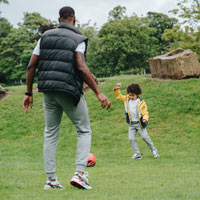 What are the Benefits of Early Years Exercise?
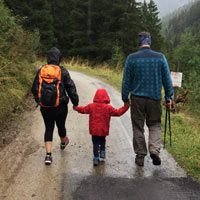 How Parents can Help
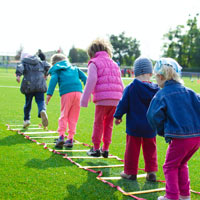 Active Play & Exercise at Little Cedars Day Nursery, Streatham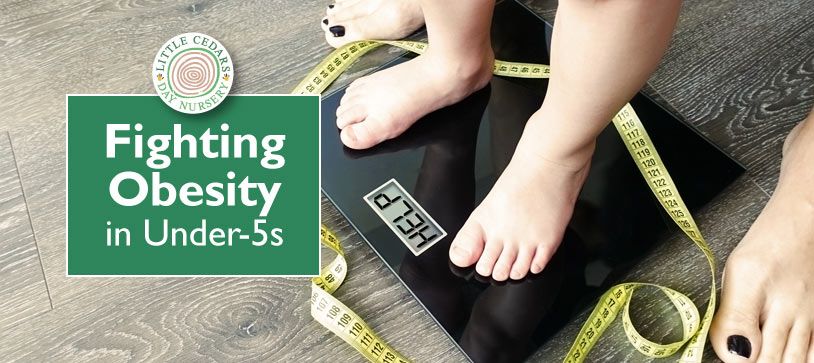
 Following on from our post last month about
 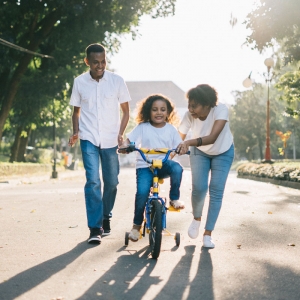 Last month we published
  However, regular exercise has many other potential benefits aside from the management of physical weight and body mass. These include:
 The Government launched its ten year ‘Plan for Action’ to fight childhood obesity back in 2017 and has continued to expand the scheme since then. This initiative was timely in light of the strain that obesity puts on the NHS, made only worse by the arrival of the coronavirus pandemic in 2020. As well as raising awareness of the issues surrounding childhood obesity, measures include things like the so-called ‘sugar tax’, where soft drinks are subject to a levy in order to persuade manufacturers to move towards healthier, reduced-sugar alternatives (a 20% reduction in sugar is a key aim). A similar campaign is being applied to sugar in foods, particularly those that appeal to children. For example, biscuits, confectionery, breakfast cereal, cakes, ice cream and suchlike. The aim is to eventually set caps on the amount of sugar and/or calories per 100g of product. Public Health England (‘PHE’) will monitor manufacturers’ responses to their campaigns and will apply additional “incentives” to improve should they be found wanting as time progresses.
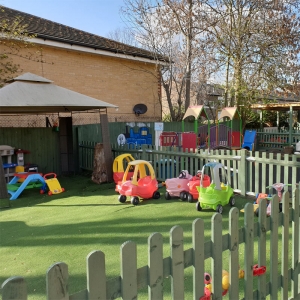 At Little Cedars Nursery in Streatham, we take physical development of children very seriously, so physical education is something that all children have available to them. All children are encouraged to be active, and interactive, so as to remain fit and to be able to hone their physical and motor skills. Indeed, this is a core element of the Early Years Foundation Stage (EYFS) framework that forms the basis of our curriculum.