
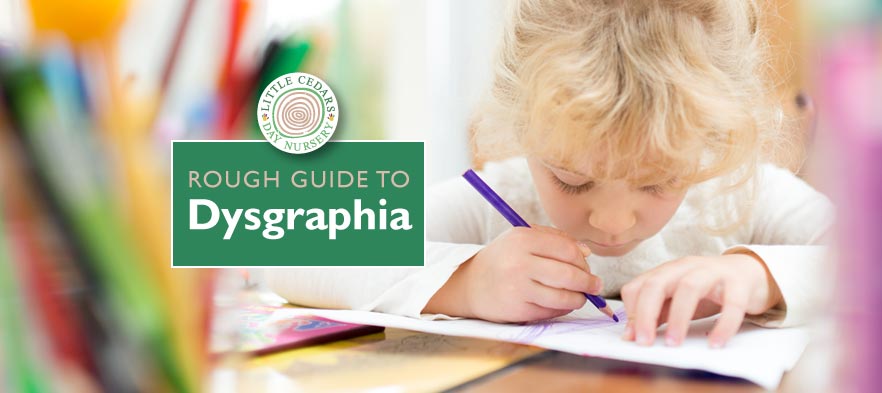
 We previously covered dyslexia, dyspraxia and dyscalculia. Today we’ll take a look at developmental dysgraphia; what it is, what the signs are and how to help children affected by the disorder.
What is Dysgraphia?
Dysgraphia is a learning disorder that adversely affects children’s ability to write coherently and/or spell. That’s in contrast to dyslexia, which affects their ability to read and, indeed, children with dysgraphia may have no trouble reading. As with so many learning disorders, dysgraphia has nothing to do with the level of a child’s intelligence. It affects more males than females and sometimes goes hand-in-hand with other conditions including ADHD.
What Are the 3 Types of Dysgraphia?
Dyslexic dysgraphia results in poor writing legibility specifically when the writing has not been copied from an existing written source. It also gets worse with longer texts. Copied written work, however, may be good although spelling is likely to be bad. This type of dysgraphia is not thought to be the result of poor motor skills nor is it thought to be caused by a neurological issues. Despite the name, dyslexic dysgraphia is unrelated to dyslexia.
 Motor dysgraphia is primarily the result of poor fine motor skills and poor dexterity, making the control needed for legible writing or drawings difficult. It may also be the result of poor muscle tone. In contrast to dyslexic dysgraphia, motor dysgraphia may result in poor writing legibility even when the words are copied. Spelling, however, is not adversely affected. Short bursts with unusually high concentration levels may result in better letter and word formation, but the level of concentration needed to achieve this is unsustainable over a longer period.
Spatial dysgraphia also results in mostly illegible writing and drawing, however in this case it’s the result of issues around spatial awareness. So, for example, written work may stray from the lines on lined paper and spacing between words will be poor. Both copied and spontaneous writing is usually illegible but spelling is normal.
Some dysgraphic children have more than one type of dysgraphia and it’s also worth noting that some may exhibit symptoms that do not necessarily fit straight into any of the 3 types above.
There is another type of dysgraphia that’s caused by neurological trauma, e.g. through a brain injury. However, we’ll concentrate here only on developmental dysgraphia.
What Causes Dysgraphia?
Dysgraphia is caused by neurological issues, although the exact cause is unknown. It may, though, be associated with Autism Spectrum Disorders.
What are the Signs of Dysgraphia?
Developmental dysgraphia can usually only be recognised once children start learning to write. For this reason, it’s seldom emerges until around the age of 5. It manifests itself when writing skills are significantly below what’s expected for a person’s intelligence, age and level of education.
Signs of possible dysgraphia include:
- In all forms of the disorder, writing will be poor and often largely unintelligible;
- Writing is likely to be very slow;
- In some cases, spelling is also adversely affected;
- Dy
 sgraphic children may also hold their writing instruments in an unusual way or have strange posture when writing;
 - The grip on the writing instrument may also be unusually tight and the child may also watch their hand when writing;
- Pain may be experienced when trying to write or draw and those with the condition may assume this is normal. It may start in the forearm and potentially spread to the entire body. Stress can also bring this on in the dysgraphic;
- Dysgraphic children my mix lower case with upper case letters. Numbers may also be difficult (so maths can also be adversely affected);
- Sizing and spacing of letters and words will be irregular;
- Letters and words may be incomplete, missing or simply wrong;
- Communication via the written word will be a struggle;
- Those with the condition may talk to themselves while writing, for example saying words out loud when writing them.
 sgraphic children may also hold their writing instruments in an unusual way or have strange posture when writing;
Additional Knock-On Effects
Because writing is so challenging, those with the condition may exhibit a reluctance around written tasks, often not completing them. This may be incorrectly construed as laziness to the uninitiated. Those with the disorder may also find writing very tiring, even for short texts. In a classroom situation, dysgraphia also makes the taking of notes extremely difficult and this can lead to additional problems around academic topics, for example keeping up with the curriculum.
Sadly, dysgraphic children’s difficulties around writing may also lead to low self-esteem and even anxiety and mental health issues. With the disorder holding a child back in so many ways, it can also lead to reduced prospects generally. So, the earlier the child is diagnosed, the more likely their challenges can be reduced to a minimum.
Diagnosing Dysgraphia
 Diagnosing Dysgraphia
As with many learning disorders, it’s always wise to first contact a GP to ensure that the issue is not caused by some other condition, for example poor eyesight. If dysgraphia is still suspected thereafter, specialists may need to be involved in order to get a firm diagnosis. They may include a paediatrician, psychologist and occupational therapist who may test the child’s writing, fine motor and academic skills. Whilst doing so, the child’s pencil grip, posture and general approach to writing will also be appraised. If positively diagnosed, an occupational therapist is usually at the forefront of any follow-up treatment.
How to Help Children with Dysgraphia
Like many of the other learning disorders, there is no cure for dysgraphia. However, there are several ways that dysgraphic children can be helped, so the challenges they face are reduced. An occupational therapist may set a plan in motion to strengthen hands, fingers and wrists, for example. They may also recommend specific ways to improve writing.
 At education settings, additional bespoke learning strategies and interventions, that all teaching professionals can employ, may include:
- Allowing dysgraphic children more time to complete tasks (both classroom assignments and any tests);
- Use of special writing instruments that may have different types of grip;
- Use of special lined paper that has raised lines. This can help affected children to keep writing within the lines more easily;
- Supply of pre-printed lesson notes, so there is less burden on the dysgraphic child to take handwritten notes;
- Use of special tools, for example voice-to-text software, dictation machines and proofreading applications;
- Bespoke learning and development plans, customised to the strengths and any weaknesses of the child;
- Teaching professionals may also be able to offer dysgraphic children different ways to submit assignments, for example non-handwritten submissions.
 Childcare/teaching professionals and parents/guardians should always work together and compare notes, so that all parties are fully informed about any challenges the child may have. By doing so, they can share strategies and each work with the child towards the same goals. It’s important to begin such work as early as possible, so that the impact of the disorder on the child’s life is minimised. Early diagnosis is therefore crucial.
Special Educational Needs at Little Cedars Nursery, Streatham
 Childcare professionals at Little Cedars Nursery will support children with any learning disorders and disabilities as a matter of course. Although dysgraphia normally only manifests itself once children reach the age of about five, we will nevertheless watch out for possible signs during children’s pre-school years at the setting. If suspected, we’ll put in place a customised learning and development plan that will help them to overcome any challenges they may be facing. Our childcare staff, including our Special Educational Needs Co-ordinator (SENCo) will work with parents/guardians to support their children in the best way possible. Our aim is for each child to achieve personal bests in every area possible, so they’re ready and able for school when they leave us to begin their time in Reception year.
One of the Best Nurseries
Would you like your baby or under-five child to attend one of the best nurseries in Streatham, Streatham Common, Streatham Hill, Streatham Park, Furzedown, Tooting, Balham, Norbury & Colliers Wood? If so, contact us for more information about Little Cedars Day Nursery, apply for a place or arrange a nursery/pre-school visit. We’d love to show you and your little one around:
 In today’s guide, we answer frequently asked questions (FAQs) about Dyscalculia, particularly in relation to children, including preschoolers. Around 5% of children of school age are thought to have dyscalculia.
 A few of the possible signs of dyscalculia include:
 They may also continue to use fingers to count long after their contemporaries have moved on to mental counting;
 Just as with dyslexia, there is no cure for dyscalculia. However, there are many ways to help children cope with its effects. It’s also worth bearing in mind that children with dyscalculia can be very gifted in other areas, for example creativity, strategic thinking, problem solving, practical abilities and often great intuition.
 They can also benefit when important words and numbers are highlighted (to draw attention to their importance);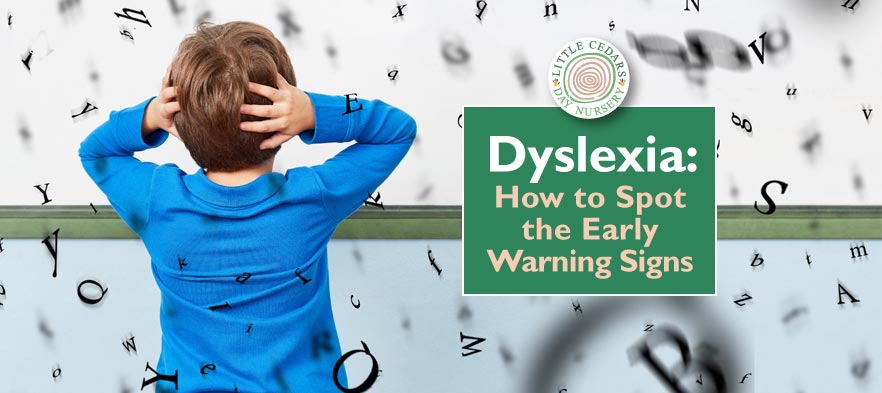
 Despite many dyslexic people being highly intelligent, dyslexia makes it difficult for them to recognise words and/or be able to break them down into their smaller components. It is recognised as a Specific Learning Difficulty (‘SpLD’) and can seriously affect their education if not recognised and addressed early.
 Such an affliction can have profound implications for a person. It will adversely affect their reading, writing and comprehension, thereby limiting their overall learning capability and hindering overall literacy. These are particularly critical skills during their early years as that’s at the start of their education, when the knock-on effects of such limiting factors will be at their most significant. It will slow down their progress in many topics and areas of education, also leading potentially to lower self-confidence and possibly even getting them mislabelled as ‘slow’ or ‘lazy’ by the unenlightened. Ultimately, it can severely limit their potential careers and life outcomes.
 Children finding it difficult to learn the alphabet;
 The child describing words and letters as visually jumbling, blurring or even moving around when they try to read them;
 There is no cure for dyslexia, but measures to mitigate its effects can be taken by education professionals, parents, carers and even those affected by it. It’s incredibly important, though, for both parents and education professionals to try to recognise it early, for example at nursery or pre-school, so that a suitable teaching programme can be introduced as early as possible.