
 Are you a student as well as a parent? If so, there are several Government schemes that offer help with childcare costs, some of which will save student parents substantial amounts of money. By doing so, they also make the prospect of juggling parenthood with being a student much more manageable. Today we examine the key childcare funding options, including how the type of course and the age of the parent affect eligibility.
For Student Parents Studying in Full-Time Higher Education
The Student Childcare Grant
The Student Childcare Grant is essentially free childcare funding and does not have to be repaid.
 The very generous Student Childcare Grant is available for eligible students who who are studying full-time on a higher education course and have dependent children aged 14 or under (16 or under if they have special needs).
Additional eligibility factors regarding the Childcare Grant for Students:
- You must either receive, or be eligible to receive, undergraduate Student Finance based on your household income.
- The Student Childcare Grant is available in addition to any standard Student Finance that may be in place for you.
- The grant does not have to be paid back.
- It can cover up to 85%* of an eligible student’s childcare fees.
- However, the most it will pay out for childcare each week is £183.75* if you have one eligible child, or £315.03* for more than one.
- The child or children mentioned in your application must be financially dependent on you.
- You, the parent, must be a permanent resident in England.
- You are not eligible for the Childcare Grant for Students if you are in receipt of a Postgraduate Loan.
- You are also not eligible for the Student Childcare Grant if you, or your partner if you have one, claim Tax-Free Childcare, Universal Credit or the childcare element of Working Tax Credit.
- Families who get financial support through the National Health Service are also not eligible.
The Student Childcare Grant is paid into a Childcare Grant Payment Service (CCGPS) account and an eligible childcare provider will be paid directly from this once the course has begun. There are strict rules around eligibility for the childcare provider, including that they must be properly registered as such (e.g. with Ofsted or the General Childcare Register) and cannot be a relative if the childcare is taking place at home.
Find out more about Student Childcare Grants and the application process here.
For Student Parents (20+) Studying in Further Education & Facing Financial Hardship
The ‘Learner Support’ Scheme
 If you are aged 20 or over, are a parent studying in further education for a qualification on a Level 3 course or below and are facing financial hardship, you may be eligible for childcare funding under the Learner Support scheme. This funding could help you with childcare and other study-related costs if you fit the right eligibility criteria.
How much childcare funding you are eligible for through the scheme depends upon your exact circumstances and income. The childcare provider, though, must be Ofsted-registered.
Those studying in higher education and in receipt of Student Finance are not eligible, nor are those studying on a Community Learning course. There are also some specific rules for those who are helped via the Advanced Learner Loan Bursary Fund.
For Student Parents Under 20 Studying on a Publicly-Funded Course
The ‘Care to Learn’ Scheme
 If you are a parent as well as a student aged under 20 when you begin one of a range of publicly-funded courses in England, you may be eligible for childcare funding through the Care to Learn bursary scheme. If eligible, you could claim as much as £175 in childcare per week, per child if you live in London, reducing to £160 per week, per child, outside London.
Care to Learn funding can be used for the standard childcare costs as well as both a deposit and a registration fee. It can even be used to fund a childcare ‘taster’ period of up to 5 days for your child and to fund your travel costs to/from the childcare setting. What’s more, it can also be used to secure your childcare place during Summer Holidays.
Publicly-funded courses that fit in with the scheme include schools, sixth-form schools/colleges, academies, some colleges and a few other types of setting. However, your course must not be a higher education course at a university, nor can you claim if you are studying as an apprentice and receive payment for it.
Your childcare provider must be either Ofsted-registered, a school, or registered with a childminding agency. However, if so, they can be a nursery, pre-school, playgroup, out-of-school club or simply a childminder. They receive payments direct, but can only claim payments once they have confirmed both your attendance on your course and your child’s attendance at the childcare setting.
Find out more about the Care to Learn Scheme and how to apply here.
Free Childcare for Streatham Students at Little Cedars Nursery

 Little Cedars supports all official childcare funding schemes and offers high quality childcare at it’s nursery and pre-school in Streatham. We may therefore suit parents who are also students studying at one of the many schools, sixth-forms, colleges, universities and training centres nearby, including around Tooting, Balham, Norbury, Colliers Wood, West Norwood, Wandsworth, Clapham and Brixton. We would be happy to discuss childcare funding options with any parent and can often point people in the right direction, including knowledge on eligibility, applications and actual funding. If you’d like to know more or would like to reserve a childcare place for your child at the nursery, please follow the buttons below.
* Figures are correct at time of writing (October 2022) in relation to the academic year 2022-2023.
 Both children and adults have a natural affinity with music. It’s one of life’s simple pleasures that just about everyone seems to enjoy in one way or another. Children will naturally start to move, dance, join in or even learn songs that they hear — such reactions seem instinctive to them. Learning to play a musical instrument is therefore a natural next step for them. Indeed, it’s one that parents, guardians and carers should consider encouraging, particularly given how beneficial such an endeavour will be to their child. Learning to play a musical instrument is not simply fun; it profoundly benefits children’s learning and development. With that in mind, we take a look today at the incredible array of benefits that learning a musical instrument poses for children, including under-fives.
 Studies have also shown that learning an instrument or learning how to read music develops the left side of the brain. This area is responsible for processing language and reasoning. Hand-eye coordination skills are also aided when learning to play a musical instrument and reading music. As children’s playing and reading become more advanced, it requires the brain to work at a range of speeds, which is also great exercise for the brain.
 Music gives children a really flexible way of expressing themselves. For instance, the way they choose to bang on a drum, shake a tambourine or strum a guitar can allow them to show happiness, anger, frustration, calmness and many other emotions. Playing a musical instrument gives them a real freedom of expression, even at a very young age. Then, if they reach a point where they are able to make up their own melodies and arrangements, music can become an almost immeasurably powerful tool for self-expression and communication.
 Although playing an instrument is creative, music and maths are very much intertwined. Beats, rhythms and scales are all based on maths and children naturally need to work out some maths in order to understand the song and any sheet music. This will naturally help them to better grasp mathematics and illustrate a real-world example of how it underlies many things.
 Whether your child is listening to a tutor, teacher, friend or relative, listening skills are very important. Music is a natural way to encourage listening and that’s even more true when children learn to play music themselves. Doing so in their early years will help them to follow instructions, listen out for smaller details as well as the bigger picture. Working together on a piece of music is also a fantastic way to hone group listening skills and teamwork and to encourage collaboration.
 Indeed, music helps to support all 7 focus areas of
  When children master a song, no matter how basic, they get an enormous sense of achievement and even more so if they are praised by adults and peers. Such praise also encourages the child to progress further, of course. Boosting self-esteem and self-confidence in their early years is important for their future wellbeing too. Achieving something through learning, patience and practising regularly also teaches them that persistence and effort will help them overcome challenges. That’s a very important lesson in life.
 Little ones can first practise keeping in time to music or a beat that an adult is demonstrating, perhaps. Maracas are also good starter instruments although, again, anything that makes a shaking sound can be made at home at zero cost. For instance using an empty carton or plastic container securely sealed with dried rice, pasta or lentils inside. Once they get the hang of such percussive or shaker-style instruments, you can consider transitioning them to more advanced instruments like recorders, ocarinas, keyboards, stringed instruments and so on. Often, children will be more than willing to give such instruments a try and some encouragement and guidance from knowledgeable adults or older children will always be helpful. And, who knows, they could end up being maestros and even stars in the making!
 A childcare nursery should not be thought of only as a crèche, playgroup, or simply somewhere that looks after babies and children while parents go to work. Good nurseries and pre-schools like Little Cedars are so much more than that. It’s incredible just how much they benefit under-fives, families and society as a whole once you take a closer look at everything they do — and that’s exactly what we’re doing today…
 What’s more, staff at childcare settings like Little Cedars will form close bonds with little ones. Studies show that
  Good Ofsted-registered nurseries/pre-schools like Little Cedars also give under-fives a full early years education. That’s important to know. Through a learning and development programme that’s customised to each individual child, we ensure they achieve their own personal bests in all areas of the statutory
  Part of children’s personal, social and emotional development comes through active play with other children that they meet and get to know at the nursery. This is firstly great fun, of course, and that’s a hugely important part of any happy childhood. However, they’ll also learn many things through play. Without socialising with others, it would be more difficult to improve social skills, for example. Only by being around other children will they learn to account for the feelings of others, learn to respect one another and ultimately form close bonds, trust and friendships. Many such friendships will indeed continue long afterwards, as children move to schools at the age of five.
 Another key aim of good early years childcare provision is to prepare children thoroughly for school. Why? Because
  It’s almost as if children are super-charged for success — the benefits of a good early years education are surprisingly long lasting. Some studies even show that the benefits last into people’s working lives, improving salaries (
 Working so closely with babies, toddlers and preschoolers allows us to continually monitor their individual progress. In so doing, we are in a prime position to spot any issues early and to make appropriate arrangements to mitigate them if needed. For example, we may spot that a child is finding reading challenging. If so, we can put extra effort and time into improving the situation for the child. On occasion, that may even include talking to parents about the possible intervention of a specialist of some kind, or it could simply be that they need to practise specific activities to overcome the issue. The earlier challenges or any special educational or developmental needs are spotted, the sooner the child in question can be helped.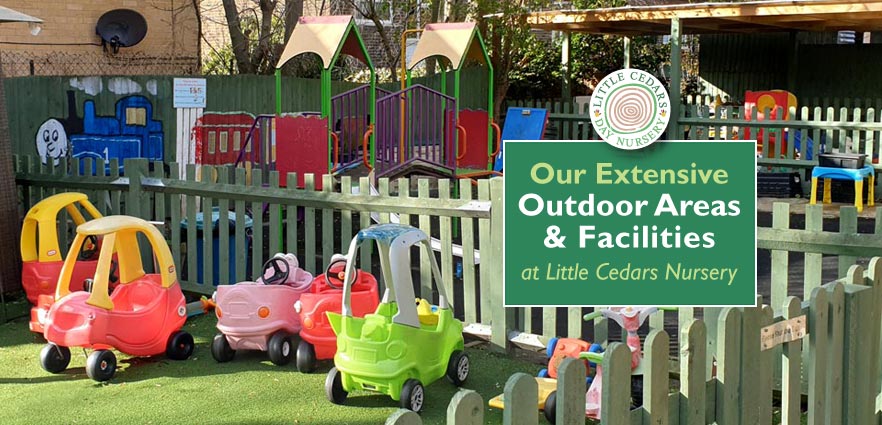
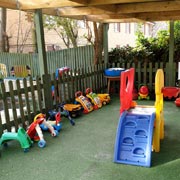 We have a huge outdoor area for children at Little Cedars Nursery, Streatham. Parents express their surprise when they first see it, regularly commenting that it’s much larger than the outdoor areas of other nurseries and pre-schools in the area. Our extensive outdoor play areas are also packed full of fun, educational play equipment and facilities that our under-five children absolutely adore. That includes areas and facilities set up especially for particular age groups.
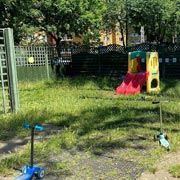 The outdoor ‘mud kitchen’ is a particular hit with children at the nursery. They can enjoy creating in the sand play and water play areas too. These are fun and educational activities —
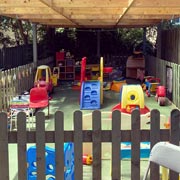 As you can see from some of the photographs, the nursery’s extensive outdoor areas include both open-air and undercover areas. That means children can play and explore whatever the weather. Outdoor play is good for children, teaching them some things that simply can’t be taught indoors, so it’s wonderful that many of the outdoor facilities can be used all-year-round.
 Outdoor play at Little Cedars Nursery also supports the Early Years Foundation Stage (EYFS) curriculum. Learning through outdoor play teaches children so much and in a natural way. Outdoor play supports such areas as communication & language, physical development, personal, social and emotional development and understanding the world. Many such lessons come naturally as children play with one another and interact together via outdoor activities.
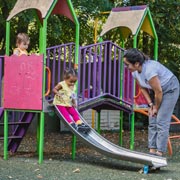 Such staff will continuously identify the individual interests and needs of each child and ensure that the learning and development activities they access will benefit them in the optimum ways. The idea is to further strengthen existing areas where children are strong, while bolstering children’s skills in areas that may require extra focus.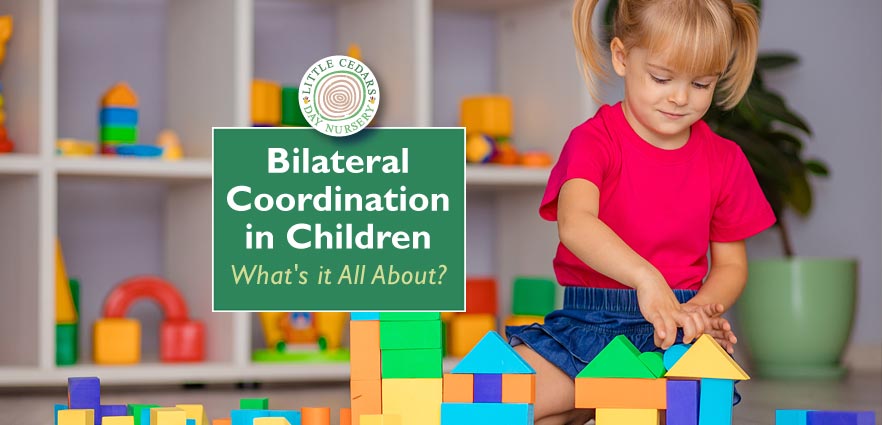
 Bilateral coordination is an important skill for children to master and is something that parents should look out for as children develop in their early years. Today we look at the topic, explaining what it is, why it’s important and how mastery of the skill benefits little ones.
 You may also hear reference to the phrase crossing the midline and this is also linked to bilateral coordination. It refers to a person reaching across their body, from one side to the opposite side, in order to complete a task. An example would be a child reaching with their right hand, across their body, to pick up a toy that’s to their left. Crossing the midline in such a way is a significant step because it demonstrates that infants have progressed from naturally using the side of their body nearest the object to using a dominant or preferred side. This may be the first indication parents have of whether their child is going to be left- or right-handed.
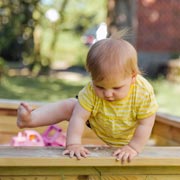 uncoordinated and will struggle with a variety of physical tasks.
 Reciprocal bilateral coordination: this is where both sides of the body form a rhythmic motion but the movements on each side alternate. Examples include walking, swimming and cycling.
 Mastery of bilateral coordination requires children to develop and fine-tune three types of motor skill:
 Threading beads on a string, or string through holes punched though paper or card;
 Play-doh — squeezing and rolling it, including use of tools to shape it;
 These are just a few examples. Any age-appropriate game or activity is likely to help improve bilateral coordination so long as it requires precise, measured movements and coordination of both sides of the body. It’s a case of the child practising over time, often through play, until a particular physical outcome has been mastered. Progress is particularly easy to see in babies and infants as they gradually become more physically able, dextrous, strong and coordinated.
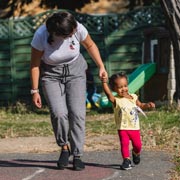 Independent feedback from other parents is worth its weight in gold. In the last five years, Little Cedars has received only 5-star reviews on Google and Facebook. That’s top marks, consistently for 5 years running.* Comments that accompanied these independent reviews were equally compelling — here are just a few examples:
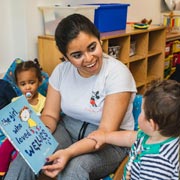 Little Cedars is a warm, welcoming and nurturing environment. To the babies and children, it very much becomes a home-from-home where they feel safe, valued, cared for and all with wonderful, close relationships with both peers and our childcare professionals. It’s also a place of immense fun where little ones are happy, stimulated and nurtured in order to bring out the best in them.
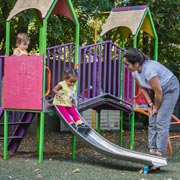 Little Cedars Nursery is extremely well resourced and equipped, both inside and out.
 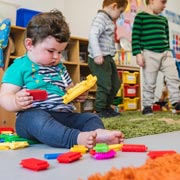 If your 2-year-old is eligible for the Government’s free childcare scheme for this age group, rest assured that Little Cedars Day Nursery supports them and this can potentially give your little one 15 free hours of childcare per week for as many as 38 weeks of the year. That’s 570 free childcare hours per year for your 2-year-old!
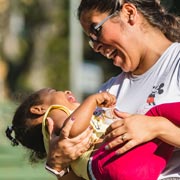 A Key Person is assigned to each child at Little Cedars Nursery. This is an early years practitioner who ensures that the child’s needs are being catered for and that their care at the setting is tailored to them as an individual. They help children settle in when they first join the nursery and build strong relationships with both the child and the parents. They are therefore usually the natural and key point of contact at the nursery.
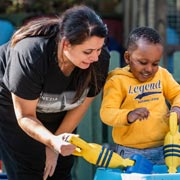 We have a very special team at Little Cedars Nursery. Every one of them has been hand picked to ensure they are the perfect fit for the nursery and for the children therein. They’re warm, natural carers who will form wonderful relationships with children and bring out the very best in them. They become the children’s safe, familiar and friendly faces at the setting as well as facilitating top-notch learning and early years education. They also ensure every child is happy and is having fun whilst under our care.
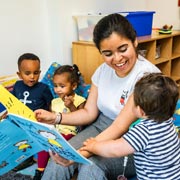 At Little Cedars we do so much more than simply look after babies, toddlers and under-fives. We educate and nurture them too. In fact, we ensure that our little ones achieve personal bests in all 7 areas of






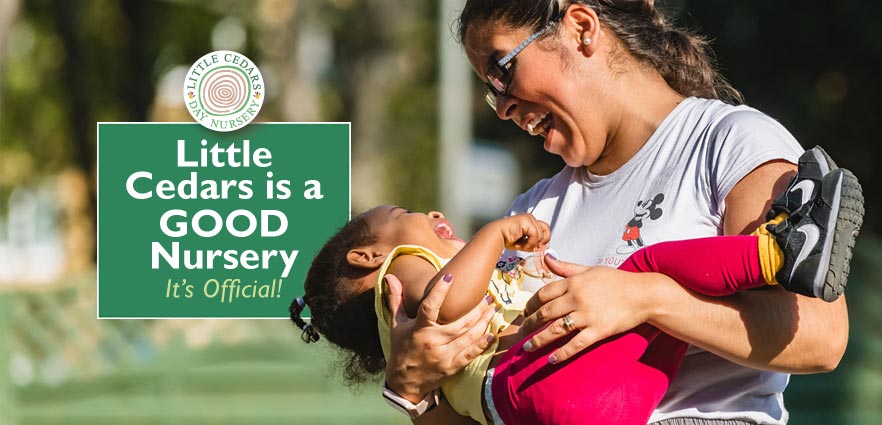
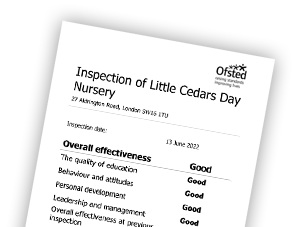 Here’s how Ofsted rate Little Cedars Nursery:
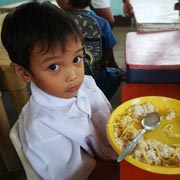
 It can be frustrating when children refuse to eat particular foods, often seemingly for no apparent reason. Much of it is new to them, though, if they’ve only recently been weaned off milk. So, firstly don’t get stressed about it. Refusing certain foods initially is quite normal for the very young. Often, all that is needed is a strategy for dealing with finicky eating and a little patience. Let’s take a look, today, at measures parents or carers can take to manage children who are fussy eaters. After all, it’s imperative that they have a healthy, balanced diet.
 Similarly, some foods are an acquired taste, i.e. one that’s initially not liked, but is later appreciated and enjoyed. Avocados have a taste that’s quite subtle and delicate, for example. Because of that, some youngsters think they are bland — but may well love their subtle flavour and texture once they’re older. That’s an acquired taste. So, again, it’s worth encouraging your child to keep trying foods even if they don’t think they like them in the beginning.
 If your child loves one food but not initially another, try using food bridges. This is when you pair one food with another food that you know they already like. You can start small and gradually increase the amount of the ‘new’ food. Adding cheese to potato or pasta is one example. Adding a small garnish of finely chopped herbs, vegetables or even fruit to pasta, rice, pulses or meat is another. These may slip under the child’s radar and this will help with gradual acceptance.
 You could even make the food into fun pictures, all entirely made of the food you want them to eat. For example, peas could be made to represent a hill, broccoli could represent a wooded area, the yolk of a fried egg could represent the sun and so on. This approach will help children to see a fun aspect of food, and to engage more directly with it.
 You could even get children involved in the creativity and choices around food. With the requisite care around safety, you could involve them in food preparation, choosing foods, deciding how they are displayed on the plate and so on. This will again get them more engaged around food and make it into a fun, creative activity. Children will love that. Remember, though, that this should only be taken so far. After all, you do not want to encourage them to always ‘play’ with their food.
 When your child eats something that they’ve not been keen on eating before, give them positive feedback as this will encourage them. A well done here and a good job there will sometimes do wonders.
 At Little Cedars Nursery in Streatham we know how finicky young children can sometimes be. So, we too occasionally employ some of the tactics described above. After all, food and a healthy, balanced diet is important and never more so than in children’s formative years. Study after study has shown this to be the case. Read our
 In a follow-up to last month’s post about
 Reading with children, well ahead of them beginning school, has also been shown to boost their language skills, incredibly by the equivalent of as much as 8 months before they’re even five! The key is to read with them; not just to them. Learn more about
  Listen to any reservations your child may have about the prospect of starting school. Listening is important, so be on the look-out for any concerns and reservations they may have.
 Children will greatly benefit in Reception Year at school if they’re already independent when they start. So, nurturing aspects of their independence well ahead of them beginning school is a good policy. For example, ensuring they know how to independently look after personal hygiene, dress themselves, tie shoe laces, dress, use the toilet, pack their bag and so on. If they can do this before they start school, it will help them enormously.
 Parents/guardians will also be wise to identify one or more of their children’s friends (or potential friends) that will also be starting school at the same time. Ensure they meet up and play regularly, before they’ve started school. In this way, there will be a friendly face at the school from the moment they start. It’ll help them feel more at home and less alone.
 Several weeks before they start school, children should start to synchronise their day with the timings of the new school day. This should include getting up time in the morning and ideally even timings for lunch and suchlike. In this way, children’s body clocks will have adjusted in good time, before they actually start.
 Ensuring children have everything they need, at least a little ahead of starting in Reception, is a good approach. Check that you have all items of their uniform, PE kit, any stationery, lunch box if appropriate, backpack or bag and so on. Is everything marked with your child’s name? Usually it should be.
 Your child will need to know, ahead of time, who is collecting them. If it’s not you, then they need to know clearly who it will be. They also need to be clear around their general safety rules, stranger danger and so on. Schools should also have safeguarding policies in place for unexpected scenarios. For example, if you are unexpectedly delayed and need to send someone else to collect your child, does the school have a password system in place to ensure that only the right person can collect your child? Find out.