
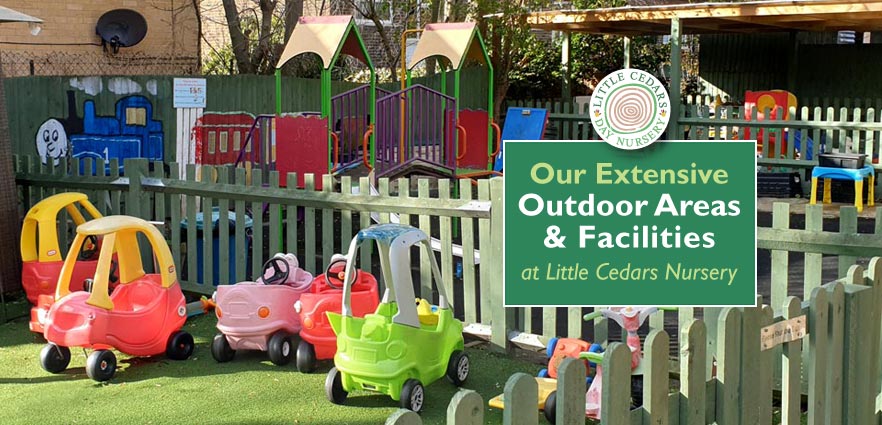
 We have a huge outdoor area for children at Little Cedars Nursery, Streatham. Parents express their surprise when they first see it, regularly commenting that it’s much larger than the outdoor areas of other nurseries and pre-schools in the area. Our extensive outdoor play areas are also packed full of fun, educational play equipment and facilities that our under-five children absolutely adore. That includes areas and facilities set up especially for particular age groups.
Outdoor Facilities & Equipment for Babies
Babies can enjoy sensory toys and equipment, soft play, sand play, water play and even a baby slide. They also have their own baby garden, which is lovely and shaded, to keep them out of direct sun.
Outdoor Equipment for Toddlers & Preschoolers
Toddlers and preschoolers can enjoy equipment like climbing frames, multiple slides along with lots and lots of bikes, trikes, cars and scooters. They even have a basketball area, hoops and lots of footballs for budding soccer players.
Outdoor Facilities for Everyone
 The outdoor ‘mud kitchen’ is a particular hit with children at the nursery. They can enjoy creating in the sand play and water play areas too. These are fun and educational activities — messy play is important as part of a healthy early years education. Construction activities also happen naturally with the varied facilities and equipment on offer outdoors at the nursery.
Children also have access to a lovely, shaded, grassy area in the amazing garden, where they can get closer to nature and all of the benefits it brings to little ones.
Children at the nursery can also play “parents” with the prams that they can wheel around. Or, there are play tunnels, climbing frames and other exploration type activities for the more adventurous.
Animal Enclosure & Vegetable Patch
 Interaction with animals and pets is important during the early years. Therefore, children also have access to quite a wide variety of well-kept creatures. For example, the nursery children help to raise chicks and, once matured into chickens, they are moved to the lovely enclosure that the nursery has outside. Rabbits (currently Miffy and Bella) also live outside and children love to help look after them, stroke them and so on. We teach children to treat them with respect, as individuals in their own right. Such lessons are invaluable at this young age.
We also have a wonderful vegetable patch outside for children to enjoy and learn from. Teaching children to look after living plants also gives them many valuable lessons and ending up with vegetables that they’ve grown and can eat is a magical experience for them.
[Having animals at Little Cedars Nursery] “enables children to actively learn about nature and gain hands-on experience of caring for living things.” (Ofsted)
All-Weather Outdoor Activities
 As you can see from some of the photographs, the nursery’s extensive outdoor areas include both open-air and undercover areas. That means children can play and explore whatever the weather. Outdoor play is good for children, teaching them some things that simply can’t be taught indoors, so it’s wonderful that many of the outdoor facilities can be used all-year-round.
Children Learn Through Play
Children learn primarily through play at Little Cedars Nursery. This has been shown to be by far the best way for under-fives to learn and develop physically during their early years. As well as learning through outdoor games, tasks, nature and the open air environment, children will be quietly improving physical skills outdoors, like balance, coordination and motor skills. They’ll also be gaining strength and fitness through exercise, even if they don’t realise they’re exercising when playing outdoors. That’s just one of the many benefits of outdoor play.
Outdoor Play Supports the EYFS Curriculum Too
 Outdoor play at Little Cedars Nursery also supports the Early Years Foundation Stage (EYFS) curriculum. Learning through outdoor play teaches children so much and in a natural way. Outdoor play supports such areas as communication & language, physical development, personal, social and emotional development and understanding the world. Many such lessons come naturally as children play with one another and interact together via outdoor activities.
A 360° Early Years Learning Experience
The equipment, resources and zones in the outdoor areas are designed to excite, stimulate and engage the children. Specific playing and learning activities and their exact make-up are also guided by early years practitioners at the nursery, along with each child’s “Key Person”. 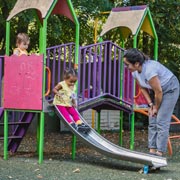 Such staff will continuously identify the individual interests and needs of each child and ensure that the learning and development activities they access will benefit them in the optimum ways. The idea is to further strengthen existing areas where children are strong, while bolstering children’s skills in areas that may require extra focus.
Older children can move freely from indoors to outdoors, under supervision of course, and thereby benefit from the inside facilities and equipment as well as those outdoors. This gives them a well-rounded playing and learning experience at the setting.
Are You Looking for Good Nurseries/Pre-schools in Streatham?
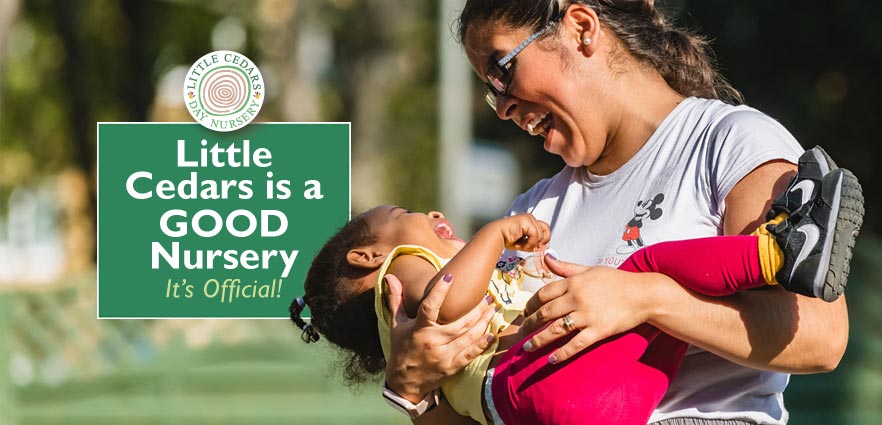
Little Cedars is officially rated by Ofsted as a Good Nursery and pre-school. We’re in Streatham, near Furzedown, Tooting, Balham, Norbury & Colliers Wood

 Little Cedars Nursery is officially rated as a good provider of childcare by Ofsted. So, if you’re looking for the best start for your child in the Streatham area, please consider us and — even better — come for a visit. We’d love to show you and your little one around! We are a good nursery and pre-school in Streatham offering high quality childcare services near Streatham Hill, Streatham Park, Streatham Common and Furzedown. We’re very near to Tooting, Tooting Bec, Tooting Broadway, Tooting Common, Balham, Norbury and Colliers Wood too, so may be a good solution to your childcare needs if those locations are near you. Click a button below to get started with your application, a nursery tour or simply to ask us a question. We’ll be happy to help.
 Bilateral coordination is an important skill for children to master and is something that parents should look out for as children develop in their early years. Today we look at the topic, explaining what it is, why it’s important and how mastery of the skill benefits little ones.
 You may also hear reference to the phrase crossing the midline and this is also linked to bilateral coordination. It refers to a person reaching across their body, from one side to the opposite side, in order to complete a task. An example would be a child reaching with their right hand, across their body, to pick up a toy that’s to their left. Crossing the midline in such a way is a significant step because it demonstrates that infants have progressed from naturally using the side of their body nearest the object to using a dominant or preferred side. This may be the first indication parents have of whether their child is going to be left- or right-handed.
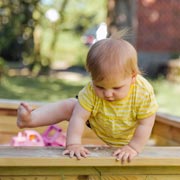 uncoordinated and will struggle with a variety of physical tasks.
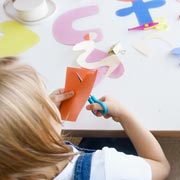 Reciprocal bilateral coordination: this is where both sides of the body form a rhythmic motion but the movements on each side alternate. Examples include walking, swimming and cycling.
 Mastery of bilateral coordination requires children to develop and fine-tune three types of motor skill:
 Threading beads on a string, or string through holes punched though paper or card;
 Play-doh — squeezing and rolling it, including use of tools to shape it;
 These are just a few examples. Any age-appropriate game or activity is likely to help improve bilateral coordination so long as it requires precise, measured movements and coordination of both sides of the body. It’s a case of the child practising over time, often through play, until a particular physical outcome has been mastered. Progress is particularly easy to see in babies and infants as they gradually become more physically able, dextrous, strong and coordinated.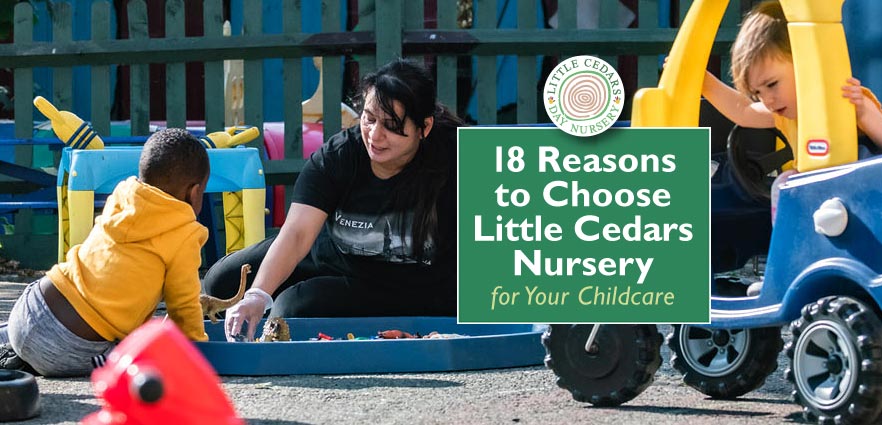
 Independent feedback from other parents is worth its weight in gold. In the last five years, Little Cedars has received only 5-star reviews on Google and Facebook. That’s top marks, consistently for 5 years running.* Comments that accompanied these independent reviews were equally compelling — here are just a few examples:
 Little Cedars is a warm, welcoming and nurturing environment. To the babies and children, it very much becomes a home-from-home where they feel safe, valued, cared for and all with wonderful, close relationships with both peers and our childcare professionals. It’s also a place of immense fun where little ones are happy, stimulated and nurtured in order to bring out the best in them.
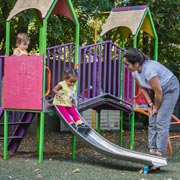 Little Cedars Nursery is extremely well resourced and equipped, both inside and out.
 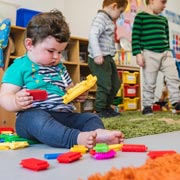 If your 2-year-old is eligible for the Government’s free childcare scheme for this age group, rest assured that Little Cedars Day Nursery supports them and this can potentially give your little one 15 free hours of childcare per week for as many as 38 weeks of the year. That’s 570 free childcare hours per year for your 2-year-old!
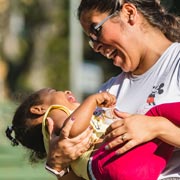 A Key Person is assigned to each child at Little Cedars Nursery. This is an early years practitioner who ensures that the child’s needs are being catered for and that their care at the setting is tailored to them as an individual. They help children settle in when they first join the nursery and build strong relationships with both the child and the parents. They are therefore usually the natural and key point of contact at the nursery.
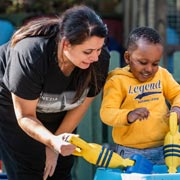 We have a very special team at Little Cedars Nursery. Every one of them has been hand picked to ensure they are the perfect fit for the nursery and for the children therein. They’re warm, natural carers who will form wonderful relationships with children and bring out the very best in them. They become the children’s safe, familiar and friendly faces at the setting as well as facilitating top-notch learning and early years education. They also ensure every child is happy and is having fun whilst under our care.
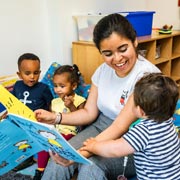 At Little Cedars we do so much more than simply look after babies, toddlers and under-fives. We educate and nurture them too. In fact, we ensure that our little ones achieve personal bests in all 7 areas of






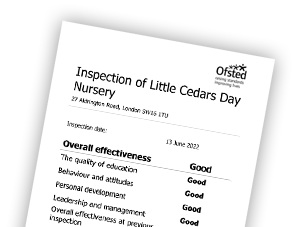 Here’s how Ofsted rate Little Cedars Nursery:
 It can be frustrating when children refuse to eat particular foods, often seemingly for no apparent reason. Much of it is new to them, though, if they’ve only recently been weaned off milk. So, firstly don’t get stressed about it. Refusing certain foods initially is quite normal for the very young. Often, all that is needed is a strategy for dealing with finicky eating and a little patience. Let’s take a look, today, at measures parents or carers can take to manage children who are fussy eaters. After all, it’s imperative that they have a healthy, balanced diet.
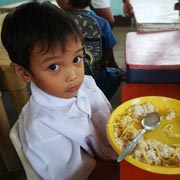 Similarly, some foods are an acquired taste, i.e. one that’s initially not liked, but is later appreciated and enjoyed. Avocados have a taste that’s quite subtle and delicate, for example. Because of that, some youngsters think they are bland — but may well love their subtle flavour and texture once they’re older. That’s an acquired taste. So, again, it’s worth encouraging your child to keep trying foods even if they don’t think they like them in the beginning.
 If your child loves one food but not initially another, try using food bridges. This is when you pair one food with another food that you know they already like. You can start small and gradually increase the amount of the ‘new’ food. Adding cheese to potato or pasta is one example. Adding a small garnish of finely chopped herbs, vegetables or even fruit to pasta, rice, pulses or meat is another. These may slip under the child’s radar and this will help with gradual acceptance.
 You could even make the food into fun pictures, all entirely made of the food you want them to eat. For example, peas could be made to represent a hill, broccoli could represent a wooded area, the yolk of a fried egg could represent the sun and so on. This approach will help children to see a fun aspect of food, and to engage more directly with it.
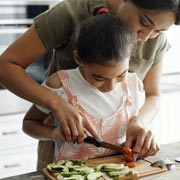 You could even get children involved in the creativity and choices around food. With the requisite care around safety, you could involve them in food preparation, choosing foods, deciding how they are displayed on the plate and so on. This will again get them more engaged around food and make it into a fun, creative activity. Children will love that. Remember, though, that this should only be taken so far. After all, you do not want to encourage them to always ‘play’ with their food.
 When your child eats something that they’ve not been keen on eating before, give them positive feedback as this will encourage them. A well done here and a good job there will sometimes do wonders.
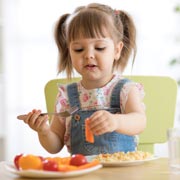 At Little Cedars Nursery in Streatham we know how finicky young children can sometimes be. So, we too occasionally employ some of the tactics described above. After all, food and a healthy, balanced diet is important and never more so than in children’s formative years. Study after study has shown this to be the case. Read our
 In a follow-up to last month’s post about
 Reading with children, well ahead of them beginning school, has also been shown to boost their language skills, incredibly by the equivalent of as much as 8 months before they’re even five! The key is to read with them; not just to them. Learn more about
  Listen to any reservations your child may have about the prospect of starting school. Listening is important, so be on the look-out for any concerns and reservations they may have.
 Children will greatly benefit in Reception Year at school if they’re already independent when they start. So, nurturing aspects of their independence well ahead of them beginning school is a good policy. For example, ensuring they know how to independently look after personal hygiene, dress themselves, tie shoe laces, dress, use the toilet, pack their bag and so on. If they can do this before they start school, it will help them enormously.
 Parents/guardians will also be wise to identify one or more of their children’s friends (or potential friends) that will also be starting school at the same time. Ensure they meet up and play regularly, before they’ve started school. In this way, there will be a friendly face at the school from the moment they start. It’ll help them feel more at home and less alone.
 Several weeks before they start school, children should start to synchronise their day with the timings of the new school day. This should include getting up time in the morning and ideally even timings for lunch and suchlike. In this way, children’s body clocks will have adjusted in good time, before they actually start.
 Ensuring children have everything they need, at least a little ahead of starting in Reception, is a good approach. Check that you have all items of their uniform, PE kit, any stationery, lunch box if appropriate, backpack or bag and so on. Is everything marked with your child’s name? Usually it should be.
 Your child will need to know, ahead of time, who is collecting them. If it’s not you, then they need to know clearly who it will be. They also need to be clear around their general safety rules, stranger danger and so on. Schools should also have safeguarding policies in place for unexpected scenarios. For example, if you are unexpectedly delayed and need to send someone else to collect your child, does the school have a password system in place to ensure that only the right person can collect your child? Find out.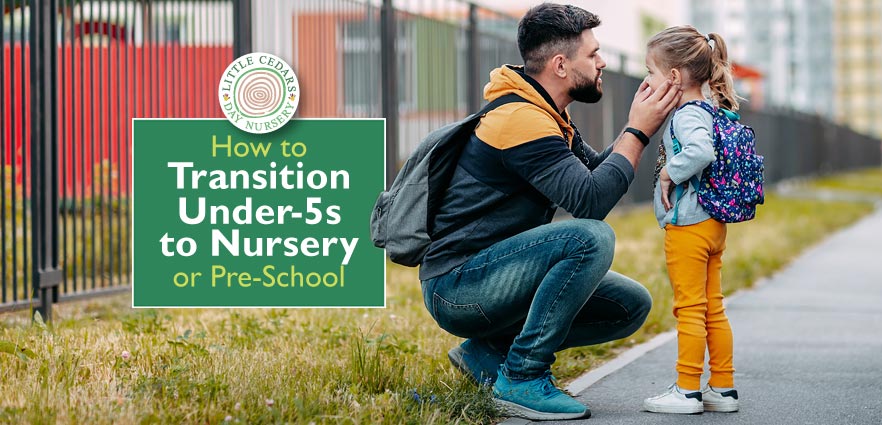
 Whether or not you’ve finished
  In the weeks or even months before their first day, toddlers and preschoolers will also benefit from becoming more independent. You can help to encourage this. For example, you could help them with toilet training, help them learn to dress themselves, encourage them to deal with personal hygiene, cleaning their hands and so on. Can they pack their own backpack? Do they know how to hang their coat up? Helping them to master all such skills will make them more confident and relaxed once they begin at nursery/pre-school.
 Any good nursery or pre-school will be more than willing to show you and your child around the setting — more than once if required. At Little Cedars Nursery, this is commonplace and it gives parents and children the opportunity to see the setting actually ‘in action’. They can ask questions, see all the amazing facilities, equipment and toys, speak to the childcare professionals and see if they feel at home. Settling-in sessions are also an option, prior to fully joining.
 Such sessions and visits are also a great way for children to get to know other children at the setting, or even to discover that an existing friend already attends. Knowing someone who will be at the same nursery or pre-school will help them settle straight in, being a friendly face to greet them from the moment they start. Getting to know the childcare practitioners ahead of starting is also going to help, of course, so they feel at home, secure and looked after by someone familiar, right from the word go.
 Being fully prepared is a big part of the success of this important milestone. However, there are a few things parent/carers can do for children on the actual day they start nursery or pre-school.
 When you drop your child off, don’t make too much of a fuss about being apart from your child. Also, remind them that you’ll be seeing them later when it’s time for them to come home again. This will all reassure them. And, if you can, see if you can pair them up with a friend for them to go in with. Chances are, they’ll then hardly be able to contain themselves with excitement and will not even look back!
 Welcome to our quick guide to Tummy Time. One of the most important things for babies during their earliest development is to build strength, muscles, motor skills and coordination. In particular, learning to lift and safely move their heads is one of the most crucial skills at this young age. Strength and muscle coordination in their neck is therefore very important. That’s not easy when they’re newborns in their first few weeks because their head is comparatively large and heavy compared with their little bodies at that age. Building upper body strength in arms, shoulders, core and back will also greatly help them in their physical development and mobility, essentially helping them to perform and survive safely as humans. Tummy Time is a key tool in learning to accomplish all of these goals — and many more.
 What is Tummy Time?
 It helps to stop the development of deformations in the skull. ‘Positional plagiocephaly’ (or ‘Flat Head Syndrome’) might otherwise occur if the baby is only positioned in a limited number of positions, i.e. mostly on its back. Bear in mind, of course, that at this young age the baby’s skull bones are far more flexible than those of an adult, so such deformations are more likely if the baby’s head is always lying in the same position.
 Making sense of sensory stimuli is also aided by the positive results of Tummy Time, as babies can better explore and gain improved sensory perception of everything in their immediate vicinity.
 Try putting the baby in a prone position (i.e. on their tummy) on, say, a clean blanket or rug. Lie down on your tummy too and face them, encouraging them to stay on their tummies by use of a game like peek-a-boo. If you can, try to get them to raise themselves onto their arms or, eventually, hands. Move yourself around a little, so they move too and strengthen their muscles. If they’re finding it too difficult initially, a rolled-up blanket underneath their chest may help to start them off. Don’t worry if at first they can only push themselves up on their arms or hands only for fleeting moments; they will gradually improve as they try more and more.
 After 6 months, they should start to be able to support their weight on their arms in a raised, kind of ‘press-up’ position. This can be encouraged with some support (and play) from you and they’ll get the hang of it with practise. Soon enough, they’ll also be able to roll sideways in either direction and get themselves back into the prone position when they want to. They’ll soon master the art of passing a toy from one hand to another at around this time. They’ll also be able to get themselves into a sitting position before they’re 9 months old, or thereabouts.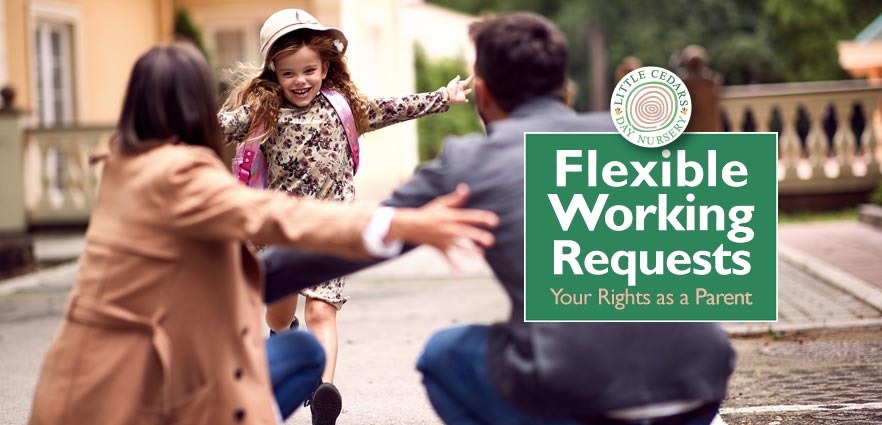
 If you were a full-time employee when you had your child, perhaps you’d rather go part time while your child is under five. Or maybe you want to explore the option of flexitime with your employer. Perhaps you’d like to ask if job sharing is possible, or whether you can work only on specific days of the week. What are the rules, though? Does your employer have to offer part-time or flexible working now you’re a parent, or are they under no statutory obligation to do so? Today we take a look at the rules.
 The rules state that
  The employer must give the employee who makes the Flexible Working Request a decision within 3 months unless the employee agrees to extend that time. This must be done having considered the facts carefully and fairly and without basing it on just a ‘personal’ opinion. They should also discuss the application with the applicant and, if it’s not possible to accept the specific suggestions requested, they should consider whether alternative options are possible.