
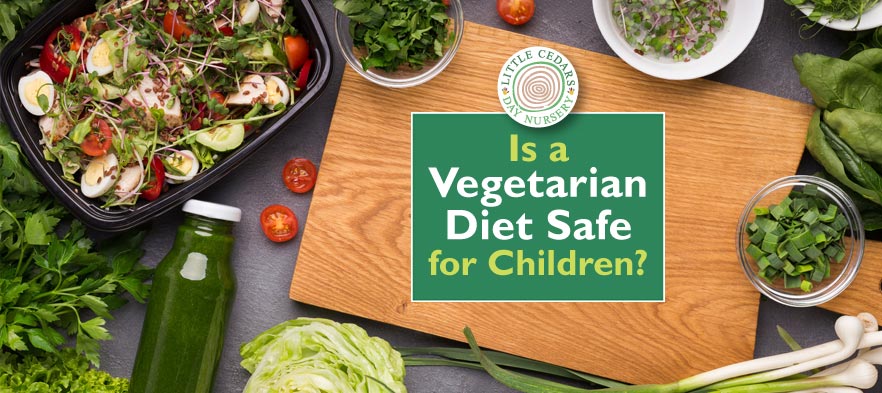
This month is often referred to as ‘Veganuary’, which is why vegan and vegetarian food, facts and meal ideas are all over social media at the moment. Parents/carers have many different reasons for raising their children on a plant-based diet. Whether it’s for health reasons, for the protection of animals, to protect the planet, for religious reasons or simply a matter of taste, more and more people are ‘going veggie’. Raising children as vegetarians or vegans is a natural extension of that. Today, we’ll begin to take look at considerations around vegetarianism for under-fives and children in general.
 Let’s first take a look at the benefits of vegetarianism …
The Health Benefits of a Vegetarian Diet
Study after study has shown that a well-balanced vegetarian diet is generally a healthy diet. That ‘well-balanced’ element is a crucial one, however, and we’ll come to that later. That said, it’s widely accepted that a vegetarian diet:
-
- is good for the heart, reducing the risk of getting heart disease;
- usually leads to lower levels of ‘bad’ cholesterol (LDL), which could otherwise cause strokes;
- reduces the risk of developing cancer;
- lowers blood pressure and reduces the risk of developing hypertension;
 is linked to a reduction in symptoms for those with asthma;
- promotes good bone health;
- lowers the likelihood of developing Type 2 diabetes;
- reduces the risk of chronic disease;
- usually results in a lower body mass index compared to that of meat eaters.
 is linked to a reduction in symptoms for those with asthma;
Kindness to Animals
What’s more, an obvious benefit of a vegetarian diet is that it does not require the death of any animals. That benefits the animals themselves, of course, but also the planet as a whole as we’ll see below. And, of course, it’s a good lesson in kindness for children as part of nurturing their moral compass.
Protecting the Planet
“Research shows that meat and dairy products are fuelling the climate crisis, while plant-based diets — focused on fruits, vegetables, grains, and beans — help protect the planet.”
(Physicians Committee for Responsible Medicine)
 Scientific studies conclude that switching to a vegetarian diet will help the planet enormously. That’s because significantly less greenhouse gas is produced in growing crops compared to raising livestock. What’s more, scientists believe that the necessary reduction in green house gas emissions will be achieved far more swiftly through a widespread switch to vegetarianism than through what’s currently just a gradual shift away from the burning of fossil fuels. Growing crops rather than animals also causes far less pollution in waterways and oceans and also uses significantly less water. The benefits of vegetarianism to the planet are simply enormous.
“A global shift to a plant-based diet could reduce mortality and greenhouse gases caused by food production by 10% and 70%, respectively, by 2050.”
(Physicians Committee for Responsible Medicine)
Is a Vegetarian or Vegan Diet Safe for Children?
 Is a Vegetarian or Vegan Diet Safe for Children?
Well, it’s good news there too. According to the UK’s National Health Service (NHS), it’s perfectly OK to raise children as vegetarians or vegans, “so long as they get all the nutrients they need.” What’s more, they’ll go on to reap all of those aforementioned benefits and will generally tend to live more caring, greener lifestyles as they grow older. And getting all the requisite nutrients is not at all difficult once parents or carers know what’s required.
The Importance of a Well-Balanced Diet
“Children need plenty of energy and protein to help them grow and develop. It’s also important that vegetarian and vegan children get enough iron, calcium, vitamin B12 and vitamin D.”
(The NHS)
Healthy Food at Little Cedars Nursery, Streatham

Our own in-house chef always caters for special diets including vegetarians and vegans, as needed. This is all part of a healthy food regime at the setting, where food is freshly prepared using only the highest quality ingredients. Food and drink are, of course, included in our standard fees. Little Cedars is an outstanding nursery and pre-school in Streatham that’s perfect for babies, toddlers and children under five. It’s also conveniently close to Streatham Common, Streatham Hill, Streatham Park, Furzedown, Tooting, Tooting Bec, Tooting Broadway, Tooting Common, Balham, Norbury as well as Colliers Wood. If you’d like to register a place for your child, to arrange a visit or simply have any questions, please get in touch.
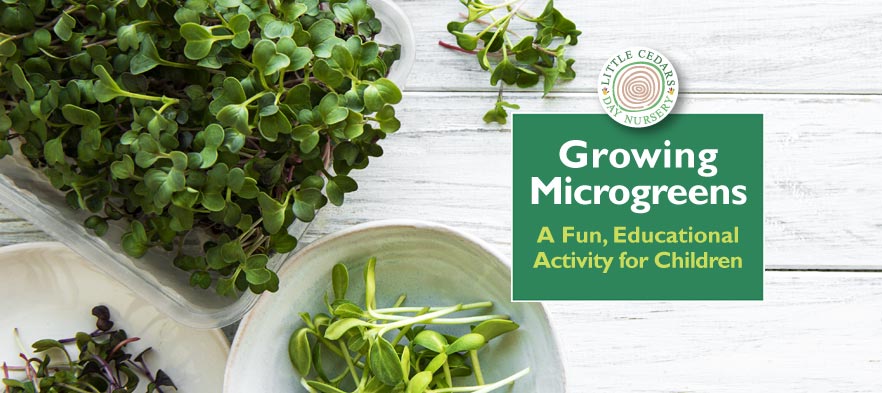
 Back in April last year, we wrote an article about
  Microgreens are great fun and extremely easy for children to grow. Once ready, they can be used rather like salads and garnishes. They are very tasty and are extremely nutritious.
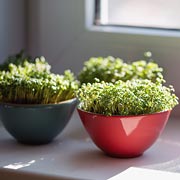 Microgreens are traditionally grown in shallow seed trays, which are inexpensive to buy. However, at home, they can just as easily be grown in flower pots, used yoghurt pots, empty egg cartons, the trays from ready-meals or even cut-down cardboard cores from kitchen rolls. So long as water is allowed to drain from them and they can support at least a shallow depth of compost, these can all be suitable. Plastic cartons will need a few holes punched in the bottom to allow for drainage, so parents might need to organise that in order to avoid their children hurting themselves. Other than that, it’s plain sailing for supervised children to do themselves.
 Suitable seeds include: rocket, a type of strongly-flavoured lettuce; beetroot, with their lovely red stems and mild, earthy taste; spinach, which also has a mild flavour and is full of goodness; red cabbage, which is also rich in a variety of vitamins and minerals; fennel, which will have a distinctive aniseed flavour; broccoli, which will grow into sprouts that have a slightly spicy taste; radish seeds, which also grow into leaves that taste a little fiery; and also mustard seeds (for children who are OK with even more hot, spicy flavours).
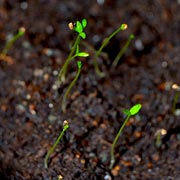 First, your child should fill the seed trays, flower pots or equivalent, almost to the top, with some compost.
 As as shoots begin to appear (usually after just a few days), remove any covering if used and continue to ensure that the compost is always kept moist, but not over-watered.
 Once harvested, they should be rinsed to get rid of any stray compost. They are delicious to eat and, depending on the seeds grown, have a huge variety of tastes and colours. Children and parents alike can benefit from the nutritious and tasty shoots as part of a variety of meal types. Full of vitamins and minerals, they can be used in salads, as pizza toppings, garnishes, toppings for risottos, soups and pastas, as fillings in sandwiches, sprinkled on top of baked potatoes or into burgers and much more. They’re very adaptable and, with their distinctive tastes and textures, will make any meal really special.
 We previously covered
  Motor dysgraphia is primarily the result of poor fine motor skills and poor dexterity, making the control needed for legible writing or drawings difficult. It may also be the result of poor muscle tone. In contrast to dyslexic dysgraphia, motor dysgraphia may result in poor writing legibility even when the words are copied. Spelling, however, is not adversely affected. Short bursts with unusually high concentration levels may result in better letter and word formation, but the level of concentration needed to achieve this is unsustainable over a longer period.
 sgraphic children may also hold their writing instruments in an unusual way or have strange posture when writing;
 Diagnosing Dysgraphia
 At education settings, additional bespoke learning strategies and interventions, that all teaching professionals can employ, may include:
 Childcare/teaching professionals and parents/guardians should always work together and compare notes, so that all parties are fully informed about any challenges the child may have. By doing so, they can share strategies and each work with the child towards the same goals. It’s important to begin such work as early as possible, so that the impact of the disorder on the child’s life is minimised. Early diagnosis is therefore crucial.
 In today’s guide, we answer frequently asked questions (FAQs) about Dyscalculia, particularly in relation to children, including preschoolers. Around 5% of children of school age are thought to have dyscalculia.
 A few of the possible signs of dyscalculia include:
 They may also continue to use fingers to count long after their contemporaries have moved on to mental counting;
 Just as with dyslexia, there is no cure for dyscalculia. However, there are many ways to help children cope with its effects. It’s also worth bearing in mind that children with dyscalculia can be very gifted in other areas, for example creativity, strategic thinking, problem solving, practical abilities and often great intuition.
 They can also benefit when important words and numbers are highlighted (to draw attention to their importance);
 Your Right to Unpaid Parental Leave
 For example, there may come a time when parents need to look at nurseries, pre-schools, primary and secondary schools and, as children approach their mid teens, further education settings. Other reasons to take time off might include time for parents to visit relatives with the children, or to investigate extra-curricular activities such as sports clubs, or simply to spend quality time with their children.
 It doesn’t really matter if you change jobs. The rules around unpaid parental leave apply in relation to your child(ren); not your employer. So, if you change jobs and have already used up 9 weeks of unpaid leave for one child during your previous job, then you can still use another 9 weeks, so long as it’s taken before your child reaches the age of 18.
 To claim a period of unpaid parental leave, just 21 days (3 weeks) of notice must be given to the employer and this must state the start and finish dates. It can be confirmed verbally although employers may request the notice in writing.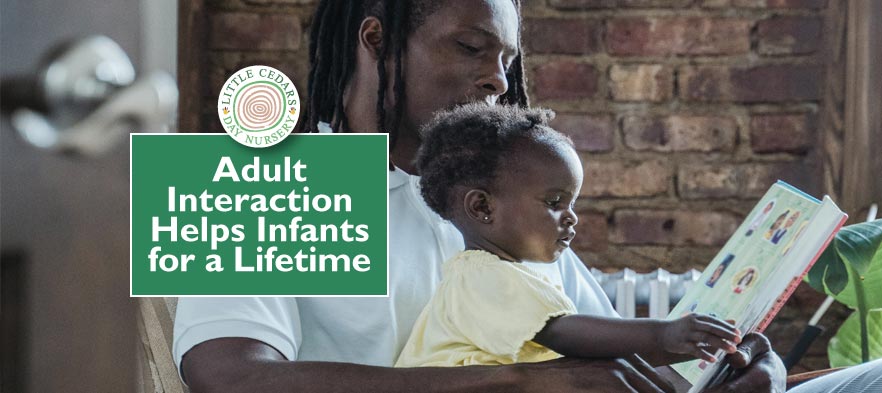
 The Government’s Early Years Foundation Stage (‘EYFS’) framework prescribes how adults should approach the education and development of children under five. As such, it forms the backbone of the curriculum at childcare settings like Little Cedars Nursery in Streatham. The EYFS guidelines were expanded this year (2021) and one aspect of early childhood development discussed therein merits closer exploration: the affect of adult interaction on an infant’s brain development. Here we take a look.
 Their research suggests that constructive experiences will build on and enhance the structure of the brain, whereas “adverse experiences early in life can impair brain architecture, with negative effects lasting into adulthood.”
 The Harvard Center on the Developing Child suggests that parents1 can help babies and toddlers develop their brain architecture in the best way through regular and strategic interaction between adult and infant. They call the process ‘serve and return’. Think of it as a tennis metaphor— we’ll explain. First, the child may indicate an interest in an object or activity. That’s the serve of the tennis ball, if you like. The adult should look out for such indications of interest, recognise them as a kind of invitation from the child and then get involved with that object or activity with the child. Responding in this way is like the ‘return’ of the ball in the tennis metaphor. It’s a great approach because the child is indicating what they are interested in and therefore, when a parent responds through activity involving themselves with the source of interest, the child will naturally get more from the interaction. After all, it was they who first indicated an interest and an adult can now help them to get the most from it.
 Repetition is also important. This helps to reinforce circuits in the brain. Reminding a child several times about something will naturally help them to understand and remember the point under scrutiny.
 The research, as well as a good dose of common sense, shows the incredible importance of parents interacting well with children from the moment they are born. Their interaction and guidance will help the developing child to understand themselves, the world around them, and their place within it. Millions of brain connections are built with every interaction, building healthy foundations upon which the baby will grow into a well-rounded individual with the requisite cognitive, physical, social and emotional skills to handle life. It all comes down to love, responsive and responsible care, with parents matching the infant’s signals and needs with positive, insightful responses. The reassurance and tools such interactions give the infant will allow them to confidently, safely and comfortably explore and learn about the world and, going forwards, their place within it.
 3. Almost 50% More Bones Than Adults
 6. Not So Hot on Eye Sight
 9. Natural Born Swimmers (… Kind of)
 14. Is Breast Really is Best?
 16. The Only Smiling Primate
 19. Outcomes of Being First Born
 Following up from our
  The father, or partner of the mother, must give their employer at least 15 weeks’ advance notice that they wish to take Statutory Paternity Leave. This can be imprecise, however, given that they won’t be 100% certain which day the child(ren) will be born. If they later change the proposed date, employers must be given at least 28 days (4 weeks) notice of the change, made in writing if requested by the employer.
 the child’s father, or
 To be eligible for Statutory Paternity Pay, a person needs to:
 The payments are made through their wages by the employer after deducting any tax and National Insurance if due. (Figures correct at September 2021).
 Today, we’ll take a look at how much time and money mothers are entitled to under Statutory Maternity Leave and what the eligibility requirements are. We’ll concentrate purely on the rules for mothers who are employees in this post. However, we will follow up to cover paternity leave, shared leave and support for self-employed mothers separately, in future guides.
 The good news is that, to be eligible for Statutory Maternity Leave in the UK, just two main rules apply. You need to:
 Statutory Maternity Pay (‘SMP’) is available to mothers who:
 There’s a great online tool that you can use to check whether you are eligible to claim maternity/paternity leave and pay (as well as Maternity Allowance, which may help self-employed mums). It’ll also calculate how much you could receive. Head over to
 Recent studies show that use of connected screens and devices by children, including under-fives, is growing fast. The pandemic appears to have increased kids’ screen use too, as children have spent more time indoors and less time playing ‘in person’ with friends.
 Over 75% of children under five have access to a connected device, with up to 60% of preschoolers actually owning their own.
 “Parents have always played a huge role in curating what [under-fives] consume and how their time is spent, but toddlers are now confidently navigating digital platforms for themselves, and using touchscreen devices with purpose and determination.” (Childwise)
 that the ‘RF wireless radiation’ emitted by Wi-Fi connected screens and devices may carry potential health risks particularly, they argue, for pregnant women, their unborn foetuses and the young. The very young, of course, have brains that are still at a critical development stage. For this reason, the experts concerned advocate that access to devices like mobile phones should be limited, removed from children’s bedrooms at night or, at the very least, placed in Flight Mode when possible. Using devices wired instead of using Wi-Fi apparently reduces risks. Use of them in hands-free mode is another useful approach, so that the devices are not so close to youngsters’ heads. We’re not experts ourselves, but these measures seem like sensible precautions.
 While time spent by children on connected screens and devices is rising, it’s not all bad news. The pandemic has also seen an increase in the time that parents have been spending with children, including on shared screen viewing as well as on other pastimes like baking, crafts and family activities. At the end of the day, it’s all about a healthy balance and, of course, adult supervision to ensure children’s wellbeing at all times.