
 Are you a student as well as a parent? If so, there are several Government schemes that offer help with childcare costs, some of which will save student parents substantial amounts of money. By doing so, they also make the prospect of juggling parenthood with being a student much more manageable. Today we examine the key childcare funding options, including how the type of course and the age of the parent affect eligibility.
For Student Parents Studying in Full-Time Higher Education
The Student Childcare Grant
The Student Childcare Grant is essentially free childcare funding and does not have to be repaid.
 The very generous Student Childcare Grant is available for eligible students who who are studying full-time on a higher education course and have dependent children aged 14 or under (16 or under if they have special needs).
Additional eligibility factors regarding the Childcare Grant for Students:
- You must either receive, or be eligible to receive, undergraduate Student Finance based on your household income.
- The Student Childcare Grant is available in addition to any standard Student Finance that may be in place for you.
- The grant does not have to be paid back.
- It can cover up to 85%* of an eligible student’s childcare fees.
- However, the most it will pay out for childcare each week is £183.75* if you have one eligible child, or £315.03* for more than one.
- The child or children mentioned in your application must be financially dependent on you.
- You, the parent, must be a permanent resident in England.
- You are not eligible for the Childcare Grant for Students if you are in receipt of a Postgraduate Loan.
- You are also not eligible for the Student Childcare Grant if you, or your partner if you have one, claim Tax-Free Childcare, Universal Credit or the childcare element of Working Tax Credit.
- Families who get financial support through the National Health Service are also not eligible.
The Student Childcare Grant is paid into a Childcare Grant Payment Service (CCGPS) account and an eligible childcare provider will be paid directly from this once the course has begun. There are strict rules around eligibility for the childcare provider, including that they must be properly registered as such (e.g. with Ofsted or the General Childcare Register) and cannot be a relative if the childcare is taking place at home.
Find out more about Student Childcare Grants and the application process here.
For Student Parents (20+) Studying in Further Education & Facing Financial Hardship
The ‘Learner Support’ Scheme
 If you are aged 20 or over, are a parent studying in further education for a qualification on a Level 3 course or below and are facing financial hardship, you may be eligible for childcare funding under the Learner Support scheme. This funding could help you with childcare and other study-related costs if you fit the right eligibility criteria.
How much childcare funding you are eligible for through the scheme depends upon your exact circumstances and income. The childcare provider, though, must be Ofsted-registered.
Those studying in higher education and in receipt of Student Finance are not eligible, nor are those studying on a Community Learning course. There are also some specific rules for those who are helped via the Advanced Learner Loan Bursary Fund.
For Student Parents Under 20 Studying on a Publicly-Funded Course
The ‘Care to Learn’ Scheme
 If you are a parent as well as a student aged under 20 when you begin one of a range of publicly-funded courses in England, you may be eligible for childcare funding through the Care to Learn bursary scheme. If eligible, you could claim as much as £175 in childcare per week, per child if you live in London, reducing to £160 per week, per child, outside London.
Care to Learn funding can be used for the standard childcare costs as well as both a deposit and a registration fee. It can even be used to fund a childcare ‘taster’ period of up to 5 days for your child and to fund your travel costs to/from the childcare setting. What’s more, it can also be used to secure your childcare place during Summer Holidays.
Publicly-funded courses that fit in with the scheme include schools, sixth-form schools/colleges, academies, some colleges and a few other types of setting. However, your course must not be a higher education course at a university, nor can you claim if you are studying as an apprentice and receive payment for it.
Your childcare provider must be either Ofsted-registered, a school, or registered with a childminding agency. However, if so, they can be a nursery, pre-school, playgroup, out-of-school club or simply a childminder. They receive payments direct, but can only claim payments once they have confirmed both your attendance on your course and your child’s attendance at the childcare setting.
Find out more about the Care to Learn Scheme and how to apply here.
Free Childcare for Streatham Students at Little Cedars Nursery

 Little Cedars supports all official childcare funding schemes and offers high quality childcare at it’s nursery and pre-school in Streatham. We may therefore suit parents who are also students studying at one of the many schools, sixth-forms, colleges, universities and training centres nearby, including around Tooting, Balham, Norbury, Colliers Wood, West Norwood, Wandsworth, Clapham and Brixton. We would be happy to discuss childcare funding options with any parent and can often point people in the right direction, including knowledge on eligibility, applications and actual funding. If you’d like to know more or would like to reserve a childcare place for your child at the nursery, please follow the buttons below.
* Figures are correct at time of writing (October 2022) in relation to the academic year 2022-2023.

 Independent feedback from other parents is worth its weight in gold. In the last five years, Little Cedars has received only 5-star reviews on Google and Facebook. That’s top marks, consistently for 5 years running.* Comments that accompanied these independent reviews were equally compelling — here are just a few examples:
 Little Cedars is a warm, welcoming and nurturing environment. To the babies and children, it very much becomes a home-from-home where they feel safe, valued, cared for and all with wonderful, close relationships with both peers and our childcare professionals. It’s also a place of immense fun where little ones are happy, stimulated and nurtured in order to bring out the best in them.
 Little Cedars Nursery is extremely well resourced and equipped, both inside and out.
  If your 2-year-old is eligible for the Government’s free childcare scheme for this age group, rest assured that Little Cedars Day Nursery supports them and this can potentially give your little one 15 free hours of childcare per week for as many as 38 weeks of the year. That’s 570 free childcare hours per year for your 2-year-old!
 A Key Person is assigned to each child at Little Cedars Nursery. This is an early years practitioner who ensures that the child’s needs are being catered for and that their care at the setting is tailored to them as an individual. They help children settle in when they first join the nursery and build strong relationships with both the child and the parents. They are therefore usually the natural and key point of contact at the nursery.
 We have a very special team at Little Cedars Nursery. Every one of them has been hand picked to ensure they are the perfect fit for the nursery and for the children therein. They’re warm, natural carers who will form wonderful relationships with children and bring out the very best in them. They become the children’s safe, familiar and friendly faces at the setting as well as facilitating top-notch learning and early years education. They also ensure every child is happy and is having fun whilst under our care.
 At Little Cedars we do so much more than simply look after babies, toddlers and under-fives. We educate and nurture them too. In fact, we ensure that our little ones achieve personal bests in all 7 areas of
 A Convenient Nursery Location
 Compatible Opening Hours
 Visit the Nurseries & Ask Questions
 Nursery Security & Safeguarding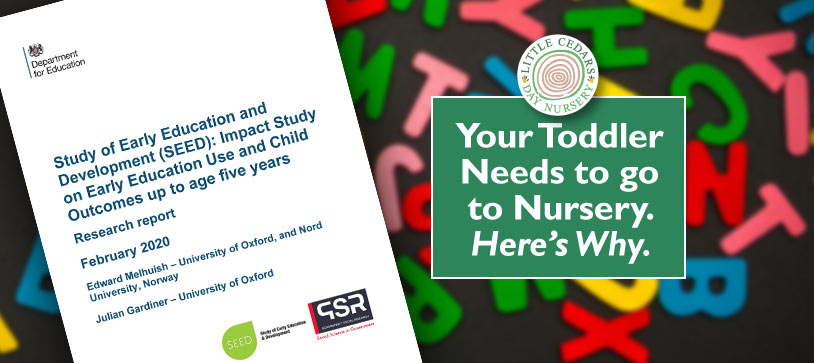
 There are compelling reasons why under-fives should attend early years education and childcare settings like nurseries or pre-schools, or their equivalent — before starting school. Missing this crucial stage in their early years education and development may disadvantage the child — a fact that’s backed up by various studies.
 Some of these benefits are even more pronounced for disadvantaged children who start to attend formal ECEC sessions no later than the age of two. The DfE impact study shows that 2-year-olds benefit most if they receive early education and care for an absolute minimum of 10 hours per week by the age of two. Three- and four-year-old children from disadvantaged backgrounds benefit most from no less than 20 hours per week thereafter in the run-up to the start of primary school at age 5. Children who follow this approach have better verbal abilities when they start school and are also much more likely to achieve expected levels of personal attainment during reception year at school. The studies show that, with ECEC’s highly appropriate, structured preparation beforehand, children are able to hit the ground running once they transition to school.
 As well as having a positive effect on children’s readiness for school, there is also compelling evidence that early years education at good nursery/pre-school type settings has a marked, positive effect on children’s long-term attainment levels there – and indeed on their lifelong outcomes. As such, early years education and care represents an extremely solid foundation for children’s futures in general.
 Are you looking at nursery/pre-school options for your baby or toddler?
 Welcome to our guide to free childcare available specifically via Universal Credit. This builds upon our previous childcare funding guides, giving parents yet another potential way to get financial help towards childcare costs. Which scheme suits you best rather depends upon your individual situation as each has its own rules for eligibility. If one scheme doesn’t fit with your situation, another may. You may even find that you can apply for multiple schemes in certain circumstances, and we’ll also touch upon that in this guide. (To view our previous guides on other funding schemes, see our
  To be potentially eligible for childcare help through Universal credit, you must live in the UK, be on a low income or out of work and be aged 18 or over (although there are some exceptions for 16 and 17 year olds). You and your partner, if you have one, must also be under State Pension age and have no more than £16,000 in savings/investments between you.
 If you have been offered new employment, you can ask for childcare costs for the month preceding the start of your new job. If you are coming to the end of your employment, you must inform the Department for Work and Pensions (‘DWP’) immediately. Help with childcare costs can be claimed at least a month after your employment ends to help you maintain childcare as you switch jobs.
 You can have more than one childcare provider. However, to apply for Government help with childcare you must use a registered/approved childcare provider. This generally means that the childcare provider is registered with Ofsted for England, The Care Inspectorate for Scotland or the
 The Tax-Free Childcare Scheme could save you thousands
 The Tax-Free Childcare Scheme is available to parents of children up to the age of 11 inclusive, or 16 inclusive if they’re disabled.
 Along with helping to fund nursery places at places like
  TIP: If you want the Government’s contribution to go into your account faster, your payment needs to be paid by Bank Transfer (rather than, say, via a debit card or standing order, although those still work fine if you don’t mind waiting a while longer for the Government’s corresponding contribution).