

Today’s post is an urgent reminder: if you want your child to benefit from free, government-funded childcare hours from January, you must apply for the funding no later than 31 December. That’s the case whether you’re a new applicant or an existing one for the types of childcare support that require a code. If you miss the 31 December deadline, you’ll have no code to give your provider — meaning they won’t be able to provide free childcare hours to your child for the whole of that term. So — time is of the essence! Today, we bring you more detailed information and a reminder of how and where to apply, so you’re not out of pocket or without childcare from the term starting this January.
“If you do not apply on or before the deadline, you will not be able to take up your entitlements in that term.” ∞
Which Childcare Funding Schemes Require a Code?
There are several ways the UK Government supports eligible children with childcare funding. Of those, the most popular childcare funding schemes in England that require a code are:
- 30 hours of free childcare per week for eligible working families with children aged from 9 months to 4 years inclusive. That’s 1140 free childcare hours per year. (Learn more).
- 15 hours of free childcare per week for disadvantaged children, aged 2, from households that receive some additional Government support — e.g., benefits like Universal Credit, JSA, Disability Living Allowance, and others. The 15 hours per week, for 38 weeks of the year, represent 570 hours of free childcare per annum. (Learn more).
Another popular scheme, which provides 15 hours of free childcare per week (570 per year) to all children aged 3 and 4 living in England, is known as the Universal Entitlement. However, this scheme does not require a code.
There are also additional schemes, for example, Tax-Free Childcare and support for student parents.
Confused About Which Childcare Support Your Child is Entitled To?
It can be confusing trying to work out which, if any, childcare funding/support schemes your child may be entitled to. However, the UK Government has a useful online tool that allows you to quickly and easily check what childcare support your child is entitled to. Click the bold blue link and answer a few simple questions. Within just a few moments, the options that apply to you will be confirmed.
“We recommend parents speak with their chosen provider about when they will be able to offer them a place.” — BestStartinLife.gov.uk
Check if a Childcare Place is Available
You will, of course, need to check whether a funded childcare place is actually available locally for your child. After researching local providers, check with your preferred childcare provider first — or with an alternative if your first choice has no availability for your child. Bear in mind that some providers also have waiting lists, so don’t leave it too late.
“If your chosen provider doesn’t have a place available, we advise that you explore other providers in your local area.” — BestStartinLife.gov.uk
Apply for Childcare Funding & Your All-Important Code
When you’re confident you know which type of childcare support you are entitled to, and have lined up a provider, you’ll need to apply for the funding and all-important code, where applicable.
- For childcare support for working parents, apply online on the Gov.uk website in order to obtain your code.
- For childcare support for disadvantaged 2-year-olds who receive some additional form of support, apply via your local council to get your code.
- For the Universal Entitlement scheme for all 3 and 4-year-olds living in England, contact your preferred childcare provider directly. No code is required, but you’ll need to provide your child’s birth certificate and sign a form.
You will need to reconfirm eligibility every 3 months, via your Childcare Account, to continue receiving the childcare funding/support. Emailed reminders will be sent to you 2 and 4 weeks before the deadlines for reconfirmation.
The Application Deadline
The deadline for applying for childcare codes is the last day of the month that precedes the start of the term. So:
- For the January term, apply for your code no later than 31 December.
- For the April term, apply for your code no later than 31 March.
- For the September term, apply for your code no later than 31 August.
That said, we urge families to apply ideally at least 6 weeks earlier than the deadline, not least because some childcare providers ask for codes earlier than the deadlines specified above. Applying early will also allow time to iron out any unexpected issues that may arise.
After Applying
After applying, most families find out whether their application is successful right away — and receive their code immediately if so. However, sometimes it takes longer, which is another reason not to leave applications until the last minute.
NOTE: Failure to successfully apply by the deadline will mean that your child is unlikely to be able to receive funding for that entire term.
DON’T FORGET: You will need to reconfirm your eligibility every 3 months.
Good luck with your application!
Nursery Places at Little Cedars Nursery, Streatham

 Are you looking for a childcare place in Streatham? If you have a baby, toddler, or child under five and live nearby, consider Little Cedars Day Nursery in Streatham for your weekday childcare. We are rated as a Good Provider by Ofsted, offer a home-from-home and nurturing environment for your child, and support various childcare funding schemes for eligible families. We also offer a stretched (51-week) provision that spreads free childcare hours over the whole year. As well as providing a childcare service to families in Streatham, we may also suit those living nearby in places like Tooting, Furzedown, Balham, Norbury, and Colliers Wood. Choose an option to get in touch today:


 Work at least 16 hours or more per week at the National Minimum Wage


 Last year,
  As well as helping families financially, the scheme expansion should help children begin their early years education even earlier, for many, which has been shown to be hugely beneficial to them. The free childcare provision will also help many more women back into the workforce. Children, families and the economy should all benefit.
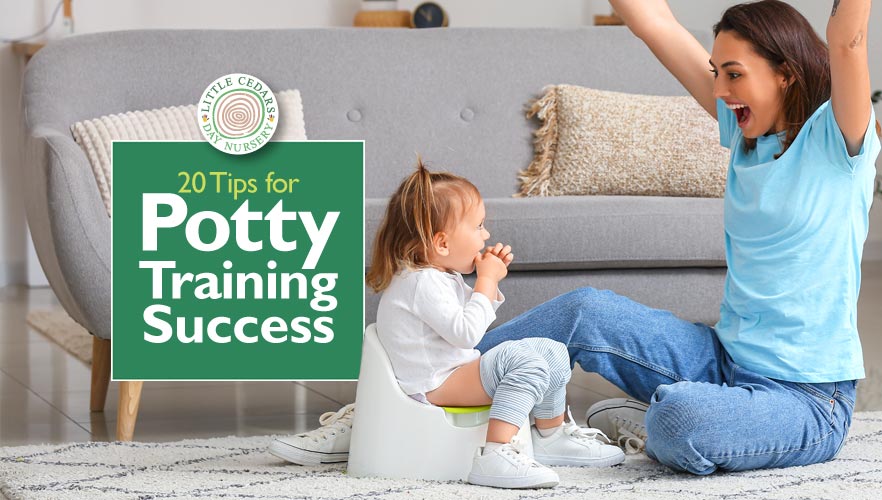
 Children are all different. They learn and develop at different rates to each other and that applies to potty training success too. Circumstances in each family are different too, and this will also have an effect. In other words, there is no hard and fast rule about the age by which little ones should have mastered the use of the potty. Parents should therefore not worry if their child is slower to master toileting than their siblings or peers. That said, some very rough guidelines will always be useful to parents and these follow.
 Allowing your toddler to help choose their potty can automatically make it less daunting and instead more of a ‘friendly’ thing to have in their life.
 Children can also be encouraged by having their own toy potties. They, and parents, can ‘train’ teddies and dolls to use these during play. Doing so will help them be both relaxed and more educated about potty training — even proactive.
 Don’t forget to make potty training fun! Many of these tips will help towards that, including the rewards idea (#4), praise (#5), characters on potties (#7), toileting-themed music (#8), and so on.
 household cleanliness, and for their independence.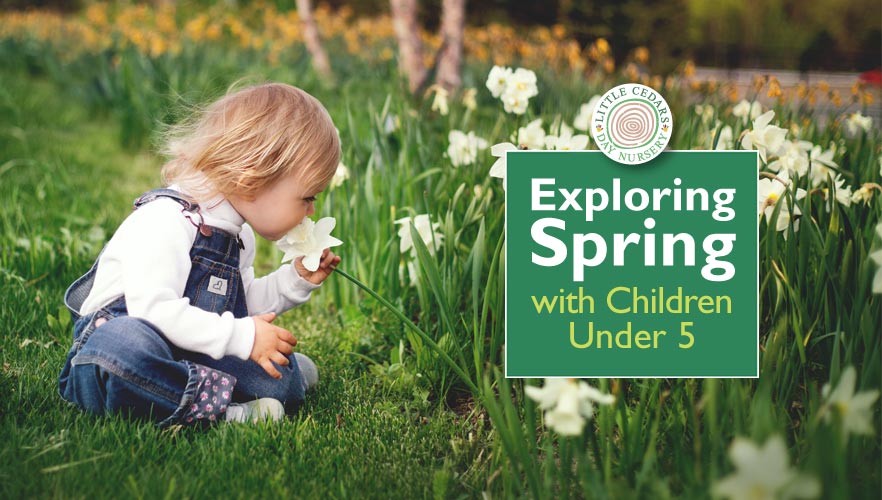
 At Little Cedars Nursery, Streatham, one of the activities we do with children around this time of year is to explore the season of spring. Spring is a wonderful antidote to the cold, winter months as new shoots begin to sprout from the soil, flowers start to reappear, birds begin to return from warmer climes and there are early indications of warmer weather ahead. Paying attention to such things when spring arrives can teach children a great deal about the world around them, nature, and the impact of the various seasons. It’s also a free, fascinating, and educational activity that parents/guardians can do with children. Families can, for example, explore the signs of spring in the garden, out on walks, in local parks, and in the countryside. With that in mind, today’s article looks at the type of things children and families can look out for during the season of spring.
 As every child knows, young lambs are an absolute delight. They’re incredibly cute and the way they play, group together with fellow lambs, and happily jump into the air is simply adorable! Although timing varies from farm to farm, most newborn lambs arrive during early spring — typically in March — with others arriving in April, particularly if they’re in UK areas further north where it can be colder. At Little Cedars Nursery, we try to ensure children get to meet some spring lambs or calves each year and it’s always a huge hit with the children.
 Another huge hit with children in spring is the appearance of frogspawn in ponds. Children will love watching the little eggs change over time, their contents growing from tiny black dots into creatures that have obvious legs, tails and heads. And, once they emerge from the eggs, the tadpoles continue to delight little ones as they gradually develop into tiny frogs. It’s a wonderfully magical thing for children to witness in spring and is also hugely educational.
 Snowdrops are one of the very first plants to reappear when spring arrives. They’re pretty little plants with slender green leaves and flowers that, as their name suggests, resemble delicate drops of snow. Young children will love that! Look out for them in gardens, parks, forests and hedgerows. Each plant generally forms a ‘bunch’ of around ten stems and they reappear every year. Warn children to look but not touch, though, as they are poisonous if eaten.
 Another of the earliest plants to appear in the year is daffodils. Their shoots begin to appear through the soil in February and, once spring arrives in March, their flowers will brighten up any garden, lawn, forest or flower bed right into May. Once daffodils are in bloom, you also know other plants will soon follow. So, they’re a great sign of the changing season for children to look out for, and a signal that gloomy winter is now over and summer is not far away.
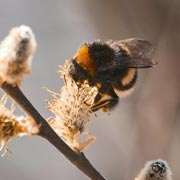 Bumblebees are amongst the cutest of garden visitors and many children will naturally love them, particularly once they’ve realised how adorable they are with their velvety bodies, sweet faces and attractive markings. They’re also peaceful little creatures, many of whom don’t even have a sting, who simply want to go about their business of collecting nectar from flowers. Bumblebees start to reappear in the spring — because flowers are also reappearing after being dormant over the winter months. They then become more and more populous as the months become warmer and can be seen right into autumn.
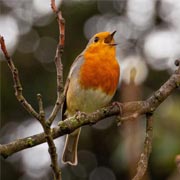 The return of many of the UK’s favourite birds is another wonderful sign that spring has arrived and winter is over. While some birds, including robins, may stay during winter, others will have migrated to warmer places, perhaps thousands of miles away. Once they return to the UK, children will be able to watch out for them and listen out for more birdsong. Early mornings and sunsets are great times to hear them, particularly when the weather is calm, meaning their sounds travel more clearly. For example, tiny wrens have an incredible and very melodic set of sounds. Robins are also beautiful to listen to. Thrushes sometimes sing at the tops of trees at dusk too, and that’s also wonderful to hear. Encourage children to watch and listen out for other birds too, for example, blackbirds, starlings, doves, blue tits, great tits and occasionally more rarely-seen birds like goldcrests.
 Buds on trees and bushes can also be an interesting natural phenomenon for children to look out for in spring. Many are quite beautiful if you take the time to have a close look. Young children are indeed fascinated by several types of tree buds in early spring and perhaps the most attractive one to them is pussy willow. For them, the soft, fur-like buds of the pussy willow are an instant hit and something that really draws their attention. They really do feel furry and it’s almost as if they’re little creatures or kittens paws — quite a magical thing for any child to look out for in spring!
 Catkins are also fascinating. Their little dangling fronds almost look like yellow caterpillars, so this is another type of spring occurrence to draw children’s attention to. From such attention, they can be taught lessons about pollen, seeds, nectar and the circle of life.
 Getting children interested in nature, and spending time around it, is extremely good for them as we’ve reported before —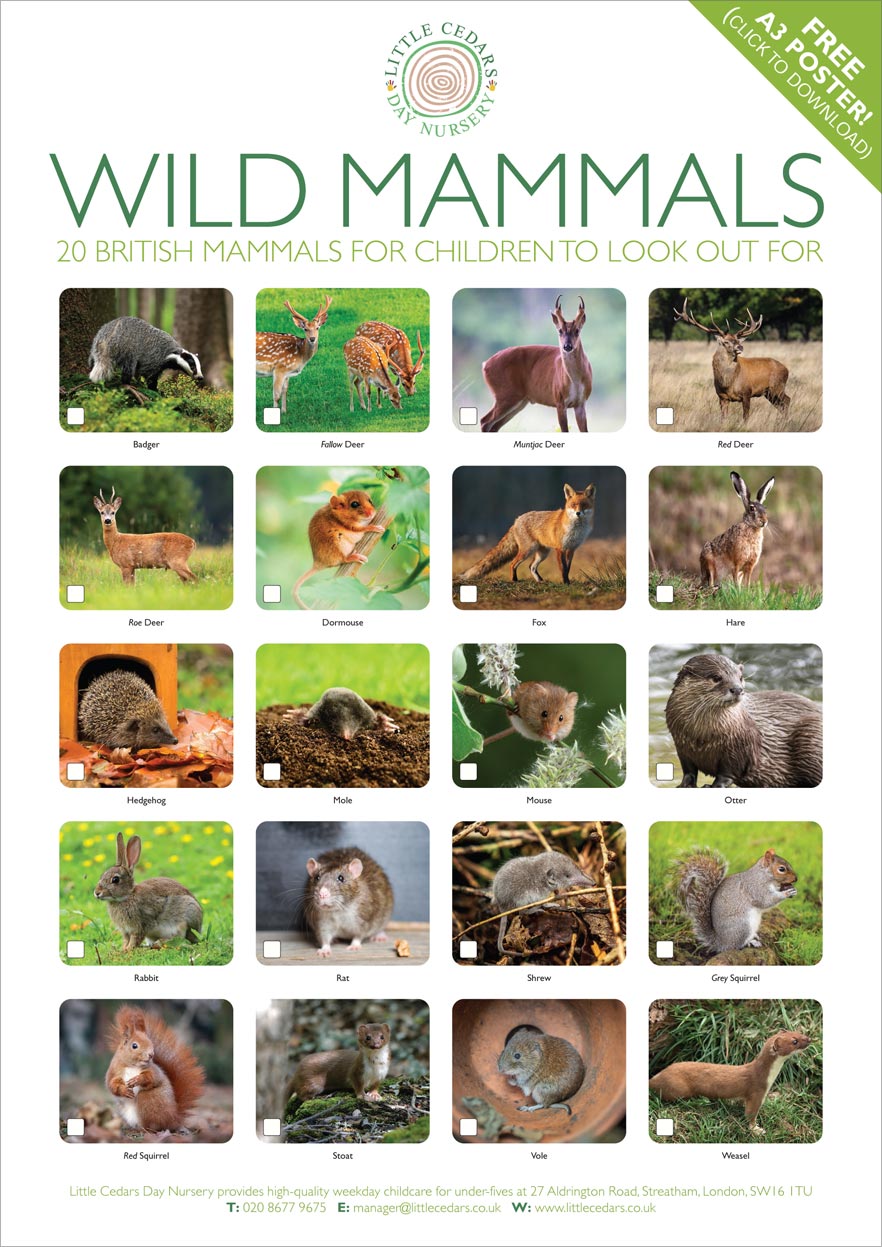
 World Wildlife Day celebrates the world’s flora and fauna. It happens on the 3rd of March each year and is a way to raise awareness of the need to protect nature. That can be achieved by reducing harmful emissions, pollution, habitat loss, and the loss of biodiversity. By introducing children to the beautiful wildlife around them, children will naturally be more empathetic towards other creatures and even progress to learning about conservation matters and the impact of humans on the planet. In this way, little ones can grow into young stewards of the planet and have an active interest in protecting it going forward. Get them started today by downloading our free Wild Mammals poster — who knows where it could lead!