

 The Government’s Early Years Foundation Stage (‘EYFS’) framework prescribes how adults should approach the education and development of children under five. As such, it forms the backbone of the curriculum at childcare settings like Little Cedars Nursery in Streatham. The EYFS guidelines were expanded this year (2021) and one aspect of early childhood development discussed therein merits closer exploration: the affect of adult interaction on an infant’s brain development. Here we take a look.
“A baby’s brain forms more than a million new connections every second when you interact with them.”
That’s an incredible statistic and one that was recently revised upwards, from a lower figure, by Harvard University’s Center on the Developing Child.
The centre explains that a baby’s brain develops through early experiences, not just because of inherent genetics. They go on to describe how experiences govern the architecture of the developing brain and form the foundation for all future learning, behaviour, and health.  Their research suggests that constructive experiences will build on and enhance the structure of the brain, whereas “adverse experiences early in life can impair brain architecture, with negative effects lasting into adulthood.”
It’s rather akin to the building of a house, starting first with the foundations during the early years and building on those gradually, to complete the full structure. The initial foundations of the brain may encompass things like control of motor function, hand-eye coordination etc. Further sub-layers of more complex skills are brought in on top, through billions of new connections generated in the brain, as the child grows and experiences more things. Interactions with adults are key to that.
Although it happens throughout an individual’s life, the growth in these new neural connections is by far the most prolific during the early years. Optimising the structure and depth of those foundations through varied and useful experiences during the early years is therefore incredibly important. Doing so ensures that the foundations for the individual’s future are strong.
How Can Parents Help With Infant Brain Development?
Serve & Return
 The Harvard Center on the Developing Child suggests that parents1 can help babies and toddlers develop their brain architecture in the best way through regular and strategic interaction between adult and infant. They call the process ‘serve and return’. Think of it as a tennis metaphor— we’ll explain. First, the child may indicate an interest in an object or activity. That’s the serve of the tennis ball, if you like. The adult should look out for such indications of interest, recognise them as a kind of invitation from the child and then get involved with that object or activity with the child. Responding in this way is like the ‘return’ of the ball in the tennis metaphor. It’s a great approach because the child is indicating what they are interested in and therefore, when a parent responds through activity involving themselves with the source of interest, the child will naturally get more from the interaction. After all, it was they who first indicated an interest and an adult can now help them to get the most from it.
What Kind of Things are ‘Serves’?
A ‘serve’ by the child could simply be them pointing to an object. Or it could take the form of discarding one toy or game and moving onto another. When they’re older, it could take the form of a question, of course.
The ‘Return’
In each case, the parent should join in and the two begin playing with and exploring the object or activity of interest to the child. With the adult involved, the child is able to get much greater insight about the activity or focus of attention. So, it’s about watching out for signals of interest from the child and interacting with them around that focus of interest. The research suggests that this is very effective compared to forcing other things onto the child that might, at that point in time, be of lesser interest.
It’s about watching out for signals of interest from the child and interacting with them around that focus of interest.
What Else?
 Repetition is also important. This helps to reinforce circuits in the brain. Reminding a child several times about something will naturally help them to understand and remember the point under scrutiny.
The ‘serve and return’ approach doesn’t only inform the child about objects and activities around them; such interactions with adults also teach and reinforce good social and language skills. They also nurture appropriate emotional responses in the child. Together these set strong foundations for the child’s growing cognitive abilities along with enhancing their general wellbeing, in readiness to build upon them at pre-school, school and ultimately the workplace.
The responses from parents need to be reliable and appropriate, of course; otherwise it could lead to sub-par learning and brain development and even possible behavioural issues. In the worst cases, where there is regular toxic interaction between parent and child, issues with learning, behaviour and physical/mental health can regrettably instil themselves in the child’s developing brain. Such outcomes can go on to adversely affect the whole life of the unfortunate individual.
Did You Know …
Conclusion
 The research, as well as a good dose of common sense, shows the incredible importance of parents interacting well with children from the moment they are born. Their interaction and guidance will help the developing child to understand themselves, the world around them, and their place within it. Millions of brain connections are built with every interaction, building healthy foundations upon which the baby will grow into a well-rounded individual with the requisite cognitive, physical, social and emotional skills to handle life. It all comes down to love, responsive and responsible care, with parents matching the infant’s signals and needs with positive, insightful responses. The reassurance and tools such interactions give the infant will allow them to confidently, safely and comfortably explore and learn about the world and, going forwards, their place within it.
Outstanding Childcare in Streatham, South West London
 If you are looking for a really good pre-school or nursery for your childcare in Streatham, please do consider Little Cedars Day Nursery. We offer high quality childcare in the London SW16 area, so are also convenient for those looking for the best nurseries, pre-schools and childcare services in Streatham Common, Streatham Hill, Streatham Park, Furzedown, Tooting, Tooting Bec, Balham, Norbury & Colliers Wood. Book a visit, register for a place, or get in touch for more information by choosing a button below:
1. We refer to parents throughout this piece for the sake of brevity, i.e. to avoid repetition. Parents is our placeholder to mean anything from parents to care-givers and guardians.

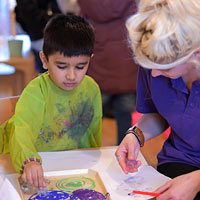
 Being let loose with coloured paints, art materials and creative opportunities is sure to bring a smile to their faces and a sense of enormous fun, creativity and discovery. No doubt too; they’ll be proud to show others their creations!
 As well as being enormous fun, messy play allows children to express themselves in unbounded creative ways. That’s important. Self-expression and creativity will help children to gain a sense of achievement and, through this subtle way, a greater sense of self-worth and confidence.
 Hand-eye coordination will also benefit, of course.
 We fully understand the many benefits of messy play at Little Cedars Nursery, of course. Indeed, it’s part of the curriculum. Under-fives are encouraged to learn through messy play using an enormous wealth of resources, equipment and materials at the setting. That’s both indoors and in our outside play areas. From paint and paper indoors to sandpits and water play outside, toddlers and preschoolers have a wonderful time with messy play at Little Cedars, all in a safe, structured, fun and educational environment.

 What are the Recommendations for Early Years Exercise?
 What are the Benefits of Early Years Exercise?
 How Parents can Help
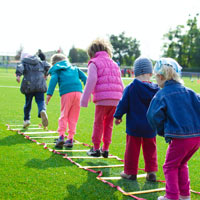 Active Play & Exercise at Little Cedars Day Nursery, Streatham
 Sensory Play Ideas for Babies
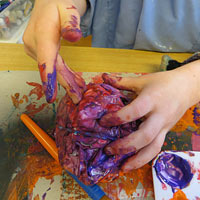 • Paper. Babies will love the feeling of scrunching up paper and will notice the sound as well as the contoured feel of their new creation. They may need a demonstration to get started, though. They’ll start to comprehend the concept that something in one form, like a pristine, wafer-thin sheet of paper, can be made into something completely different — in this case, perhaps a simple ‘ball’ of scrunched-up paper. Even
 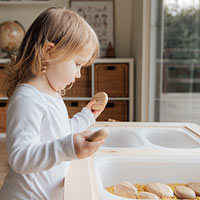 • Different objects & materials: babies will enjoy playing and learning about the properties, touch, feel and sound of different objects and materials. For example, (safe) wooden utensils, water in a closed beaker or bottle or small plastic or card boxes that they tap like a drum, or try to stack into a ‘wall’ — and so on. They’ll learn about physical properties of each along the way, including sounds, textures, touch and, if they include some carefully chosen food items, taste. It’s amazing what fun babies will have with such simple items — often learning far more from these than from purchased toys.
 • The natural world: babies also greatly enjoy the simple pleasures offered by the natural world. A breeze on their faces may greatly intrigue them, even more so when they see leaves rustling and moving a little on the ground. The feel and texture of grass on the lawn or the sight of sunlight dappling through the trees or reflecting off puddles can be wondrous to them. Under close supervision, getting to know the textures, hues and smells of safe, natural objects outdoors can also be a source of sensory discovery.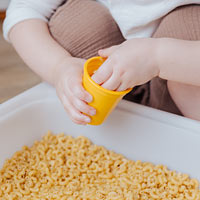
 • Hand & foot prints: preschoolers will never be bored with smothering their hands or feet in coloured paints, then making prints on paper or card. Footprints and handprints can be random or used to make images or patterns. This process is both creative and a sensory experience for them as the cold paint squelches between fingers or toes. They’ll learn so much including about mixing pigments, creating images from simple printed shapes, about the concept of paint eventually drying to form something semi-permanent and about different textures being formed, depending on the consistency of the paint. We take these discoveries for granted as adults, but we would originally have had to learn about them during our early, formative years.
 • Food creativity: toddlers can also take playing with food to the next level by introducing the concept of making images out of things like fruit- or vegetable-based sauces, cream or yogurt. Whole pictures can be made of food, using the hands, for example using broccoli for ‘trees’, peas for grassy areas and so on. The whole thing can smell great and even be tasted! Playing, hands-on, with food in this way can be fun and creative but also help children learn to accept new foods and tastes into their diets. However, care needs to be taken because proper mealtimes require good manners and children need to understand that food is not usually for playing with.
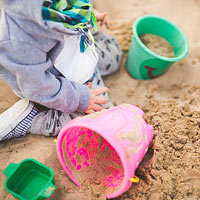
 • Sensory sand: it’s very rare for little ones to dislike playing with sand, which allows youngsters to get hands-on creatively. They can learn about the unique and varying textures, consistencies and properties of sand, depending on how much moisture it contains. Dry sand has its own unique set of properties, acting and feeling almost like a powder. Very runny, wet sand is great fun as it can be used to run through the hands and ‘set’ into pointy mountain shapes that look quite magical. Or, when less water is added, sand can be fashioned into shapes and, of course, “castles”, using the hands or by filling buckets, hollow vessels, or tubs. Children can also press their hands and feet into level, damp sand in a sandpit or tray, to make impressions and patterns. It feels great too and is an almost essential part of childhood. Young children learn so much from this stimulating, multi-sensory type of play.
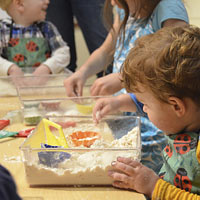 • Playing with dough: whether bought or home-made, dough is always a big hit with young children. It can be fashioned with the hands into shapes, characters, animals and mini-sculptures. Using food colouring in dough also allows children to discover more about mixing pigments. Salt dough can also be baked (under the close supervision of an adult) so that it hardens into more permanent creations. Many types of dough even smell great too! What’s more, it can even lead to a bigger interest in cooking real, edible dough and other baked foods when they’re a little older.
 • A sensory garden. We’ve left perhaps the best until last. Making a sensory garden area with, or for, little ones will give them a magical experience. There are so many materials that can be used in the construction of sensory gardens, including soil, earth, pea shingle, tree bark, moss and so on. Plants themselves will also add to the fascinating mixture of textures, colours and even smells found within a sensory garden. It can be as small or large as you have room for and can even be achieved in containers, pots or on balconies for those who do not have gardens. It can take many forms so it’s design also gives children a wonderful creative opportunity. Sensory gardens are a complete feast for the senses for young children — adults too — encompassing touch (e.g. the textures of materials, moss and plants), smell (why not include some herbs — these smell wonderful and can be tasted too), potentially sound (crunchy gravel, rustling leaves etc.), sight (aesthetics, colour etc.) and will also give children ample opportunity to improve balance and body awareness as they construct and create in this unique space.
 Sensory play is incredibly important for under-fives. Babies and young children benefit enormously when their play activities stimulate the senses and in this article we’ll explore those benefits in some detail.
 activities that involve touch, where babies and children can acquaint themselves with the feelings of temperature, softness, hardness, pressure, vibration, roughness, smoothness etc.;
 The Benefits of Sensory Play
 Babies and children are, of course, given a huge variety of sensory-based play opportunities at

























 Let’s first go back to the beginning. A sense of humour is apparently a learned aspect of a person’s character, to a fair extent. It’s something that develops and changes as a child gets older, rather than something they’re born with as a result of their DNA. As such, it’s important that babies and young children are given every opportunity to enjoy laughter and, while doing so, have fun with those around them. Laughing also is also closely linked to happiness, and being happy is, of course, priceless.
 Laughing helps children to develop better self-esteem;
 Improves mental health;
 The staff at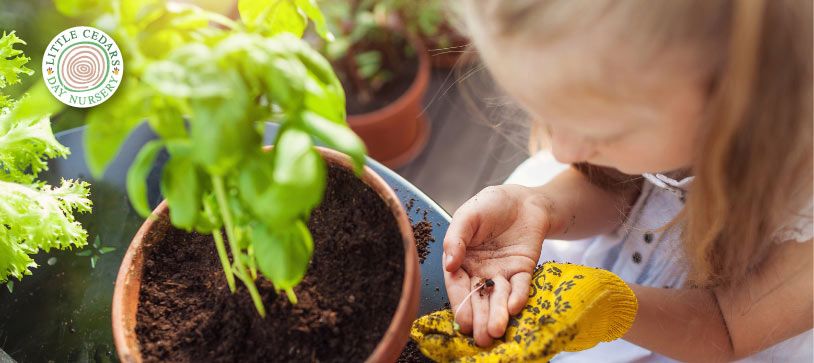
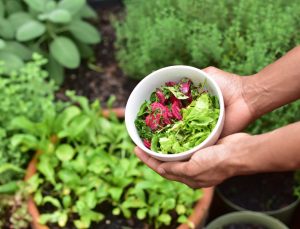 It may surprise some to learn that you can buy some vegetables and herbs just once and never have to buy them again. The secret is knowing which, and how to re-grow them. It turns out that it’s pretty easy, so we encourage parents to help youngsters get started. Once they see growing shoots or roots and, later, vegetables or herbs that the family can actually eat, they’ll be so pleased that they made this little miracle possible. What’s more, it will have taught them something about where food comes from, how to grow it sustainably and how to look after the living plants. If you’re really lucky, it may even encourage them to take things a step further and get involved in food preparation and cooking later on. It’s amazing, actually, where such a simple, fun, activity can lead!
 It’s possible, and indeed fairly easy, to grow your own produce even without a garden. So long as you look after your plants and give them water, soil and light as a bare minimum, they will grow. If you don’t have a garden, perhaps you have a small courtyard or patio where you can grow in containers. If you don’t have any outside areas at all, you can grow in flower pots and other containers on window sills, balconies, under skylights and so on. This makes growing produce possible almost anywhere, including in urban London in high-rise flats. After all, it’s in a plant’s nature to want to grow.
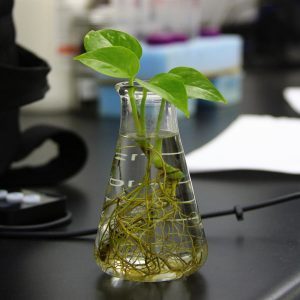 Children could start with green onions or spring onions. These are particularly easy to ‘re-grow’. Later, perhaps, the children can apply the same approach to celery, lemon grass, Cos lettuce and Pak Choy (a type of Chinese cabbage). Simply save an inch or so thick section of your shop-bought root vegetables (perhaps the last you will ever need to buy), which includes the bottom part at the root end. All your children need to do is to place that section, root end downwards, in a glass of water. Leave them in the water and, after somewhere between 1 and 3 weeks, roots will start growing. Children will love monitoring this process each day and they will enjoy looking after and caring for a living thing. Once the roots are substantial enough, children can take them out of the glass and re-pot them in soil, ideally with a bit of compost if you have any. This can be in containers, appropriately sized flower pots or in the garden if you have access to one. Before long, your plants will give your children more, free herbs and vegetables that you can all enjoy.
 Garlic cloves are also incredibly easy to regrow in a similar way. Perhaps at some point you’ve unintentionally allowed your shop-bought garlic cloves to ‘sprout’. Well, that’s how to start off. Rather than discarding them, your children can put them in water and allow roots to grow. Then, they should plant them out in soil and eventually they’ll end up with more, free, garlic cloves. What’s more, they will tend to taste more mild and delicate than shop-bought garlic — children will probably appreciate that. It’s the same with ginger roots, but allow months rather than weeks in their case.
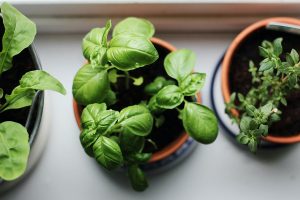 Herbs like Coriander, Rosemary and Basil can also be re-grown. Children can simply take scraps or clippings (4 inches long in the case of basil, 2-3 inches in the case of Rosemary) and place them in glasses of water in a well-lit spot on the windowsill. Once they have sprouted roots of about 2 or so inches long, these young ‘plants’ can be transplanted into soil or compost in pots. Your child will then be able to watch the plants flourish and grow into new herbs that can be harvested for food later on. The children will also soon discover that each of these herbs has a wonderful and distinctive taste and smell.
 Later, when growing sprouts reach the surface, the child should keep those covered with soil (this is called ‘hilling’). Get your child to keep the soil moist but not over-saturated over the subsequent weeks. If planted in the spring, your children should be able to harvest potatoes in the summer.
 Then, of course, your children can also experiment with nursery bought, or mail order seeds. Although not free, they’re reasonably inexpensive and also fun for children to grow if you follow the instructions and timing suggested on the seed packets. Beans of various kinds and sugar snaps are particularly easy to grow and usually result in an excellent crop. They will benefit from being in a garden or outdoor patio area, ideally, due to the space they require. They will need more vertical space than horizontal space, however, so even balcony planting may be possible if you have suitable grow bags.