
Today, we’re looking at what help is available for children under five with Special Educational Needs & Disabilities (‘SEND’, also sometimes referred to as ‘SEN and disabilities’). Good support for such children, particularly in their formative years, is of critical importance to their longer-term progress, well-being and success. Appropriate support, provided in a timely and tailored manner, can have a real, positive impact on outcomes for children’s lives.
An Environment of Inclusivity
It is important to foster an inclusive environment for children with SEND, including at childcare/early years settings like Little Cedars Nursery. Whatever their differences, we know it’s crucial for all children to feel safe, comfortable, valued, and loved, as well as being free to express themselves. It’s also important that all children, irrespective of ability/disability, are able to make friends and socialise freely. This is therefore nurtured at childcare settings like Little Cedars.
Changes can also be made to childcare environments like ours, where appropriate, to improve accessibility for children with special educational needs and disabilities.
Identifying SEND
 Identification of a special educational need or disability is, of course, the first step in being able to properly support a child with SEND. For this reason, good early years providers like Little Cedars Nursery will, as a matter of course, watch out for signs of things that might be challenging for children. As prescribed by the EYFS approach to early years learning and development, such assessment will occur as part of the day-to-day activities at such nurseries, preschools and early years settings, as well as during more formal assessments like the Progress Check at 2. Childcare practitioners, the Key Person allocated to each individual child, and the setting’s Special Educational Needs Coordinator (SENCo) will usually all be involved in all assessment stages.
Parents will be alerted to any suspicions and indeed should alert childcare settings if they have a SEND-related concern regarding their child. After all, parents may well have more insight, as they know their child best.
External professionals including health visitors, paediatricians and professional specialists and therapists can also be brought in to help with assessments if deemed appropriate. Only once a possible special need or disability has been identified and evaluated is it possible to look at appropriate support options for a child.
Developing a Tailored Support Plan
 Support plans for suspected or confirmed special needs or disabilities are then discussed and custom-designed for the child. Such plans will be agreed between the child’s parents/caregivers, staff at the early years setting itself and any external specialists or professionals involved in the child’s care. Such programmes will be customised to suit the individual child’s specific needs and may include tailored activities, strategies, resources and so on. Formalisation of the support programme will allow all parties to pull in the same direction, working cooperatively for the benefit of the child.
“Assess, Plan, Do and Review.”
Progress and the effectiveness of support plans will be evaluated continuously. Should the support plan require fine-tuning along the way, then adjustments will be made to suit the ongoing needs of the child. There is also possible recourse to request an Education, Health & Care (EHC) assessment of the child’s needs from the local authority if deemed appropriate and sanctioned by parents. Should one occur, then a new support plan may be devised.
Similarly, if the help of external experts is required, for example help from a speech and language therapist, this can be arranged as part of the support package for the child.
With the right support, “the great majority of children and young people with SEN or disabilities … can find work, be supported to live independently, and participate in their community.” (DfE)
Special Funding & the Area SENCo
 In parallel to the SENCo at the child’s early years setting, local authorities also have their own Special Educational Needs Coordinator, known as the Area SENCo. They will also be integral to a child’s SEND support plan, helping with coordination between the local authority, the various parties involved in supporting the child, and in relation to any special funding requirements. If approved, special funding might be required, for example, for an additional member of staff tasked with giving one-to-one support to the child, or to fund extra learning resources and activities for them.
Area SENCos also continue to coordinate support for children with SEND through the transition from early years settings to school.
The ‘Local Offer’ Information Portal
Every local authority publishes information that informs families about the support available in their area for children and young people with special educational needs or disabilities. This is encapsulated in what’s known as The Local Offer. A Local Offer example for Streatham may help to illustrate the kind of help and resources available. Little Cedars Nursery is in the part of Streatham that falls within the London Borough of Wandsworth, and their Local Offer for SEND can be found here.
Funded Childcare for Under-5s with SEND
Parents may be wondering whether any free childcare is available for children with SEND. Here’s a quick snapshot of some of the options:
 All 3- and 4-year-olds living in England are eligible for a minimum of 570 hours of free childcare per annum, irrespective of whether or not they have SEND. This is known as Universal Free Childcare or their Free entitlement and is typically taken as 15 hours of childcare each week over 38 weeks of the year, but how it is taken can differ. Learn more here.
- In some circumstances, the above entitlement for 3- and 4-year-olds may be extended to 1140 hours per annum, equivalent to 30 hours of free childcare over 38 weeks of the year. This is known as Extended Free Childcare or the 30 hours scheme but, unlike with Universal Free Childcare, is means-tested. Many more eligibility criteria also apply (learn more here).
- 2-year-olds with SEND may also be eligible for free childcare hours if they fall within one or more specific categories (learn more here). These include:
– Receiving Disability Living Allowance (‘DLA’);
– Being subject to an Education, Health & Care Plan (‘EHC’);
– Having received a referral via their local authority’s Portage Service. - Parents of disabled children may be able to claim for free childcare support valued up to £4,000 per year through the Government’s Tax-Free Childcare Scheme. Learn more here.
 All 3- and 4-year-olds living in England are eligible for a minimum of 570 hours of free childcare per annum, irrespective of whether or not they have SEND. This is known as Universal Free Childcare or their Free entitlement and is typically taken as 15 hours of childcare each week over 38 weeks of the year, but how it is taken can differ.
 More information about various Government-funded childcare schemes is available in our rough guide to childcare funding here.
Nursery Places at Little Cedars Nursery, Streatham
Little Cedars is a Nursery & Preschool in Streatham, London SW16


We support all Government-funded childcare schemes for eligible families at Little Cedars. We also endorse all the above support measures aimed at helping children with special educational needs and disabilities. We are officially a good nursery, as benchmarked by Ofsted. Our nursery and preschool are located in Streatham, London SW16 although we are also conveniently close by for families in Streatham Hill, Streatham Common, Streatham Park, Furzedown, Tooting, Balham, Norbury, Colliers Wood, West Norwood, Wandsworth, Clapham and Brixton.
If you would like to apply for a nursery place for your child, ask any questions or book a tour with your child, please select an option below:
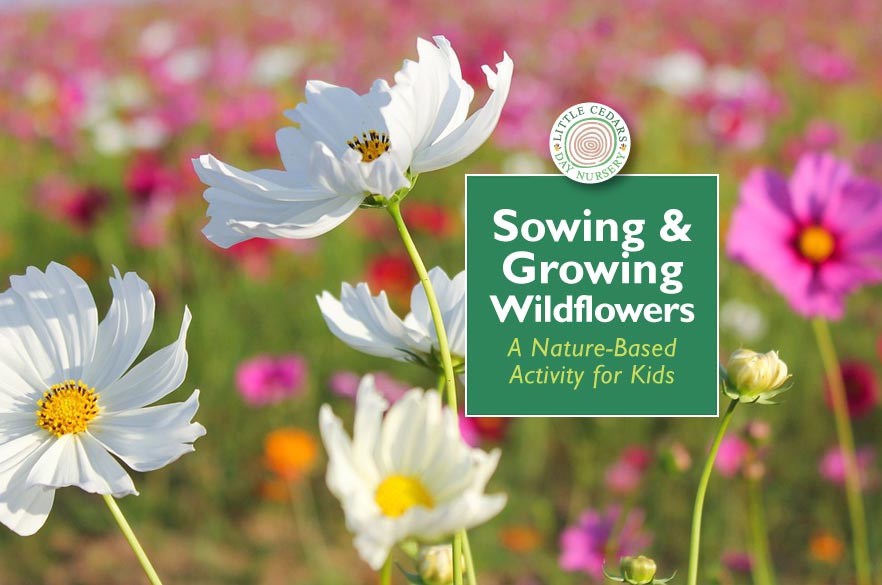
 In today’s guide, we outline a simple but powerful nature-based activity that will be both fun and educational for children and under-fives. This one is all about how to sow wildflower seeds. Once growing, these will bring beauty and wonder to any setting. The activity will also complement our recent
  Children benefit very much from spending time in nature, as we outlined in our article entitled
  Colour(s) — Children can help decide whether to grow wildflowers of just one colour, a limited 2- or 3-colour palette or perhaps multiple colours. If parents have an existing colour theme in their garden or plant area, they may wish to point children in a particular direction, so as to keep that colour theme going.
 Free wildflower seeds can be harvested from existing wildflowers — either from your own wildflowers if you have them, or from those found in the wild along hedgerows and similar (N.B. only do so in moderation and for personal use). Timing will, of course, be critical because seeds will only be available at certain times of the year, i.e. when the wildflowers have “gone to seed” at the end of their flowering period.
 Sowing seeds on existing lawns that you/your child want as a wildflower meadow is simply a case of scattering seeds on the lawn, ideally spaced out in such a way that they don’t have to compete with each other once they start growing. Then ensure that the area of lawn is kept moist by either rain or, if there is no rain, regular sprinkling from a watering can fitted with a sprinkling head (a.k.a. ‘rose head’). Children may need to remind adults not to cut the lawn thereafter, of course!
 Children will love it once the wildflowers begin to grow and later bloom. They’ll also love seeing bees, butterflies, and other insects visiting and the results of the activity may indeed give them a great sense of accomplishment. The whole process and the results are quite magical when you think about it.
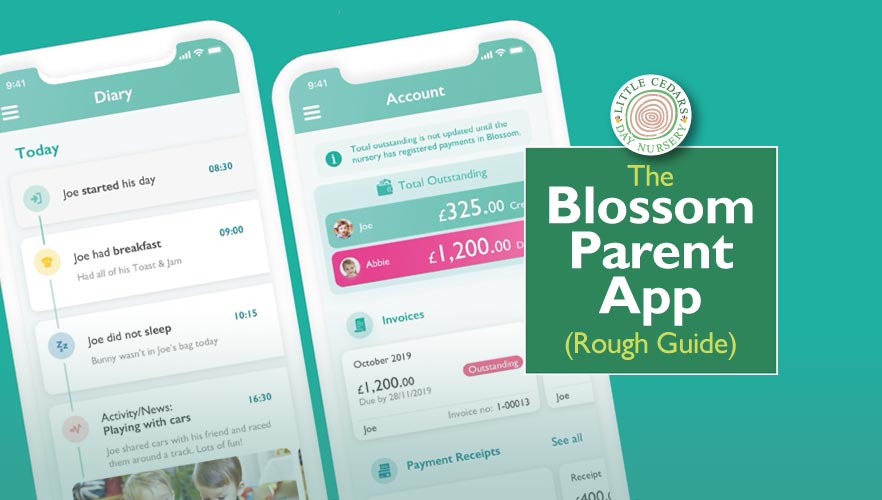
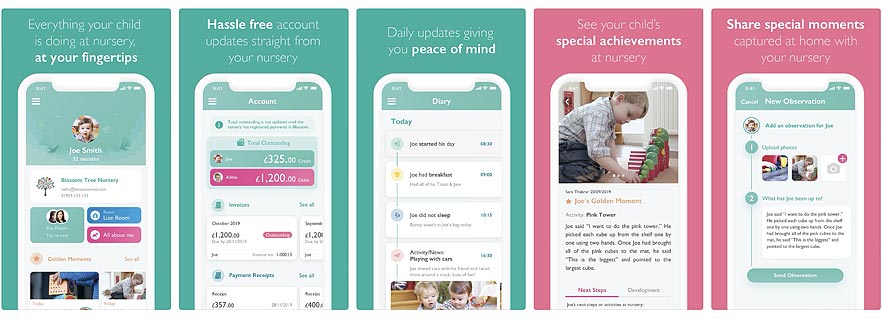
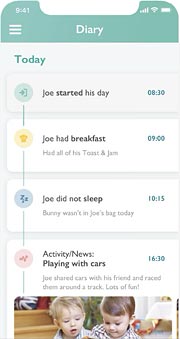
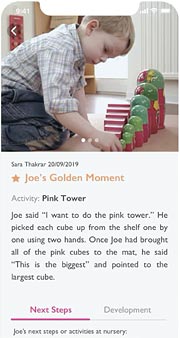 With the Blossom app, you can get real-time updates on your child’s activities at nursery/pre-school, including nappy changes, meals, naps, and developmental moments. You can also view photos and videos of your child’s day, helping you feel connected to your child even when you’re not there.
 The Blossom app also provides a useful mechanism for booking non-standard childcare sessions that fall outside of your child’s usual days and hours. With the app, you simply request a particular session and the childcare provider will see your request and let you know whether it’s approved.
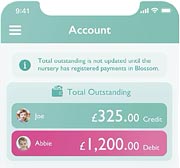 Convenient Payment & Invoicing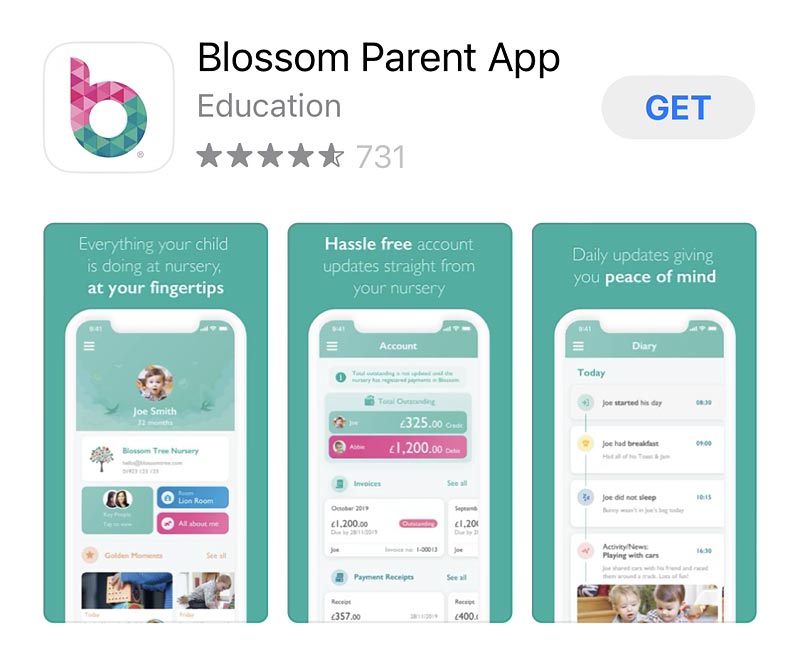
 With Universal Free Childcare, children aged 3 or 4 can receive up to 570 hours of free childcare over the course of the year.
 With Extended Free Childcare, eligible 3- and 4-year-olds can receive up to 1140 hours of free childcare per year instead of only 570.
 Some disadvantaged children aged 2 can also receive up to 570 hours of free childcare over the course of the year.
 For those that are eligible, up to £2,000 in free childcare is available each year to children aged 11 or under* through the Tax-Free Childcare scheme.
 You can sacrifice up to £55 per week of your earnings, which will be free of National Insurance and Income Tax, to fund Childcare Vouchers.
 Following the Spring Budget 2023, childcare funding through Universal Credit is to be improved with nearly 50% more generous funding becoming available from July 2023.
 Those already claiming for childcare costs via Working Tax Credits may be able to obtain up to £122.50 for one or £210.00 for more than one child each week.
 2-year-olds may be eligible for the ’15 Hours’ scheme from April 2024.
 Up to 85% of childcare costs incurred by students may be claimed, up to a maximum of £188.90 per week for 1 child or £323.85 for 2 or more (correct for academic year 2023-2024).
 Up to £160 per child is available each week for those living outside London.
 While it’s not designed to fund childcare, it can be used to do so in some circumstances.
 March 15th 2023 saw the Chancellor of the Exchequer’s Spring Budget announcement, which included news of extra funding to cover costs for childcare. Crucially, the new funding will support childcare for infants as young as 9 months old for the first time, as well as including other positive changes. Although it’ll be introduced in stages, the free funding should be welcome news for those parents who will be eligible. Let’s take a look today at the proposed childcare changes, including which age groups will benefit, what extra funding is promised to support families and when the new help will become available. First, though, we’ll look at the main aims of the new funding.
 The ‘main event’ in the Spring Budget from the perspective of childcare provision is the significant expansion of the ‘free hours’ schemes. Previously, only
  Some struggling parents in receipt of Universal Credit childcare support, who would like to move into work or increase existing working hours, will have subsidised childcare costs paid in advance under the new proposals. This is in contrast to the existing approach where all parents had to pay for the childcare upfront and then reclaim the costs retrospectively. Funding the childcare costs in advance will make the subsidised childcare costs much easier for the lowest-income families to afford from a practical, cash-flow point of view. It will also hopefully improve the situation whereby, currently, only 13% of eligible low-income families actually claim the childcare element of Universal Credit.
 Although this website and our childcare service are geared to the early years age groups, it would be remiss of us not to include a brief overview of the enhancements that are being introduced for children of school age. These are coming in via proposed changes to what is known as ‘Wraparound Care’ as we’ll explain.
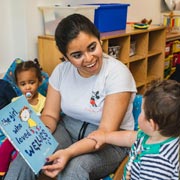 Milestones are a crucial thing to monitor when you’re bringing up a baby or young child. Speech is an important one and it’s one that parents would be wise to take stock of at regular times in their child’s early years. Today we look at this milestone at around the age of 30 months. So, what should you expect your 30-month-old to be able to say at this age and, if appropriate, how can you encourage them to speak more? Let’s explore speech milestones at 30 months…
 The more ‘chatty’ time you have with your toddler, the more they will naturally get involved — and learn from you. Talking to your toddler facilitates good listening skills and helps them to build up their own vocabulary, particularly when you make physical reference to the things you are talking about. In this way they can associate a word with its physical equivalent (e.g. holding up or pointing to an object that you’re talking about).
 Use repetition. This helps your toddler through hearing the same words over and over again. They will copy and get used to which words go with which scenario in this way. You can take this a step further too…
 The same applies to books. Get your toddler to point out details in pictures sand repeat the words after you. You can also ask your toddler questions about the book and get a conversation going, for example, whether they know a particular character, a particular object or a colour. Point to details and see if they know the word, or say the word out loud and let them repeat it.
 Improving Education for Disadvantaged 3- & 4-Year-Olds
 To be eligible for the EYPP funding, a child must meet certain criteria:
 After checking eligibility, interested families or guardians can either
 In today’s post, we look at the importance and benefits of periods of ‘quiet time’ for toddlers and children under five. Toddlers are busy little people, often rushing around, going from one toy or activity to the next. They’re at a stage where they realise the world is an exciting place and often want to experience it all at once. However, when they are so ‘on-the-go’, playing and learning from everything and everyone around them, their brains and body have a lot to take in and process. It can be extremely tiring! So, this is where some much-needed quiet time often comes in, bringing with it a whole range of benefits. Studies also back this up.
 With so much going on around them, children’s young senses of sight, hearing, touch and smell are experiencing a full-on assault. Their minds are also being challenged with learning new skills. This can all be very tiring for our youngsters, so a period of quiet time will give them a break, to allow them to breathe and unwind.
 After prolonged activity or concentration on the part of the child, a well-earned nap may well be on the agenda. As well as giving the toddler a chance to re-charge their batteries,
  Quiet time provides an opportunity for children to develop their own, natural creativity. During quiet time, they have the opportunity to make up a game or activity, without intervention from others. This time is totally unstructured too, so children can be as free as they like to explore and adapt the game or activity. They can create their own little environment and immerse themselves in their own new world. Their imaginations are set free and opportunities to be creative will come naturally.
 As we can see above, during quiet time, children can engage in activities that they have chosen for themselves. This can greatly help them to become more independent and self-reliant. That’s a great skill for them to develop as they approach the time to transition to school. There, they will need to rely much more on such skills.
 When you first introduce quiet time to your child, start slowly and begin with short periods each day. This can be increased as your little one gets used to it.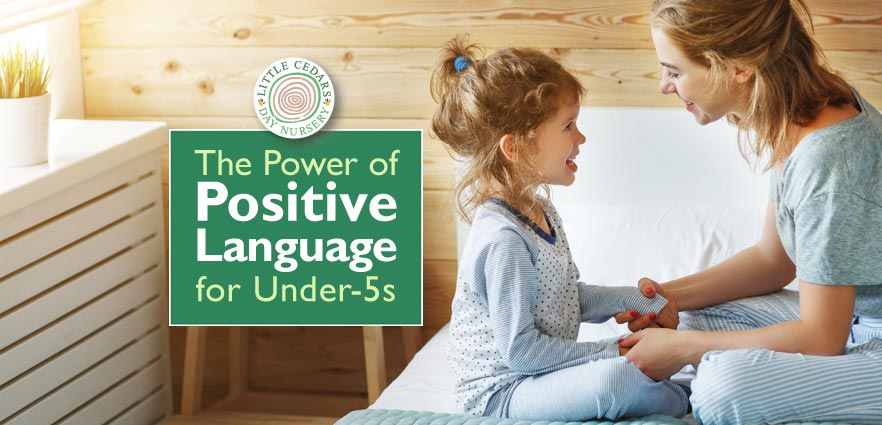
 In today’s post, we explore the benefits of using positive language around under-fives. All too often, it’s tempting to say ‘No!’, ‘Stop that!’ or even ‘Don’t Eat That!’ and similar around little ones. This is particularly true when you want them to cease the offending activity urgently or are simply exhausted if it’s been a challenging day. There are good reasons for such negative commands, of course, not least that of their safety in many cases. However, such commands can sound stern and cause stress for the little ones. What’s more, if a child hears too much negative language and cannot understand why they’re not allowed to do a particular thing, problems can begin to arise and, indeed, the issue can become insidious. It may even result in worsening behaviour. Let’s explore, therefore, the issues around negative language and the simple solution that’s available in the form of positive language.
 Sometimes, though, constantly hearing ‘no’ can spark tantrums, particularly if a child doesn’t understand the reason they are not allowed to do something. They can feel particularly frustrated when they receive a succession of negative commands and, in the end, may feel they simply can’t do anything right. This can lead not only to stress for them, but also to possible low self-esteem. Furthermore, if they hear ‘no’ and other negative language too often, they can begin to ‘tune out’ to it. They could then go on to develop challenging behaviour due to this, their confusion and frustration. Stress levels can then rise for the parent too, the infant can pick up on this and it can become a real vicious circle. It doesn’t have to be that way, though …
 Stop shouting!
 Please use a much softer voice.