

When women have a new baby, they will need to take time off work to give birth and to look after the newborn during their first weeks or more. It’s a precious time for both mother and baby and the good news is that employed mothers are legally entitled to maternity leave under UK employment law.  Today, we’ll take a look at how much time and money mothers are entitled to under Statutory Maternity Leave and what the eligibility requirements are. We’ll concentrate purely on the rules for mothers who are employees in this post. However, we will follow up to cover paternity leave, shared leave and support for self-employed mothers separately, in future guides.
Statutory Maternity Leave Entitlement
Eligible mothers are entitled to take up to 52 weeks of Statutory Maternity Leave:
- The first 26 weeks (i.e. first 6 months), known as Ordinary Maternity Leave;
- The last 26 weeks (i.e. months 7 to 12), known as Additional Maternity Leave.
These are the statutory maximums, i.e. mothers do not need to take all 52 weeks off. However, they must take off the first 2 weeks from the date of birth as a minimum, or 4 weeks if they’re factory workers. (They can also arrange to share some of the remaining 50 weeks of their leave with their partner under Shared Parental Leave (‘SPL’) rules, which we’ll cover in the future).
Timing
Statutory Maternity Leave can begin up to 11 weeks prior to the baby’s anticipated due date. It must, however, begin no later than the day after birth if the baby is born early. For eligible mums, Statutory Maternity Leave (& Pay) must also start automatically in the event that the mum-to-be is off work for a medical illness, related to pregnancy, during the 4 weeks prior to the week the baby is due.
Eligibility
 The good news is that, to be eligible for Statutory Maternity Leave in the UK, just two main rules apply. You need to:
a). officially be an employee of a company 1 and
b). give your employer the right amount of advanced notice.
How long you have been employed is not a factor and it also doesn’t matter what you are paid or how many hours you work.
1. Not a ‘worker’, ‘contractor’, ‘office holder’ nor ‘self-employed’ (like a sub-contractor) under UK employment tax law.
Notice should be given at least 15 weeks before the baby’s due date. The notice may need to be in writing, depending on your employer’s preference. It needs to confirm the baby’s likely due date and when you would like to begin the maternity leave. Once notified, your employer then has 28 days to officially confirm the beginning and end dates for that leave.
Statutory Maternity Pay (‘SMP’)
 Statutory Maternity Pay (‘SMP’) is available to mothers who:
- earn £120 minimum per week on average;
- have given their employer proof of pregnancy (usually an MATB1 certificate or letter from their doctor/midwife);
- have given their employer the correct notice (min. 28 days) of going on Statutory Maternity Leave;
- have worked for their employer for a minimum of 26 weeks (6 months) including into the 15th week preceding the anticipated due date;
- have not been in police custody during the SMP period.
Those whose income has dropped below an average of £120 per week due to being on furlough during the pandemic may still be eligible for SMP.
How Much Do You Get?
You can receive SMP for up to 39 weeks. For the first 6 weeks, you receive 90% of your average gross weekly earnings. For the remaining 33 weeks if you take them, you receive the lower of £151.97 per week, or 90% of your average gross weekly earnings. They’re paid to you from your employer with tax and National Insurance deducted as if they’re part of your usual wages or salary. (Figures correct at August 2021).
Your Employment Rights
When you are away from work on Statutory Maternity Leave, a number of statutory employment rights are still protected. These include your right to a possible pay rise, your right to accrue holiday leave and your right to return to work when your maternity leave comes to an end.
Company Maternity Schemes
Some employers have their own Maternity/Paternity schemes. These must be at least equal to the statutory leave and pay schemes, however, many offer even greater allowances and benefits. So, always check with your employer or HR department to see what may be available.
Try the Online Tool
 There’s a great online tool that you can use to check whether you are eligible to claim maternity/paternity leave and pay (as well as Maternity Allowance, which may help self-employed mums). It’ll also calculate how much you could receive. Head over to the Government tool here, ensure you have everything ready in the ‘Before you start’ section and click the green ‘Start now’ button.
If You’re Not Eligible
If you’re not eligible for Statutory Maternity Leave or Pay, other Government help options may be available. For example, for the self-employed, those who have recently stopped working, or are receiving one or more benefits. Click the bold blue link for more details.
Unpaid Parental Leave
Did you know that it’s possible to take unpaid parental leave if your child is under 18? In fact, eligible employees are entitled to up to 18 weeks off work before their child reaches the age of 18. Rules apply, of course, including a maximum of 4 weeks of unpaid parental leave being allowed in any one year. We cover eligibility and the finer detail in a separate post, so click the bold link earlier in this paragraph for the complete picture.
Outstanding Childcare in Streatham, for Your Baby, Toddler or Under-5
 Are you looking for a high quality nursery in Streatham for your baby, toddler or under-five child? Little Cedars Day Nursery offers outstanding childcare in Streatham, close to Streatham Common, Streatham Hill, Streatham Park, Furzedown, Tooting, Tooting Bec, Tooting Common, Balham, Norbury & Colliers Wood. We’re one of the very best nurseries in SW16 and open on weekdays throughout the year. We’d love to show you and your little one around, so you can see the setting in action, and to answer any questions that you might have. Please select an option:

 Recent studies show that use of connected screens and devices by children, including under-fives, is growing fast. The pandemic appears to have increased kids’ screen use too, as children have spent more time indoors and less time playing ‘in person’ with friends.
 Over 75% of children under five have access to a connected device, with up to 60% of preschoolers actually owning their own.
 “Parents have always played a huge role in curating what [under-fives] consume and how their time is spent, but toddlers are now confidently navigating digital platforms for themselves, and using touchscreen devices with purpose and determination.” (Childwise)
 that the ‘RF wireless radiation’ emitted by Wi-Fi connected screens and devices may carry potential health risks particularly, they argue, for pregnant women, their unborn foetuses and the young. The very young, of course, have brains that are still at a critical development stage. For this reason, the experts concerned advocate that access to devices like mobile phones should be limited, removed from children’s bedrooms at night or, at the very least, placed in Flight Mode when possible. Using devices wired instead of using Wi-Fi apparently reduces risks. Use of them in hands-free mode is another useful approach, so that the devices are not so close to youngsters’ heads. We’re not experts ourselves, but these measures seem like sensible precautions.
 While time spent by children on connected screens and devices is rising, it’s not all bad news. The pandemic has also seen an increase in the time that parents have been spending with children, including on shared screen viewing as well as on other pastimes like baking, crafts and family activities. At the end of the day, it’s all about a healthy balance and, of course, adult supervision to ensure children’s wellbeing at all times.
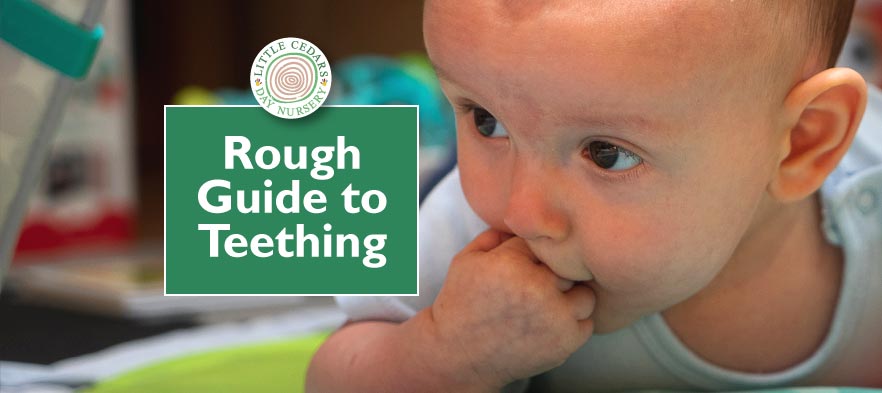
 Teething can be an uncomfortable and painful stage for babies. As teeth start to come through, gums can become sore. Because of this, the little ones can become irritable and emotional, without really understanding why they’re feeling as they do. Every parent will know that having an irritable, tearful baby can be stressful for parents as well as for the baby. With all of this in mind, our Rough Guide to Teething should help parents to help their babies through this difficult stage.
 Along with the bluish-grey colouration in the gums mentioned above, other signs of a teething baby include drooling, sore-looking gums, red cheeks, the baby being tearful, rubbing their ears or chewing hands/toys more than usual. If the baby does drool, ensure that their faces are regularly wiped so as to avoid painful rashes causing further discomfort.
 Once your baby has one or more teeth showing through the gum, you should start brushing their teeth right away. This typically happens at the age of about 6 months. Take a look at our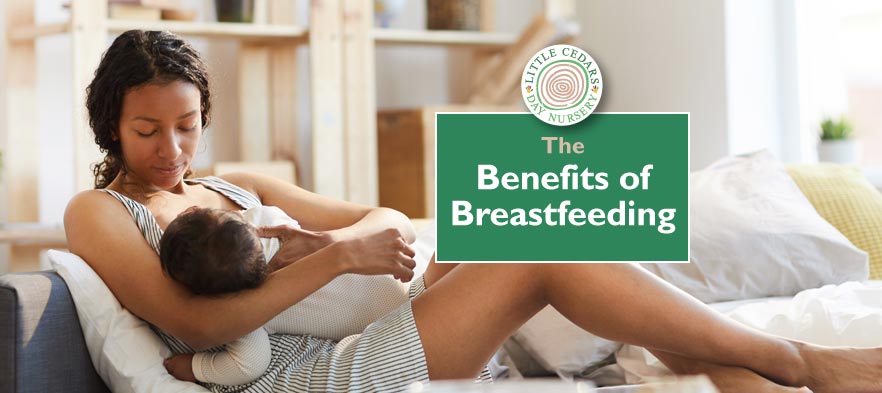
 Babies benefit enormously from breast milk; from simple, practical considerations to major health benefits, many of which continue to benefit them into adulthood. Let’s take a look:
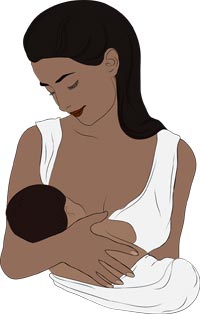 Breastfeeding also has a range of significant health (and other) benefits for mothers. These include:
 The childcare professionals at Little Cedars Nursery are keen to fall in with the wishes of parents when it comes to baby and infant milk. To that end, parents are free to supply
 Also known as complementary feeding, weaning is an important milestone for any parent or baby and usually occurs when the baby reaches the age of about 6 months. Sometimes babies simply tire of milk and weaning thereby comes naturally. In other cases, a baby needs a bit more encouragement to make their transition towards solids. Here, we’ll explore the whole topic of weaning in more detail, including ways parents can help to make the transition smoothly and stress-free for all parties.
 Weaning should be fun and it’s also the only time in a child’s life where they won’t have any preconceived ideas about what foods they “do or don’t like”. So, parents can experiment, within reason of course. It’s a time when introducing new foods to the baby comes naturally once the baby has caught on to the idea of this new experience.
 Don’t rush it; set aside some time with baby so it’s relaxed, otherwise everyone can get stressed, especially initially.
 You can later move on to whole, (adult) finger-sized pieces of very soft fruits that baby can learn to hold. However, do read the Health & Safety Considerations section below before moving to un-mashed foods.
 Huge care needs to be taken to avoid giving infants anything that’s going to represent a potential choking hazard. Whole grapes, cherry tomatoes or anything else of a similar size would be examples of this as they are perfectly sized to block a baby’s airway if not first chopped up. Also avoid anything hard like nuts, raw vegetables or un-mashed apple and ensure that any pips/seeds/stones are removed from fruit and bones are removed from fish or meat.
 Always try to maintain a varied diet for the infant, so they get all the vitamins and nutrients they need as they intake less and less milk. Ensure the foods contain sufficient iron, which can be sought from fortified cereal, fish, milk, dark green vegetables, lentils and beans. Giving them finger foods to hold and eat themselves is a great way to encourage them to feed themselves (under supervision, of course). As they grow older they can be encouraged to eat at the family table with parents/siblings and eventually upskill to using cutlery, along with eventually learning the rules around good table manners etc.
 In April last year, we published a compelling article about
  Reading with children also makes the task less daunting, particularly for the youngest children. Reading together also makes it more interesting and more fun. When it’s more interesting and more fun, the child is going to enjoy it more and naturally want to read more often — eventually independently — and all of that is priceless as part of their education and general knowledge going forwards. Reading can also bring parent and child closer through the time spent together. It can be great fun for the adult too, particularly when the child gets older and adults are exposed to classic children’s books that perhaps they were not, themselves, exposed to when they were young.
 The Nuffield Foundation’s mission is to advance social wellbeing and educational opportunity. In a partnership with the University of Newcastle, the foundation funded a deep study
 It will come as no surprise, therefore, to learn that we put all of the above into practice at Little Cedars Nursery in Streatham. Getting closely involved in children’s reading, using a huge variety of reading material in an interactive way, gives our nursery children the very best start in life. Indeed, our childcare professionals prepare them thoroughly for school by the time they leave us. They take with them reading, writing, literacy, language, vocabulary and self-expression skills in the process — and all this accomplished at least in part through guided reading.
 What are the Recommendations for Early Years Exercise?
 What are the Benefits of Early Years Exercise?
 How Parents can Help
 Active Play & Exercise at Little Cedars Day Nursery, Streatham
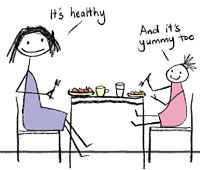 Are you pregnant, or a parent with a child under four? If so, your family may be eligible for free healthy food, milk and vitamin supplements. In England, some of these free items are available under the ‘Healthy Start’ scheme, which we’ll explain in this quick-start guide.
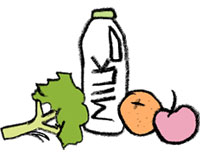
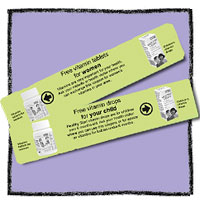 Eligible individuals can get the following, absolutely free:
 The infant formula milk:
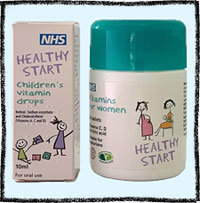 These free vitamin supplements are important for pregnant women, breastfeeding mums, babies and young children because many are deficient in them at this stage in their lives.
 In order to be eligible for Healthy Start vouchers, you need:

 These are significant benefits, so high quality sleep — and the right amount — is incredibly important.
 ‘Sleep Hygiene‘ is a term that refers to the whole routine around bedtime and sleeping, including important preparation measures during the run-up to bedtime A good sleep hygiene regime will help children get to sleep and to sleep soundly.
 The biggest message is that setting up — and sticking to — a set bedtime routine will greatly help with the quality of your child’s sleep. It sets a pattern that their minds and bodies will become used to naturally. A regime of this nature can include winding-down activities like a warm bath or shower, a peaceful book-reading session, dimmed lights and so on in the approach to bedtime. The routine will prepare them automatically for sleep even during the run-up to actually sleeping.
 At Little Cedars Day Nursery in Streatham, we understand the importance of sleep, particularly for babies and the youngest of the children. For that reason, we ensure that children have the opportunity of a nap both in the morning and in the afternoon. For example, babies sleep for about half an hour to an hour around 9.30am and then again after lunch, for 1 to 2 hours between about 1pm and 3pm. Preschoolers don’t have to sleep if they don’t want to, but are given the opportunity to do so — every child is different. We also take a lead from parents who may prefer their child to keep to a particular sleep pattern. If you would like more information about this topic, and how we approach it at the nursery, please do get in touch.