
Nature & Its Incredible Importance to Children
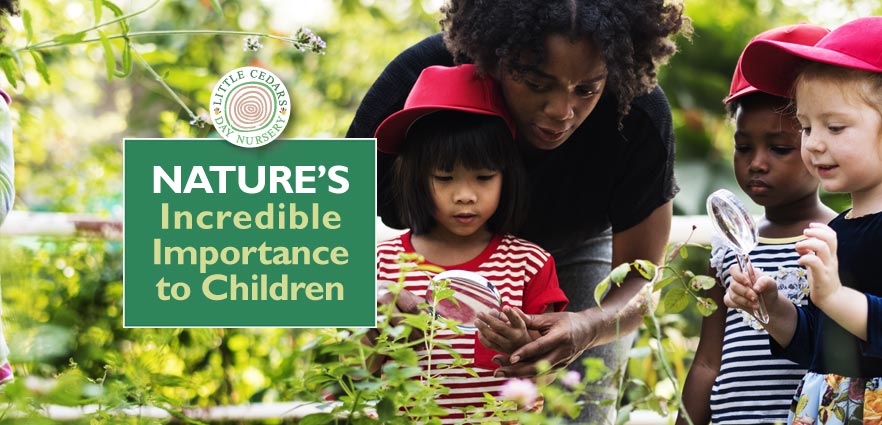
 It’s amazing how much nature benefits children, particularly in their early years when they’re finding out about the world around them — and also learning about themselves. There have been many studies into the importance of nature, to youngsters in particular, and the studies all reach a similar conclusion — nature is incredibly important and beneficial to children. Today we’ll explore the topic and learn why children should regularly access the natural world.
Multiple studies show that nature is incredibly important and beneficial to children.
Nature’s Benefits for Children, Particularly in their Early Years
So, let’s take a look at some of the many benefits of nature to children, especially in their early years.
Time spent in nature, even for just a short time, has been shown to restore children’s cognitive abilities, improve attention spans and boost mental resilience. Studies even showed this to be the case when just a view of nature was available from the classroom. For this reason, experts have suggested that education settings will benefit children more if they are made into more ‘green’ environments in terms of there being flowers, grass and trees nearby.
Another study showed that test results from children were improved after they’d spent time in a woodland environment. Improvements were seen in both accuracy and speed of answers. That’s an amazing result, when you think about it!
Stress is also reduced on both a mental and physiological level through exposure to a natural environment. In studies …

 Sooner or later, many parents will consider the possible benefits of pets and whether their child should grow up with one. Mostly, the answer is positive because growing up with a pet can benefit children in many important ways — and really enrich their lives. However, looking after animals is a huge responsibility, not least to the animal itself, so should never be taken on lightly. Today we explore the topic and also outline a couple of animal-related initiatives that we have undertaken at
  On a simple level, pets are incredibly cute and great fun to be around. As such, most children are naturally drawn to them.
 Once babies can crawl, they’re well on their way to becoming toddlers. Then, in no time at all, they can suddenly become fully mobile, able to climb and even be out of your sight in just seconds. With this new mobility comes exploration. With exploration comes the potential for danger and even possible injury. With that in mind, we bring you 20 ways to begin childproofing your home to keep little ones safer and further from harm’s way …
 It can be frustrating when children refuse to eat particular foods, often seemingly for no apparent reason. Much of it is new to them, though, if they’ve only recently been weaned off milk. So, firstly don’t get stressed about it. Refusing certain foods initially is quite normal for the very young. Often, all that is needed is a strategy for dealing with finicky eating and a little patience. Let’s take a look, today, at measures parents or carers can take to manage children who are fussy eaters. After all, it’s imperative that they have a healthy, balanced diet.
 Similarly, some foods are an acquired taste, i.e. one that’s initially not liked, but is later appreciated and enjoyed. Avocados have a taste that’s quite subtle and delicate, for example. Because of that, some youngsters think they are bland — but may well love their subtle flavour and texture once they’re older. That’s an acquired taste. So, again, it’s worth encouraging your child to keep trying foods even if they don’t think they like them in the beginning.
 If your child loves one food but not initially another, try using food bridges. This is when you pair one food with another food that you know they already like. You can start small and gradually increase the amount of the ‘new’ food. Adding cheese to potato or pasta is one example. Adding a small garnish of finely chopped herbs, vegetables or even fruit to pasta, rice, pulses or meat is another. These may slip under the child’s radar and this will …
 In a follow-up to last month’s post about
 Reading with children, well ahead of them beginning school, has also been shown to boost their language skills, incredibly by the equivalent of as much as 8 months before they’re even five! The key is to read with them; not just to them. Learn more about
 Whether or not you’ve finished
 Welcome to our quick guide to Tummy Time. One of the most important things for babies during their earliest development is to build strength, muscles, motor skills and coordination. In particular, learning to lift and safely move their heads is one of the most crucial skills at this young age. Strength and muscle coordination in their neck is therefore very important. That’s not easy when they’re newborns in their first few weeks because their head is comparatively large and heavy compared with their little bodies at that age. Building upper body strength in arms, shoulders, core and back will also greatly help them in their physical development and mobility, essentially helping them to perform and survive safely as humans. Tummy Time is a key tool in learning to accomplish all of these goals — and many more.
 What is Tummy Time?
 It helps to stop the development of deformations in the skull. ‘Positional plagiocephaly’ (or ‘Flat Head Syndrome’) might otherwise occur if the baby is only positioned in a limited number of positions, i.e. mostly on its back. Bear in mind, of course, that at this young age the baby’s skull bones are far more flexible than those of an adult, so such deformations are more likely if the baby’s head is always lying in the same position.
 If you were a full-time employee when you had your child, perhaps you’d rather go part time while your child is under five. Or maybe you want to explore the option of flexitime with your employer. Perhaps you’d like to ask if job sharing is possible, or whether you can work only on specific days of the week. What are the rules, though? Does your employer have to offer part-time or flexible working now you’re a parent, or are they under no statutory obligation to do so? Today we take a look at the rules.
 Our
Our  The variety of formula milks is surprisingly large, not helped by the fact that different brands call some of them by different names. Some products and names also seem to have been developed in order to cover small niches, many of which are actually already adequately covered by larger, existing product lines (‘Toddler Milk’ and ‘Growing-Up Milk’ are two examples cited by the NHS). Then add in the fact that many are sold as liquid and also as powder that needs to be made up. The choice can be overwhelming, which is where the following guide can help …
 In our last post, we asked
  For those on dairy-based formula milk, it’s pretty much plain sailing too. Because vegetarians — as opposed to vegans — are OK eating dairy-based food, formula milk is generally fine for them. The most popular types are based on cows’ milk, although several other animal milks are also available. So long as dairy-based formula milk is high quality, given in the right quantities, consumed at the right intervals and is age appropriate for the child, it contains all the nutrients and vitamins needed. That’s without the need to give additional supplements too.