
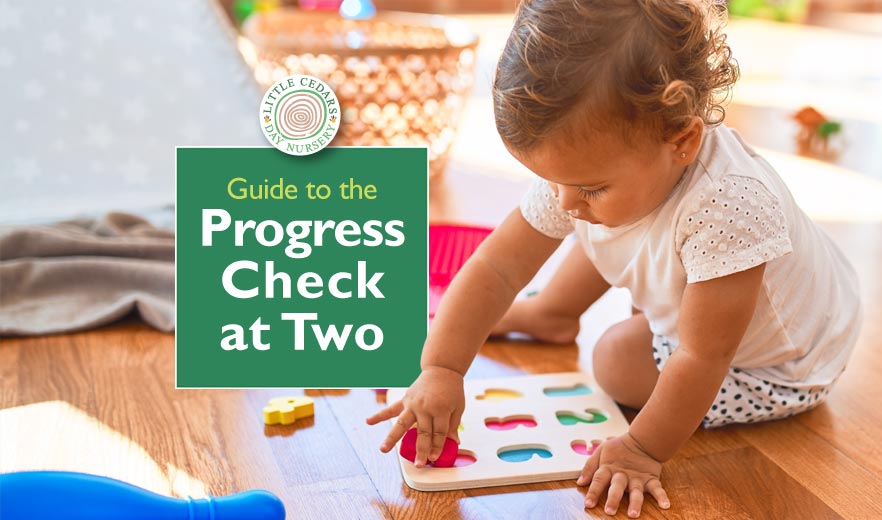
At Little Cedars Nursery, we understand the importance of monitoring growth in children’s learning and development and ensuring they are reaching their full potential. With that in mind, today’s article is a detailed guide to the Progress Check at Two. An essential milestone in children’s early development, the assessment leads to profound benefits for young children. So, today, we will walk you through everything you need to know about the Progress Check at Two, its purpose, what to expect, and how parents* can actively participate.
The Purpose of the Progress Check at 2
The ‘Progress Check at 2’ is a comprehensive evaluation conducted for children who have reached the age of two. This assessment, completed prior to their third birthday, examines their progress across various essential areas of their learning and development journey. Its primary aim is to identify any areas where additional support or intervention1 may be needed. By closely monitoring children’s progress, early years providers can tailor their approach to meet each child’s unique needs and thereby ensure children’s optimum growth and success.
1. In cases where specific educational needs or disabilities are identified, a collaboration between the childcare provider’s Special Educational Needs Coordinator (SENCo) and relevant health professionals or specialists will be built into the support plan that’s tailored to the child’s requirements.
The Significance of the Age of 2
The age of two is a pivotal period in a child’s development. It is during this stage that a child’s progress in learning, speech, language, cognitive abilities, physical growth, and social-emotional development becomes increasingly clear. Ensuring that each area is developing optimally at this early stage will have long-term benefits for the child, so it is important to confirm that everything is on track. A solid foundation for the child’s long-term growth and success can then be built.
Key Areas of Focus
The Progress Check at 2 concentrates on children’s progress primarily in the three ‘prime’ areas of the Early Years Foundation Stage (EYFS) framework. These are:
- Communication and Language,
- Physical Development, and
- Personal, Social and Emotional Development.
However, those involved in conducting the assessment often also evaluate children’s progress in the remaining four ‘specific’ areas of the EYFS curriculum. These are Literacy, Mathematics, Understanding the World, and lastly Expressive Arts and Design.
Preparing Children for School
Initiating the Progress Check at 2 and providing early support increases the likelihood of children overcoming developmental challenges before starting school. This proactive approach prevents setbacks during this crucial period in children’s lives. Without such intervention, children may face difficulties at the beginning of their educational journey, potentially hindering their overall growth and learning long into the future. Without a doubt, the Progress Check at 2 is vital in facilitating a smooth transition into school and fostering children’s long-term success.
Who is Involved?
The Progress Check at 2 is a collaborative effort between a child’s early years childcare provider, their parents and, if applicable, their health visitor and any external professionals that may be involved in the child’s early years learning and development.
The Role of Parents in the Progress Check at 2
The importance of parental involvement during a child’s early years education cannot be overstated. Such involvement is particularly invaluable to early years educators and childcare providers during the progress check. Ultimately, it is also crucially important to the child being assessed. Parents are therefore encouraged to share any observations or concerns that they may have regarding their child’s development. Their insights, combined with those of the child’s childcare/early years provider and those of any external professionals (if applicable), create a holistic picture of a child’s growth and progress. It thereby enables providers like Little Cedars Nursery to organise tailored support to address children’s specific needs most effectively.
The Report
Following the assessment, parents will receive a written summary of the report. This outlines their child’s achievements, strengths, and any areas for further development. The report serves as a valuable tool that allows all involved parties to track a child’s progress over time and to devise a plan of action to support their individual growth trajectory. It also serves as a basis for ongoing communication and collaboration between the childcare/early years provider and the child’s family.
To Sum Up
The Progress Check at 2 is a significant milestone in every child’s early development journey. At Little Cedars Nursery, we are committed to fostering a supportive and engaging environment that nurtures each child’s unique abilities. By actively participating in the progress check process, parents are ensuring that their child receives the necessary support and resources to absolutely flourish. Together, we can help children reach their full potential and prepare them for a successful educational journey ahead.
Little Cedars Nursery, Streatham
Little Cedars Nursery is a ‘Good Provider’ of Childcare & Early Years Education in Streatham


Little Cedars is a good nursery — and that’s official, says Ofsted! Our nursery and preschool are in Streatham, SW16 but are also conveniently close to Streatham Hill, Streatham Common, Streatham Park, Furzedown, Tooting, Balham, Norbury, Colliers Wood, West Norwood, Wandsworth, Clapham and Brixton. We may therefore suit families living or working in those locations.
At Little Cedars Nursery free childcare is available as all Government childcare funding schemes are supported for eligible families (follow the bold links for more information).
Please choose a button below if you’d like to apply for a nursery place for your child, ask a question or arrange a guided tour to see how well your child would fit in. We’ll be delighted to help!
A Clarification:
The ‘Progress Check at 2’ is Different to the ‘2-Year Review’ — but they’re Intertwined
As well as the ‘Progress Check at 2’, there is another, related assessment called the ‘2-Year Review’. Although both occur around the same age, they each serve distinct purposes. In contrast to the Progress Check at 2, the 2-Year Review is more about the child’s health and well-being. It is undertaken by healthcare professionals such as health visitors and assesses overall health. This includes things like immunisation status, physical and mental development, well-being, and parental support. Although separate, the two reviews share overlapping areas and, for that reason, are often conducted simultaneously. The result is thereby a more comprehensive understanding of the child’s development at this key age.
* To avoid repetition in this article and for the sake of brevity, the term ‘parents’ is used as a placeholder for parents, guardians or caregivers.

 In today’s post, we look at the importance and benefits of periods of ‘quiet time’ for toddlers and children under five. Toddlers are busy little people, often rushing around, going from one toy or activity to the next. They’re at a stage where they realise the world is an exciting place and often want to experience it all at once. However, when they are so ‘on-the-go’, playing and learning from everything and everyone around them, their brains and body have a lot to take in and process. It can be extremely tiring! So, this is where some much-needed quiet time often comes in, bringing with it a whole range of benefits. Studies also back this up.
 With so much going on around them, children’s young senses of sight, hearing, touch and smell are experiencing a full-on assault. Their minds are also being challenged with learning new skills. This can all be very tiring for our youngsters, so a period of quiet time will give them a break, to allow them to breathe and unwind.
 After prolonged activity or concentration on the part of the child, a well-earned nap may well be on the agenda. As well as giving the toddler a chance to re-charge their batteries,
  Quiet time provides an opportunity for children to develop their own, natural creativity. During quiet time, they have the opportunity to make up a game or activity, without intervention from others. This time is totally unstructured too, so children can be as free as they like to explore and adapt the game or activity. They can create their own little environment and immerse themselves in their own new world. Their imaginations are set free and opportunities to be creative will come naturally.
 As we can see above, during quiet time, children can engage in activities that they have chosen for themselves. This can greatly help them to become more independent and self-reliant. That’s a great skill for them to develop as they approach the time to transition to school. There, they will need to rely much more on such skills.
 When you first introduce quiet time to your child, start slowly and begin with short periods each day. This can be increased as your little one gets used to it.