
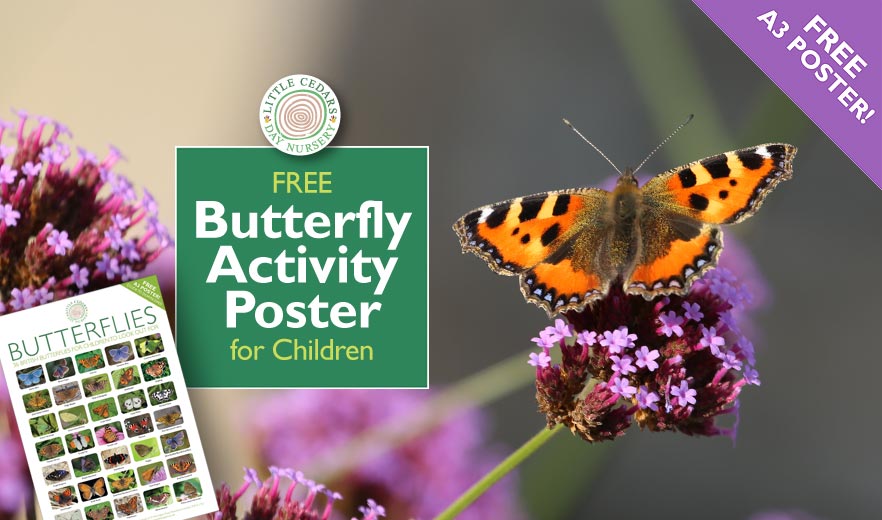
 Following on from our bird-spotting article and poster published in March, we now bring you a matching butterfly-spotting activity. Butterflies are both beautiful and adorable. As such, children will love them and will enjoy spending time around them during this activity. Like before, it comes with another free poster for children to print out, display, learn from and enjoy. Butterfly spotting is another wonderful way to get children outdoors to enjoy the fresh air and benefit from everything that nature has to offer.
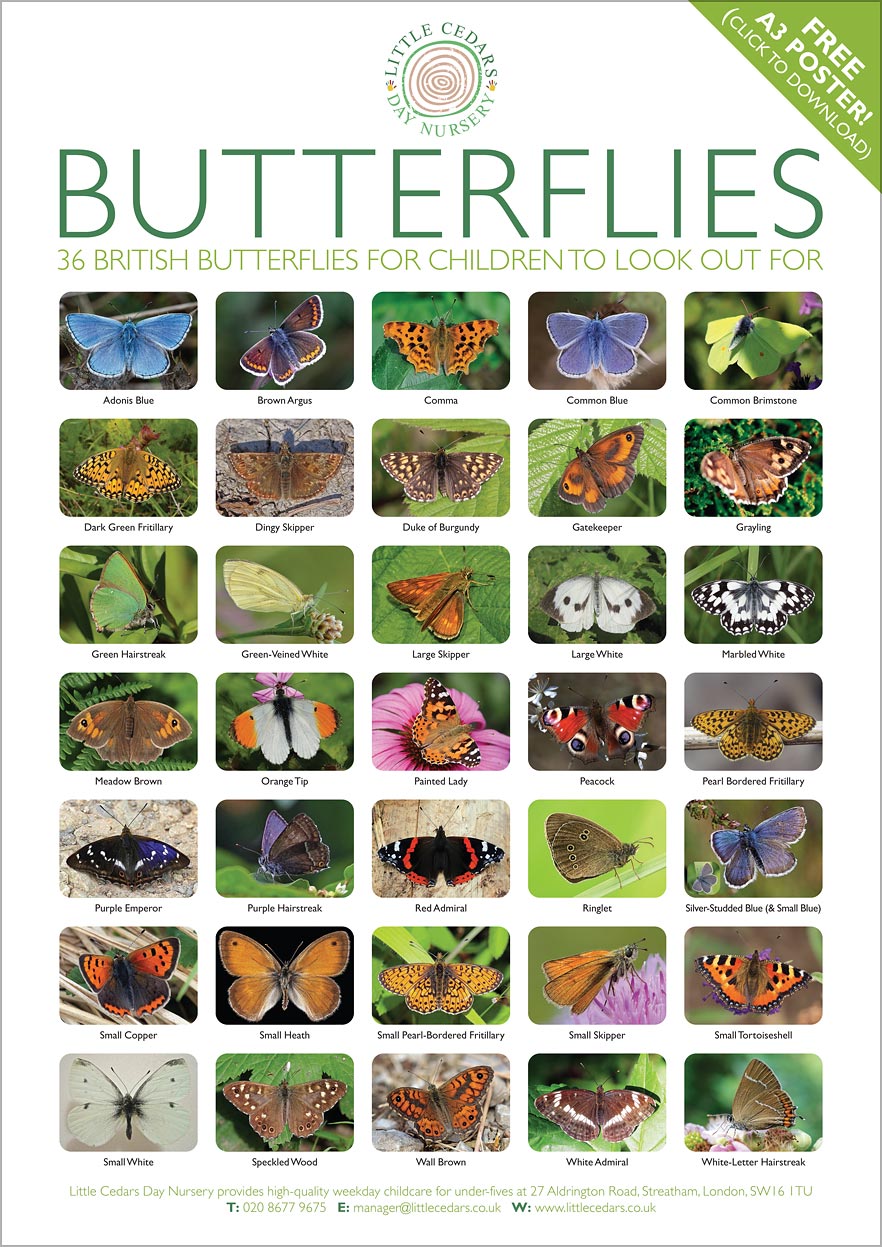
This time around, we showcase 36 beautiful butterflies that can be seen in many parts of Britain. Indeed, that was one of the main criteria we used when deciding which butterflies to include. Having said that, some of the butterflies will be more common than others and we really don’t expect every child to spot all 36 butterflies that are featured — although it’s possible if they’re patient and adventurous! It’s a lovely challenge for children, though, and spotting such beautiful creatures may begin to instil in them an appreciation of nature and all the amazing creatures within it. That would be a good thing because nature is more under threat than ever and children of today will eventually become custodians of Britain’s phenomenal natural environment. Nature will also benefit children in many profound ways, including spiritually and even academically.
Free Butterfly Poster
Download Instructions
View the poster in the greatest detail onscreen by clicking the big image above or, with some web browsers, you may need to first download it by right-clicking and then saving. Then view it in Acrobat Reader, which is available free. From Acrobat, print out the poster at full size (A3) or choose ‘reduce to fit’ if your printer is only A4. We recommend using high-quality printing paper and the highest settings for the best results, glorious colour, and the finest detail.
Attract butterflies by putting out fruit wedges — they love the sugary taste of ripe oranges, grapefruits, nectarines, bananas, strawberries and apples!
Shown on the poster are some of the more commonly-known butterflies like Large Whites, Peacocks, Red Admirals and Small Tortoiseshells. However, children may also spot some lesser-known butterflies like Purple Emperors, Orange Tips, Green Hairstreaks and Adonis Blues. Butterflies have wonderful names, don’t they? Parents can help younger children with names, as we don’t expect them to be able to read them all if they’re very young. The young will also need supervising outdoors, of course, for their safety.
Look but Don’t Touch the Butterflies
 We must also add that children should be encouraged to ‘look but don’t touch’ as butterflies are very delicate creatures. Children should not try to touch or catch them — they are best left in peace as every one of them is a little individual that simply wants to go about his or her day. They’re wonderful to watch, though, and our free poster should help children and adults identify many of the different types. Perhaps see how many different species can be spotted over the course of a year. Take photos too, and compare them with friends! Some butterflies visit gardens, floral window boxes and parks while others may only be found in wilder locations in the countryside. This activity is therefore a great excuse for families to get out and explore The Great Outdoors! Recording the date and location of each butterfly spotted will also help families work out where the best butterfly-spotting locations are for next time.
Fun fact: Butterflies have taste buds on their feet!
Butterflies are In Decline
Sadly, many butterflies are in decline, with studies reporting a 40% drop in populations in recent decades. That’s really sad, so it’s imperative that they and their precious habitats are not unduly disturbed. Therefore, please do take care. If anything, habitats need to be restored and greater protections put in place. Raising awareness of the plight of butterflies and other creatures in decline, like bees and birds, is therefore something that’s also important for children to be aware of. After all, as they grow older, they will eventually take over stewardship of the natural world and can help to steer decision-makers to improve things if they’ve developed a deep-seated interest in nature by the time they become adults.
The Big Butterfly Count
 With that in mind, why not take this activity a step further and get involved in the UK’s annual Big Butterfly Count? For 2024, it takes place between Friday the 12th of July and Sunday the 4th of August, which is when most butterflies are at their adult stage. All it takes is 15 minutes and children will love being little ‘citizen scientists’! The activity can be done in gardens, parks, school grounds or out in the countryside. Taking part will give children a real opportunity to help with butterfly conservation.
Learn more about the Big Butterfly Count and to take part here. Our guide includes links to a free smartphone app that will help you/your children during the butterfly counting activity.
A Fun, Educational & Worthwhile Activity for Children
We hope families and children enjoy their butterfly-spotting activities and use our free poster to learn the names. In this way, they can get to recognise some of the different types of butterflies when they spot them when out and about. It’s a fascinating activity and butterflies are both amazingly beautiful and incredibly endearing. As pollinators, they’re extremely important too and represent a barometer for the health of the natural world. Learning more about butterflies and nature is therefore incredibly important and beneficial for children — and ultimately for the planet. So, we encourage children to dive into this activity at the earliest opportunity. Have fun, be gentle and stay safe.
Little Cedars Nursery & Preschool, Streatham, London SW16

 Little Cedars is a high-quality nursery/preschool in Streatham SW16, providing childcare excellence for babies, toddlers and preschoolers under 5 years of age. If you’re looking for a good nursery or preschool for your child, arrange a free tour with us and we’ll show you and your little one around. You’ll be able to get answers to any questions you have and also you’ll see how well your child fits in. Ours is a lovely, welcoming, home-from-home environment where the very best is brought out of every child under our care, so your child will be in good hands. As well as looking after them while parents work or recharge, every child receives an excellent early years education and is prepared for a great start once they leave us to start school. Please choose a button to contact us today, arrange a guided tour or to apply for a place for your child; we’ll be happy to help.
Little Cedars Nursery: high-quality childcare services in Streatham, near Furzedown, Tooting, Balham, Norbury and Colliers Wood
Little Cedars is located in Streatham, just a stone’s throw from Tooting Common and the A214. As well as suiting those families in Streatham and Tooting, we may also be conveniently located for those looking for a nursery or preschool near Streatham Hill, Streatham Park, Streatham Common, Furzedown, Tooting Bec, Tooting Broadway, Balham, Norbury or Colliers Wood.
 A wonderful way to
  Combine with our Bird-Spotting Activity
 The fastest and easiest bird feeder for children/families to make is simply an apple. This can either be hung with string from a tree branch, bush, or similar, or the apple can be ‘spiked’ on the pointy end of a tree branch, a strong twig or something like a bamboo pole embedded in the ground (so long as it’s tall enough to keep birds safe* from predators). Easy! We suggest stripping some of the apple skin off to expose the flesh. Apples are a particular favourite of blackbirds and bluetits, amongst others.
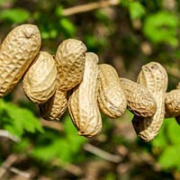 This is also a very easy bird feeder for children/families to make. All you need is some string and some monkey nuts* (peanuts still in their outer husk). A supervising adult will need to make some small holes in one end of each husk and then string can be threaded through to form a kind of chain (like a necklace). Monkey nuts can be threaded on to form the right length and then this can be tied between the branches of a tree, or similar. See our note about safely locating* them, though.
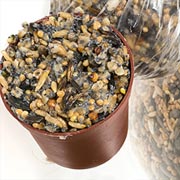 Home-made seed cakes are another type of bird feeder that is both easy and fun for children to make. Basically, they consist of lots of seeds mixed into a ‘cake’ made from either suet* or lard*. The seeds are mixed in when the lard or suet is melted, so parents/adults will need to help with that part as it’s done by heating it in a saucepan. Once melted, the seeds can be added and mixed in. Once cool enough to be safe, the children can take over to make most of the feeders. First, a piece of string can be tied from the centre of the base of something like a flower pot or yoghurt pot (parents should make the hole, if needed). Then the child can mould the seed cake into the pots, or other similar plastic containers. Once cooled, the seed cakes will harden and can then be suspended from the branches of a tree, bush, fence post or under the eaves of a house or outbuilding. Bluetits, great tits, starlings and robins will usually be the first to try out the new cakes.
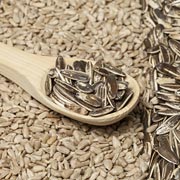 Your choice of seeds directly affects the success – or otherwise – of your bird feeders. While many commercially-available seed mixtures contain several different types of seed, we have found that birds ignore some of them, so they go to waste. Our own bird feeders have been far more popular when they use more sunflower ‘hearts’ (the sunflowers without the other case) and less of the wheat and barley type seeds. Crushed peanuts* are also popular, but see our notes below about the safety of both baby birds and children when it comes to nuts.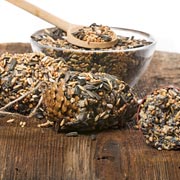
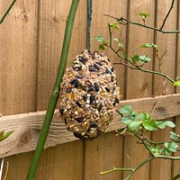 Another type of bird feeder that is both fun and easy to make is a pine cone feeder. All you need is a big pine cone, ideally with the cone splines open, a birdseed mixture and either peanut butter*, suet* or lard*. All your child needs to do is paste the peanut butter (or suet or lard that’s been safely warmed to soften it) all over the pine cone, including into the open splines. Then the whole thing can be rolled over your seed mixture, so the seeds stick all over the pine cone. Once complete, the pine cone feeder can be hung with a piece of string in an appropriate place outside. Even better: hang several together so the birds can’t miss them. The birds will love pecking them when they’re hungry.
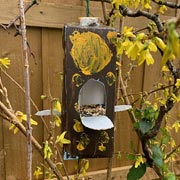 Bird feeders made from recycled cartons can be great fun, fairly easy and can be quite creative. All you need is an empty milk or juice carton, by which we mean the card ‘Tetra Pak’ type, plus some bird seed/food and some string. Parents will need to help younger children safely attach the string to the tops of the cartons and cut flaps/openings into the sides of the carton. These can be folded down, as shown in the photo, and suspended outside somewhere suitable for the birds. For extra creative fun, children can first paint patterns, designs or even faces on the cartons. This type of bird feeder is great because it not only holds the bird food but also potentially gives birds somewhere safe to land while feeding. As they were originally for holding liquid, they can alternatively be used to hold drinking water for birds — or perhaps children can make one for food and another for drinking water.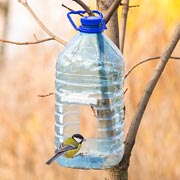
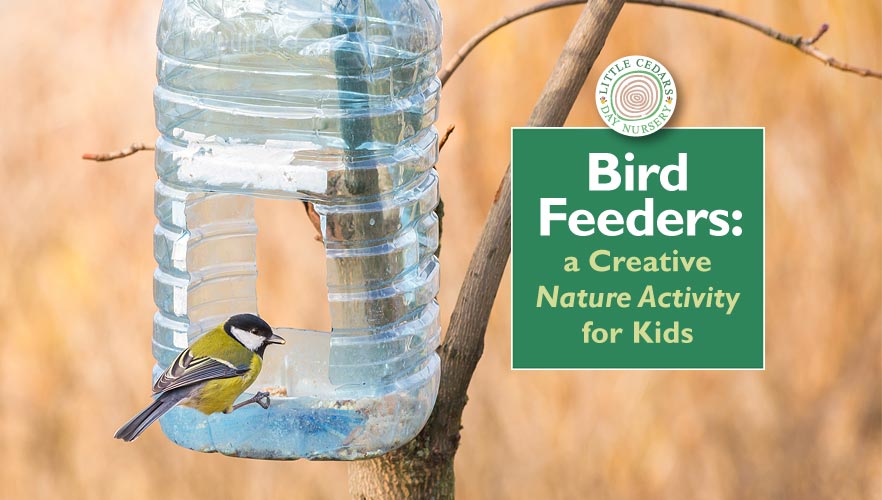
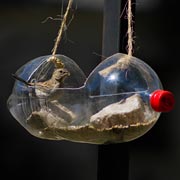 In a similar way, clear plastic bottles can be used as bird feeders or for water. The same approach can be used but flaps are not advised as they’re trickier for children to fold and also plastic bottles will have sharper edges than the carton approach above. So, this particular type of bird feeder needs extra supervision from a parent or adult. Take a look at the photos to see what’s possible, though. One photo (the first small image at the start of this article) even shows a plastic spoon that’s used as a landing platform and seed dispenser, all in one. Once finished, plastic bottle feeders tend to last a long time, so long as they’re regularly cleaned and refilled.