

 Recent studies show that use of connected screens and devices by children, including under-fives, is growing fast. The pandemic appears to have increased kids’ screen use too, as children have spent more time indoors and less time playing ‘in person’ with friends.
The big question for parents is: is all this screen time healthy for children? In this article, we’ll take a look …
First, Some Recent Statistics
According to Childwise, the leading research experts for children and young people, children are spending more and more time on connected devices. These are devices like mobiles, tablets, smart TVs, virtual assistants like Alexa and so on. Most feature a screen but all can connect to the Internet, to other devices and/or to people via Wi-Fi or data connection.
Here’s what the recent research has to say about children’s use of connected devices:
- 50% of all children aged between 5 and 10 own a mobile.
- Nearly three-quarters (73%) of all children own a mobile, with the majority of them having one by the time they’re 7. Pretty much all of them are mobile phone owners by the age of 11.
 Over 75% of children under five have access to a connected device, with up to 60% of preschoolers actually owning their own.
- Under-fives were found to be using tablets on average for 9 hours a week.
- Over a quarter of preschoolers were also found to have access to games consoles.
- 83% of children have access to the Internet in their bedrooms.
- Over half of children surveyed stated that they kept their phone next to their bed when sleeping.
- 11 and 12-year-olds spend, on average, 4.2 hours per day online. This has grown significantly since the preceding year’s report, when it was 3.3 hours per day.
- Over a quarter of all children surveyed are spending 4 to 6 hours per day online.
- Children are watching, on average, 3.3 hours (under five: 3 hours) of video content every day, with TikTok and YouTube being their favourite video platforms.
- The number of homes with a virtual assistant (e.g. Alexa etc.) has risen to 39%.
- Due to the Pandemic, 45% of school children surveyed said they were worried that they might be falling behind at school, while 62% said that they were feeling lonely.
 Over 75% of children under five have access to a connected device, with up to 60% of preschoolers actually owning their own.
Most figures in the surveys had increased in the last 12 months, although there were occasional exceptions.
Are Parents Choosing the Content Their Children Access?
According to findings of the research, half of preschoolers found online content without parental input and 60% of children aged 3 to 4 are more than capable of deciding which apps they wanted to use.
 “Parents have always played a huge role in curating what [under-fives] consume and how their time is spent, but toddlers are now confidently navigating digital platforms for themselves, and using touchscreen devices with purpose and determination.” (Childwise)
Is Screen Time All Bad?
It’s generally accepted that too much screen time for children is not healthy for them. There are many reasons for this and we explore a few of the issues below …
- Children need to keep fit and active rather than spending too much time inactive, in front of electronic screens. Exercise is incredibly important for children, whether they’re under five or older.
- Also, it’s not healthy for them to disengage from the real world too much. Few ‘real world’ skills like physical, social interactions and honing of gross motor skills are possible when reliance is placed only on the virtual world through handheld and connected devices.
- Screen time undertaken close to bedtime is also known to be a brain stimulant and that can adversely affect sleep patterns and the quality of sleep. This, in turn, can adversely affect concentration and energy levels and ultimately their ability to function and to learn optimally.
- Some medical professionals and scientists say
 that the ‘RF wireless radiation’ emitted by Wi-Fi connected screens and devices may carry potential health risks particularly, they argue, for pregnant women, their unborn foetuses and the young. The very young, of course, have brains that are still at a critical development stage. For this reason, the experts concerned advocate that access to devices like mobile phones should be limited, removed from children’s bedrooms at night or, at the very least, placed in Flight Mode when possible. Using devices wired instead of using Wi-Fi apparently reduces risks. Use of them in hands-free mode is another useful approach, so that the devices are not so close to youngsters’ heads. We’re not experts ourselves, but these measures seem like sensible precautions.
 - Given the statistics about children, even toddlers, being able to access what they want on connected devices, some automatic Parental Controls would also seem sensible. For example, software from security companies like Norton allow great control over which websites can or can’t be accessed by children, and for how long.
 that the ‘RF wireless radiation’ emitted by Wi-Fi connected screens and devices may carry potential health risks particularly, they argue, for pregnant women, their unborn foetuses and the young. The very young, of course, have brains that are still at a critical development stage. For this reason, the experts concerned advocate that access to devices like mobile phones should be limited, removed from children’s bedrooms at night or, at the very least, placed in Flight Mode when possible. Using devices wired instead of using Wi-Fi apparently reduces risks. Use of them in hands-free mode is another useful approach, so that the devices are not so close to youngsters’ heads. We’re not experts ourselves, but these measures seem like sensible precautions.
“The battle to forge a healthy digital lifestyle is now a very real consideration for parents” (Childwise).
 While time spent by children on connected screens and devices is rising, it’s not all bad news. The pandemic has also seen an increase in the time that parents have been spending with children, including on shared screen viewing as well as on other pastimes like baking, crafts and family activities. At the end of the day, it’s all about a healthy balance and, of course, adult supervision to ensure children’s wellbeing at all times.
Indeed, despite the sometimes alarming statistics, parents are in a prime position to influence what their children are exposed to on screens and connected devices. As such, that’s a golden opportunity to encourage content that’s not only stimulating and fun, but also educational. Programmes about nature or science are obvious examples, but there are many others.
Technology & Screen Time at Little Cedars Nursery, Streatham
When it comes to screen time for under-fives at Little Cedars Nursery, we understand both the benefits and the pitfalls. Technology has a great many benefits when used correctly and indeed is part of the Early Years Foundation Stage (EYFS) curriculum at the nursery. However, for obvious reasons, any time spent online or with electronic screens is stringently monitored and controlled by our childcare professionals. We aim to maximise the positive benefits of technology, while at the same time keeping children as safe as possible. We also, of course, know the importance of physical activities and active play at the setting so, at the end of the day, it’s about getting the balance right.
Nursery Places in Streatham, Near Furzedown, Balham & Tooting
If y ou are looking for a high quality nursery or pre-school place for your baby or child in and around Streatham, please do consider Little Cedars Nursery. We’re in Aldrington Road, SW16, so we’re also suitable for those looking for nurseries and pre-schools near to Furzedown, Balham, Tooting, Streatham Common, Streatham Hill and Streatham Park. Please choose a contact option below to get in touch:

 A Convenient Nursery Location
 Compatible Opening Hours
 Visit the Nurseries & Ask Questions
 Nursery Security & Safeguarding
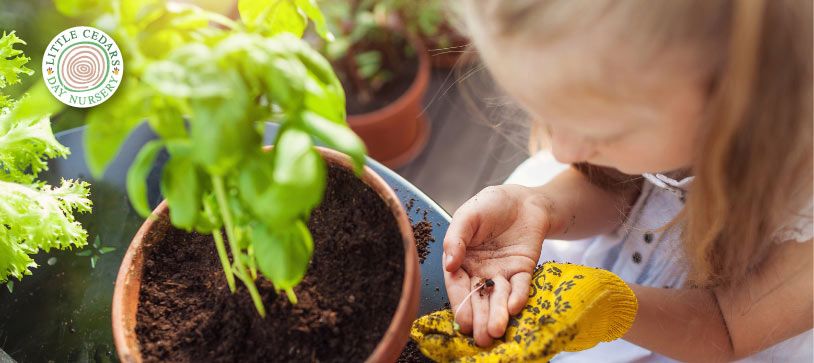
 It may surprise some to learn that you can buy some vegetables and herbs just once and never have to buy them again. The secret is knowing which, and how to re-grow them. It turns out that it’s pretty easy, so we encourage parents to help youngsters get started. Once they see growing shoots or roots and, later, vegetables or herbs that the family can actually eat, they’ll be so pleased that they made this little miracle possible. What’s more, it will have taught them something about where food comes from, how to grow it sustainably and how to look after the living plants. If you’re really lucky, it may even encourage them to take things a step further and get involved in food preparation and cooking later on. It’s amazing, actually, where such a simple, fun, activity can lead!
 It’s possible, and indeed fairly easy, to grow your own produce even without a garden. So long as you look after your plants and give them water, soil and light as a bare minimum, they will grow. If you don’t have a garden, perhaps you have a small courtyard or patio where you can grow in containers. If you don’t have any outside areas at all, you can grow in flower pots and other containers on window sills, balconies, under skylights and so on. This makes growing produce possible almost anywhere, including in urban London in high-rise flats. After all, it’s in a plant’s nature to want to grow.
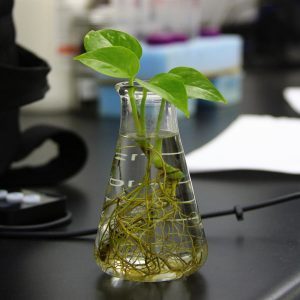 Children could start with green onions or spring onions. These are particularly easy to ‘re-grow’. Later, perhaps, the children can apply the same approach to celery, lemon grass, Cos lettuce and Pak Choy (a type of Chinese cabbage). Simply save an inch or so thick section of your shop-bought root vegetables (perhaps the last you will ever need to buy), which includes the bottom part at the root end. All your children need to do is to place that section, root end downwards, in a glass of water. Leave them in the water and, after somewhere between 1 and 3 weeks, roots will start growing. Children will love monitoring this process each day and they will enjoy looking after and caring for a living thing. Once the roots are substantial enough, children can take them out of the glass and re-pot them in soil, ideally with a bit of compost if you have any. This can be in containers, appropriately sized flower pots or in the garden if you have access to one. Before long, your plants will give your children more, free herbs and vegetables that you can all enjoy.
 Garlic cloves are also incredibly easy to regrow in a similar way. Perhaps at some point you’ve unintentionally allowed your shop-bought garlic cloves to ‘sprout’. Well, that’s how to start off. Rather than discarding them, your children can put them in water and allow roots to grow. Then, they should plant them out in soil and eventually they’ll end up with more, free, garlic cloves. What’s more, they will tend to taste more mild and delicate than shop-bought garlic — children will probably appreciate that. It’s the same with ginger roots, but allow months rather than weeks in their case.
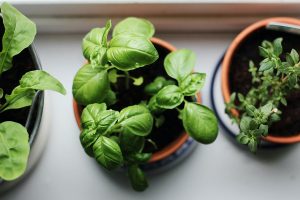 Herbs like Coriander, Rosemary and Basil can also be re-grown. Children can simply take scraps or clippings (4 inches long in the case of basil, 2-3 inches in the case of Rosemary) and place them in glasses of water in a well-lit spot on the windowsill. Once they have sprouted roots of about 2 or so inches long, these young ‘plants’ can be transplanted into soil or compost in pots. Your child will then be able to watch the plants flourish and grow into new herbs that can be harvested for food later on. The children will also soon discover that each of these herbs has a wonderful and distinctive taste and smell.
 Later, when growing sprouts reach the surface, the child should keep those covered with soil (this is called ‘hilling’). Get your child to keep the soil moist but not over-saturated over the subsequent weeks. If planted in the spring, your children should be able to harvest potatoes in the summer.
 Then, of course, your children can also experiment with nursery bought, or mail order seeds. Although not free, they’re reasonably inexpensive and also fun for children to grow if you follow the instructions and timing suggested on the seed packets. Beans of various kinds and sugar snaps are particularly easy to grow and usually result in an excellent crop. They will benefit from being in a garden or outdoor patio area, ideally, due to the space they require. They will need more vertical space than horizontal space, however, so even balcony planting may be possible if you have suitable grow bags.