
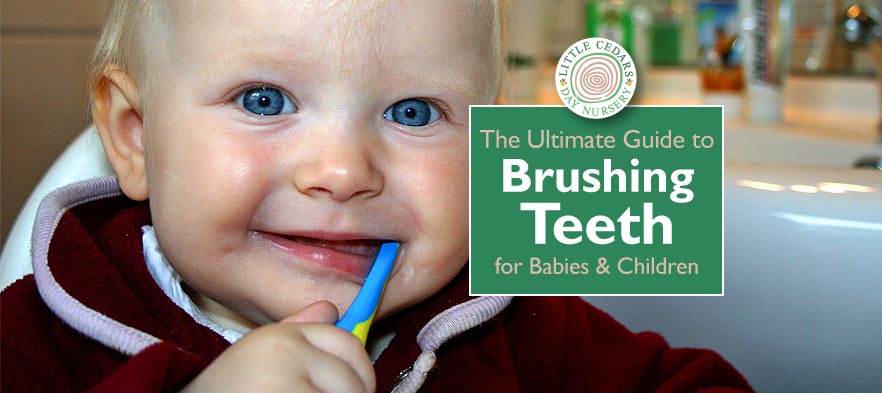
It’s important for children to start their teeth cleaning regime right from the moment their first tooth appears. Good oral hygiene is important for teeth, health, and ultimately self-confidence when they’re a little older. It’s therefore essential for children to get used to cleaning teeth properly and visiting their dentist right from their early years.
When & How To Brush Baby/Toddler Teeth
Start brushing your baby’s teeth as soon as they get their first tooth. On average, this is usually around 6 months although it does vary. Here is a good approach:
 Facing a mirror, sit your baby on your lap, facing away from you, with the back of their head against your chest or shoulder. The mirror in front of you both will allow the baby or toddler to learn from you and for you to clearly see what you’re doing. Sitting them with their head backing onto your chest will allow a stable head position when you come to brush. Toddlers a little older can perhaps stand in front of you instead, but otherwise the same approach usually works nicely.
- Using a small toothbrush, a ‘finger brush’ or, if they only have one or two teeth, even a piece of clean gauze wrapped around your finger, apply a small smear of age-appropriate* toothpaste if it’s for a baby or toddler up to 3, or a pea-sized amount for children aged over 3.
- You can then begin the process of brushing your baby’s teeth. Small, gentle, circular motions around all teeth and gums is a good approach when starting. Because of the view in the mirror, they will gradually learn how to do it themselves. You can also help to guide their hands initially when they first start trying themselves.
- For the 3-6-year-olds who have a pea-sized amount, encourage them to spit out any toothpaste and foam etc. There’s no need to rinse, because the fluoride in the toothpaste will work better without washing it completely away.
- Repeat their teeth brushing twice a day with one instance ideally being just before they go to bed. This ensures that their teeth are clean all night rather than allowing any build-up of plaque during the night hours when they’re asleep.
- Continue helping them until you can ensure that they’re able to brush their teeth properly, unaided. This could take them up to the age of 7 or more.

Teeth brushing can be made more fun for your child. For example, with music, by singing a song to your baby/toddler, making it part of a game, cleaning your own teeth at the same time or using a fun timer.
There’s a Phone App for Brushing Teeth!

The NHS even recommends a teeth brushing phone app that parents & carers can download — called ‘Brush DJ’ in the phone app stores (available for IOS and Android). It’s free (correct at time of writing), plays 2 minutes of fun music while the child’s teeth are brushed — and a whole lot more. Developed by a dentist, the timer’s purpose is to teach the child that it’s not a race — quite the opposite in fact. Ideally they need to give every tooth and gum area individual attention to ensure everything is very well cleaned. 2 minutes is a good benchmark for the whole teeth brushing exercise, so the app is ideal. It gives useful information, for example about cleaning in between teeth, and allows users to set reminders for dentist visits and suchlike.
* Toothpaste Type & Fluoride Content
Some parents may be aware of some negative information circulating about fluoride. For those who are really concerned, there are fluoride-free toothpaste options. However, in contrast, the UK’s NHS recommends¹ using fluoride toothpaste and suggests the following guidelines:
| Up to 3 years of age: | Use children’s fluoride toothpaste containing no less than 1,000ppm of fluoride (check label) or family toothpaste containing between 1,350ppm and 1,500ppm of fluoride. | Use only a smear |
| Children 3 to 6 years of age: | Use children’s fluoride toothpaste containing no less than 1,000ppm of fluoride (check label) or family toothpaste containing 1,350ppm to 1,500ppm of fluoride. | Use a pea-sized amount |
| Children aged 7 years & over: | Use fluoride toothpaste containing 1,350ppm to 1,500ppm of fluoride (check label). | Use a pea-sized amount |
Safety Considerations
- Always supervise babies and toddlers — they will need your help when they’re very young.
- Don’t allow your baby or toddler to play with the toothbrush when it’s not being used. They should also not walk or run around with it, particularly with it in their mouth, as this would be a huge safety risk.
- Discourage your child from swallowing or eating the toothpaste and never allow them to lick paste from the tube.
Take Children to the Dentist Early On
 It’s important to get children used to visiting the dentist and for this to be a positive experience. Dentists can highlight any potential problems early on and regular visits will also ensure that children realise the importance of teeth cleaning and oral hygiene as they grow. Starting early is also more like to avoid the possibility of them being nervous about visiting the dentist (if you are nervous yourself, try not to let this show as it could project the fear onto your child). NHS dental treatment is free for UK children. Find a dentist here.
Go Easy on Sugar
Natural sugars are found in things like fruit, fruit juice, honey and even in whole milk. Added sugars are types of sugar that have been added as ingredients to foods by manufacturers. These can include sucrose, glucose, dextrose, maltose, fructose, hydrolysed starch, inverted sugar syrup, raw sugar, brown sugar, cane sugar, muscovado sugar and so on.
Sugar and tooth decay go hand-in-hand
 Sugar and tooth decay go hand-in-hand, especially if too much sugar is in the diet and/or if toothbrushing isn’t regular and thorough. The amount of potential decay is also made worse the longer sugar stays on the teeth. Cutting down on sugar intake will help limit the problem, as will a good tooth brushing regime. Here’s what parents and carers of babies and young children can do:
- Avoid giving little ones drinks with added sugars. Milk and water are usually best.
- Check labels and ingredients so you know your child’s food and drink is not laced with sugars. That includes pre-prepared baby foods.
- Encourage them to eat savoury foods rather than sugary ones.
- Avoid giving children sweets and biscuits, except as occasional treats. Ask friends and family members to do the same.
- If you give your little one fruit juice, limit it to once in the day (150ml) as part of their ‘five a day’ and, better still, dilute it with water (1 part fruit juice to 10 parts water).
- Limit any sweet food and drink to meal times.
- Brushing teeth after sweet foods and drinks is a good habit to get into.
- If you need to buy medicine for your baby or child, as the pharmacist if a sugar-free version is available.
- If your child needs a drink at night, only give formula or breast milk, or water. Sugar contained in milk is less likely to cause tooth decay so does not need to be avoided.
- Avoid the use of bottles and valved bottles (from the age of 6 months) when giving children fruit juice or squash. Free-flowing alternatives like beakers mean any sugar or acid contained in the drink is less likely to bathe the teeth in sugar for so long. Acids found in fruit juice or squash can also harm teeth, by the way.
Getting it Right – the Benefits for Your Child
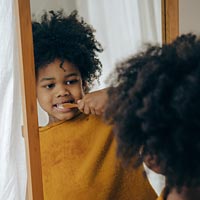 Getting the approach right means healthier teeth and gums, fresher breath, better looking teeth, more self-confidence and potentially better health overall as the child grows up. Setting good teeth cleaning and tooth hygiene habits early on means children are more likely to continue the good work as they grow into adulthood. This includes regular, fear-free visits to the dentist for check-ups.
Little Cedars Nursery, Streatham
This guide was brought to you by Little Cedars Nursery. We are an outstanding nursery and pre-school in Streatham, near Balham, Tooting and Furzedown in London SW16. We have just a few spaces available at time of writing so, if you are looking for high quality nurseries or childcare in this area, please get in touch:
 What are the Recommendations for Early Years Exercise?
 What are the Benefits of Early Years Exercise?
 How Parents can Help
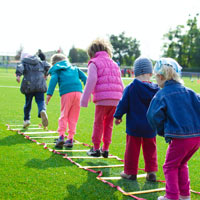 Active Play & Exercise at Little Cedars Day Nursery, Streatham
 Sensory Play Ideas for Babies
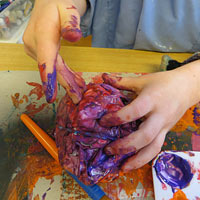 • Paper. Babies will love the feeling of scrunching up paper and will notice the sound as well as the contoured feel of their new creation. They may need a demonstration to get started, though. They’ll start to comprehend the concept that something in one form, like a pristine, wafer-thin sheet of paper, can be made into something completely different — in this case, perhaps a simple ‘ball’ of scrunched-up paper. Even
 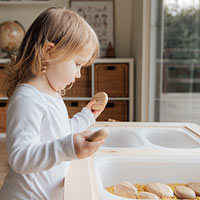 • Different objects & materials: babies will enjoy playing and learning about the properties, touch, feel and sound of different objects and materials. For example, (safe) wooden utensils, water in a closed beaker or bottle or small plastic or card boxes that they tap like a drum, or try to stack into a ‘wall’ — and so on. They’ll learn about physical properties of each along the way, including sounds, textures, touch and, if they include some carefully chosen food items, taste. It’s amazing what fun babies will have with such simple items — often learning far more from these than from purchased toys.
 • The natural world: babies also greatly enjoy the simple pleasures offered by the natural world. A breeze on their faces may greatly intrigue them, even more so when they see leaves rustling and moving a little on the ground. The feel and texture of grass on the lawn or the sight of sunlight dappling through the trees or reflecting off puddles can be wondrous to them. Under close supervision, getting to know the textures, hues and smells of safe, natural objects outdoors can also be a source of sensory discovery.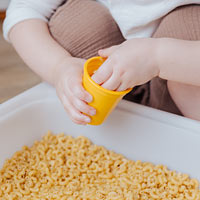
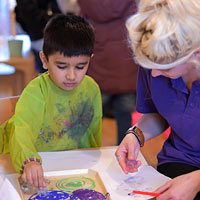
 • Hand & foot prints: preschoolers will never be bored with smothering their hands or feet in coloured paints, then making prints on paper or card. Footprints and handprints can be random or used to make images or patterns. This process is both creative and a sensory experience for them as the cold paint squelches between fingers or toes. They’ll learn so much including about mixing pigments, creating images from simple printed shapes, about the concept of paint eventually drying to form something semi-permanent and about different textures being formed, depending on the consistency of the paint. We take these discoveries for granted as adults, but we would originally have had to learn about them during our early, formative years.
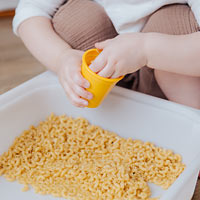
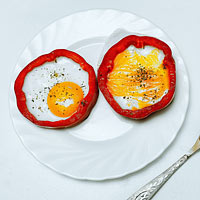 • Food creativity: toddlers can also take playing with food to the next level by introducing the concept of making images out of things like fruit- or vegetable-based sauces, cream or yogurt. Whole pictures can be made of food, using the hands, for example using broccoli for ‘trees’, peas for grassy areas and so on. The whole thing can smell great and even be tasted! Playing, hands-on, with food in this way can be fun and creative but also help children learn to accept new foods and tastes into their diets. However, care needs to be taken because proper mealtimes require good manners and children need to understand that food is not usually for playing with.
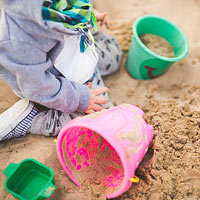
 • Sensory sand: it’s very rare for little ones to dislike playing with sand, which allows youngsters to get hands-on creatively. They can learn about the unique and varying textures, consistencies and properties of sand, depending on how much moisture it contains. Dry sand has its own unique set of properties, acting and feeling almost like a powder. Very runny, wet sand is great fun as it can be used to run through the hands and ‘set’ into pointy mountain shapes that look quite magical. Or, when less water is added, sand can be fashioned into shapes and, of course, “castles”, using the hands or by filling buckets, hollow vessels, or tubs. Children can also press their hands and feet into level, damp sand in a sandpit or tray, to make impressions and patterns. It feels great too and is an almost essential part of childhood. Young children learn so much from this stimulating, multi-sensory type of play.
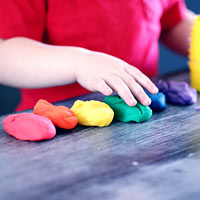
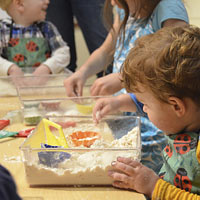 • Playing with dough: whether bought or home-made, dough is always a big hit with young children. It can be fashioned with the hands into shapes, characters, animals and mini-sculptures. Using food colouring in dough also allows children to discover more about mixing pigments. Salt dough can also be baked (under the close supervision of an adult) so that it hardens into more permanent creations. Many types of dough even smell great too! What’s more, it can even lead to a bigger interest in cooking real, edible dough and other baked foods when they’re a little older.
 • A sensory garden. We’ve left perhaps the best until last. Making a sensory garden area with, or for, little ones will give them a magical experience. There are so many materials that can be used in the construction of sensory gardens, including soil, earth, pea shingle, tree bark, moss and so on. Plants themselves will also add to the fascinating mixture of textures, colours and even smells found within a sensory garden. It can be as small or large as you have room for and can even be achieved in containers, pots or on balconies for those who do not have gardens. It can take many forms so it’s design also gives children a wonderful creative opportunity. Sensory gardens are a complete feast for the senses for young children — adults too — encompassing touch (e.g. the textures of materials, moss and plants), smell (why not include some herbs — these smell wonderful and can be tasted too), potentially sound (crunchy gravel, rustling leaves etc.), sight (aesthetics, colour etc.) and will also give children ample opportunity to improve balance and body awareness as they construct and create in this unique space.
 Sensory play is incredibly important for under-fives. Babies and young children benefit enormously when their play activities stimulate the senses and in this article we’ll explore those benefits in some detail.
 activities that involve touch, where babies and children can acquaint themselves with the feelings of temperature, softness, hardness, pressure, vibration, roughness, smoothness etc.;
 The Benefits of Sensory Play
 Babies and children are, of course, given a huge variety of sensory-based play opportunities at
 A Convenient Nursery Location
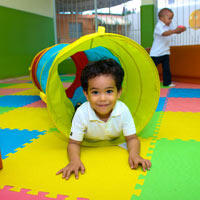 Compatible Opening Hours
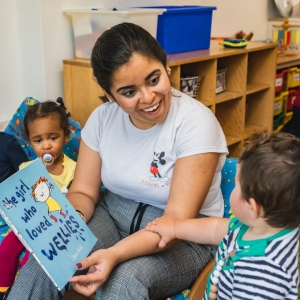 Visit the Nurseries & Ask Questions
 Nursery Security & Safeguarding





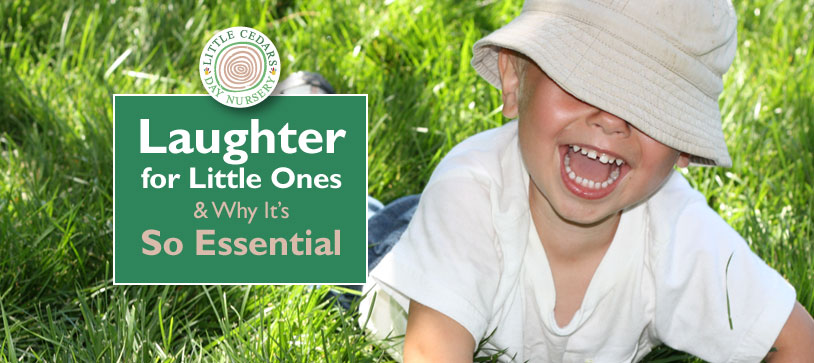
 Let’s first go back to the beginning. A sense of humour is apparently a learned aspect of a person’s character, to a fair extent. It’s something that develops and changes as a child gets older, rather than something they’re born with as a result of their DNA. As such, it’s important that babies and young children are given every opportunity to enjoy laughter and, while doing so, have fun with those around them. Laughing also is also closely linked to happiness, and being happy is, of course, priceless.
 Laughing helps children to develop better self-esteem;
 Improves mental health;
 The staff at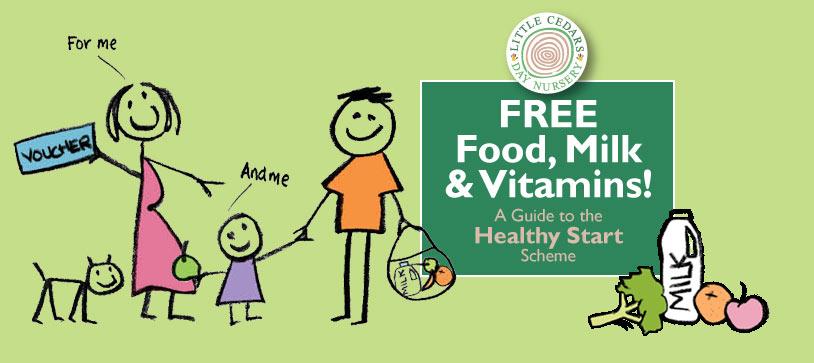
 Are you pregnant, or a parent with a child under four? If so, your family may be eligible for free healthy food, milk and vitamin supplements. In England, some of these free items are available under the ‘Healthy Start’ scheme, which we’ll explain in this quick-start guide.
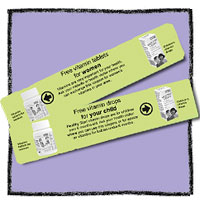 Eligible individuals can get the following, absolutely free:
 The infant formula milk:
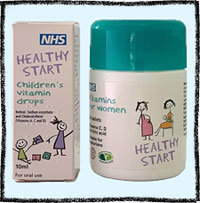 These free vitamin supplements are important for pregnant women, breastfeeding mums, babies and young children because many are deficient in them at this stage in their lives.
 In order to be eligible for Healthy Start vouchers, you need:
 These are significant benefits, so high quality sleep — and the right amount — is incredibly important.
 ‘Sleep Hygiene‘ is a term that refers to the whole routine around bedtime and sleeping, including important preparation measures during the run-up to bedtime A good sleep hygiene regime will help children get to sleep and to sleep soundly.
 The biggest message is that setting up — and sticking to — a set bedtime routine will greatly help with the quality of your child’s sleep. It sets a pattern that their minds and bodies will become used to naturally. A regime of this nature can include winding-down activities like a warm bath or shower, a peaceful book-reading session, dimmed lights and so on in the approach to bedtime. The routine will prepare them automatically for sleep even during the run-up to actually sleeping.
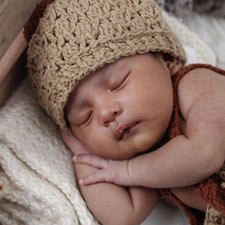 At Little Cedars Day Nursery in Streatham, we understand the importance of sleep, particularly for babies and the youngest of the children. For that reason, we ensure that children have the opportunity of a nap both in the morning and in the afternoon. For example, babies sleep for about half an hour to an hour around 9.30am and then again after lunch, for 1 to 2 hours between about 1pm and 3pm. Preschoolers don’t have to sleep if they don’t want to, but are given the opportunity to do so — every child is different. We also take a lead from parents who may prefer their child to keep to a particular sleep pattern. If you would like more information about this topic, and how we approach it at the nursery, please do get in touch.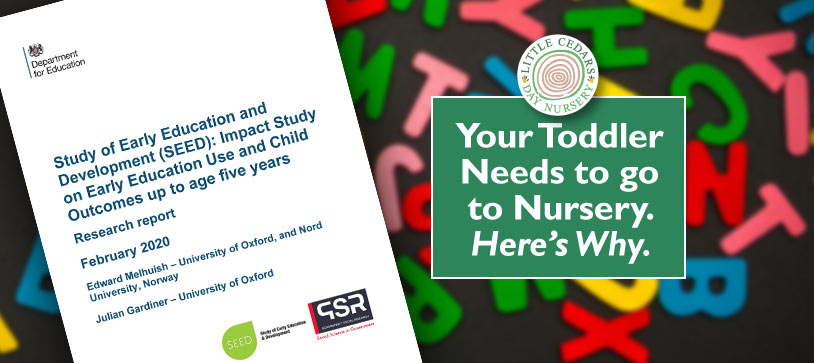
 There are compelling reasons why under-fives should attend early years education and childcare settings like nurseries or pre-schools, or their equivalent — before starting school. Missing this crucial stage in their early years education and development may disadvantage the child — a fact that’s backed up by various studies.
 Some of these benefits are even more pronounced for disadvantaged children who start to attend formal ECEC sessions no later than the age of two. The DfE impact study shows that 2-year-olds benefit most if they receive early education and care for an absolute minimum of 10 hours per week by the age of two. Three- and four-year-old children from disadvantaged backgrounds benefit most from no less than 20 hours per week thereafter in the run-up to the start of primary school at age 5. Children who follow this approach have better verbal abilities when they start school and are also much more likely to achieve expected levels of personal attainment during reception year at school. The studies show that, with ECEC’s highly appropriate, structured preparation beforehand, children are able to hit the ground running once they transition to school.
 As well as having a positive effect on children’s readiness for school, there is also compelling evidence that early years education at good nursery/pre-school type settings has a marked, positive effect on children’s long-term attainment levels there – and indeed on their lifelong outcomes. As such, early years education and care represents an extremely solid foundation for children’s futures in general.
 Are you looking at nursery/pre-school options for your baby or toddler?