 In our last post, we asked “is a vegetarian diet safe for your children?” and, in essence, the answer was yes, so long as they get all the nutrients they need. What’s more, we discovered a huge range of benefits of vegetarianism. These included significant benefits to both health and to the planet. In today’s post, we’ll follow up by looking at the types of food groups, vitamins and minerals that are essential for children as part of a well-balanced vegetarian diet.
Infant Milk
While little ones are still drinking milk and haven’t yet moved onto solids, it’s fairly simple. Breast milk will obviously contain just about everything a baby or toddler could want, with one possible exception: Vitamin D. The NHS recommends that breast-fed infants should take a Vitamin D supplement, which is available in easy-to-administer drop form.
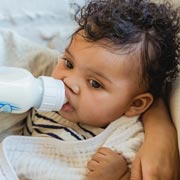 For those on dairy-based formula milk, it’s pretty much plain sailing too. Because vegetarians — as opposed to vegans — are OK eating dairy-based food, formula milk is generally fine for them. The most popular types are based on cows’ milk, although several other animal milks are also available. So long as dairy-based formula milk is high quality, given in the right quantities, consumed at the right intervals and is age appropriate for the child, it contains all the nutrients and vitamins needed. That’s without the need to give additional supplements too.
The 4 Essential Food Groups After Weaning
Once they’re weaned off milk, a well-balanced diet for children will include food from all four of the main food groups. These are:
1. Dairy
It’s important that dairy products for children are all pasteurised, basically for the good of their health and wellbeing. Infants can have whole (full fat) cow’s milk mixed in with food or added during cooking, but must not use it as a drink until they’re a year old. We’ll go into much more detail in our milk guide next month. Dairy products are wonderful sources of calcium, Vitamin D and other nutrients.
2. Fruit & Vegetables
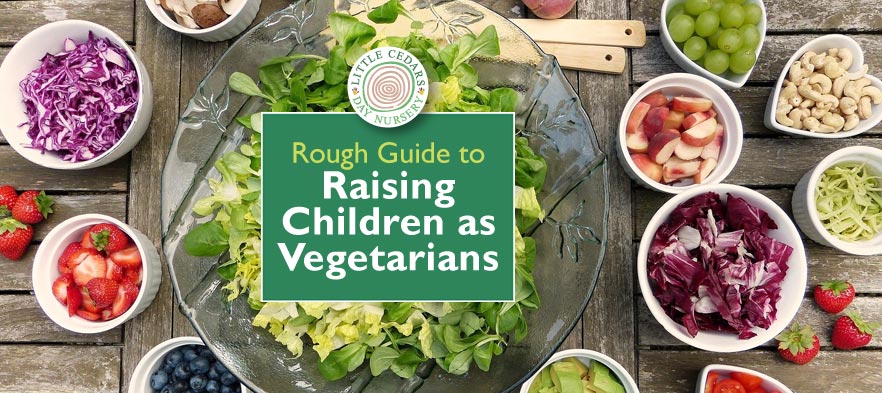
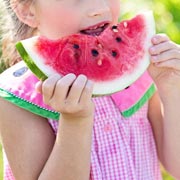 Fruit and vegetables are really a given because they pack so much goodness, including many vitamins, minerals like potassium and also fibre. Fresh vegetables and fruit are ideal but, failing that, frozen, tinned and even dried varieties are also OK.
3. Starch
Starchy foods provide energy by breaking down glucose as well as providing a range of nutrients like iron, calcium, folate and B vitamins. They are also another source of fibre, which is important for digestive health. Starchy foods include pasta, bread, potato, grains and cereal like oats. Wholegrain varieties are generally best for human health.
4. Protein
Protein is a little more complex for vegetarians, simply because they don’t eat the most obvious sources of it — meat, fish and seafood. However, there are lots of sources of protein, as we’ll see shortly. Protein is essential as a key building block for the body. It builds muscles, bones, hair, nails, tissues and organs as well as providing Omega-3 fatty acids, iron and amino acids. Health professionals recommend that children and adults get protein from a variety of different sources and have at least two portions of protein per day.
Sources of protein that are suitable for vegetarians include:
 Tofu, also known as bean curd, which is made from soy.
- Lentils and pulses, including peas, beans, chickpeas, sugar snaps etc.
- Houmous, made from chickpeas, is also therefore a good source of protein but ensure only the smoothest variety is given to infants, so as to avoid possible choking.
- Grains contain protein, but should be served in ground form for very young infants, again so as to avoid possible choking. Examples include oats, barley, rice and quinoa. Quinoa is unique in containing all nine essential amino acids.
- Nuts are also a great source of protein but should be served to infants in smooth ‘butter’ form to avoid choking risks. Examples include peanut butter, almond butter, cashew butter and walnut butter (a great source of Omega-3).
- Seed butters are also great sources of protein.
- Lastly, there is also a cross-over between dairy products (see above) and protein because cheese and yoghurt also contain protein.
- For vegetarians who are OK eating eggs, these are also an excellent source of protein as well as Vitamin B12.
 Tofu, also known as bean curd, which is made from soy.
Please note: although great as a source of protein for adults, Quorn is not recommended as a regular meat replacement for children. While it’s great for protein, fibre and making them feel full, it’s low in fat, so will not offer sufficient energy release to children during their early years.
Special Mention: Iron
Iron is incredibly important as part of a healthy, balanced diet for children as well as adults. However, there are certain foods that block its absorption into the body. These include:
- Tea.
- Some whole grains and legumes i.e. those that contain ‘phytates’.
- Dairy foods that contain ‘casein’.
- Eggs and dairy foods containing a specific type of calcium.
In order to counteract this, firstly ensure that the child has a varied diet. In addition to this:
- any pulses, seeds or grains should be sprouted, cooked or soaked before consumption (as appropriate);
- any foods that block iron absorption should be consumed separately to main meals;
- Vitamin C should be included in the meals as this binds to any phytates, thereby neutralising their effect on iron absorption. Citrus fruits, berries and juice (diluted 1 part juice to 10 parts water) are rich in Vitamin C, as are vegetables including broccoli, spinach, greens, asparagus, tomatoes and many others.
 any pulses, seeds or grains should be sprouted, cooked or soaked before consumption (as appropriate);
We hope that this rough guide to bringing up children as vegetarians has been useful. If so, we recommending reading the NHS’s guidelines for bringing up a healthy child on a vegetarian or vegan diet here. It is also always wise to obtain advice from your child’s health visitor, midwife, doctor or other healthcare professional.
Vegetarian & Vegan Food at Little Cedars Nursery, Streatham
Vegetarians and vegans are well catered for at Little Cedars Nursery. These and any other special diets are supported fully by our in-house chef, who prepares food freshly each day as part of our healthy eating regimen at the setting. Little Cedars is one of the best Streatham nurseries and pre-schools for babies and under-fives. It’s also near Streatham Common, Streatham Hill, Streatham Park, Furzedown, Tooting, Tooting Bec, Tooting Broadway, Tooting Common, Balham, Norbury and Colliers Wood. To register for a nursery place for your child, to arrange a visit or to ask any questions, please contact us and we’ll be happy to help: