
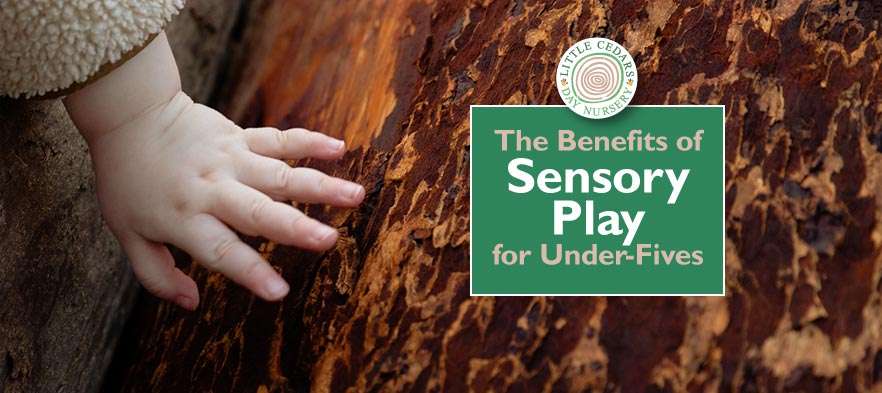
 Sensory play is incredibly important for under-fives. Babies and young children benefit enormously when their play activities stimulate the senses and in this article we’ll explore those benefits in some detail.
The Senses
For the purpose of this blog post, ‘senses’ will mean the famous five (touch, taste, smell, sight and hearing) plus a couple of others that are often overlooked; balance and body awareness (also known as ‘proprioception’). As with the core 5 senses, the two additions are critically important as part of the learning and development journey for little ones.
What is Sensory Play?
Sensory Play is any kind of play activity that involves stimulation of any of the senses outlined above. For example:
 activities that involve touch, where babies and children can acquaint themselves with the feelings of temperature, softness, hardness, pressure, vibration, roughness, smoothness etc.;
- activities involving food, which can involve tasting to see whether the food is sweet, sour, savoury and so on;
- play activities involving smell, which involve items that have a scent, whether natural like flower petals, fruit, organic materials and suchlike or man-made scents like diluted bubble bath and so on;
- visual (sight) activities, where children explore colours, tones, visual textures, contrast, brightness and images, learning how to associate them with the real world;
- hearing activities, where children experience the different types of sounds that surround them;
- play activities that help them to learn to balance i.e. to counteract the effects of gravity;
- activities that help children to develop a sense of spacial awareness i.e. of where their bodies are within their surroundings and in relation to objects and other people around them.
 activities that involve touch, where babies and children can acquaint themselves with the feelings of temperature, softness, hardness, pressure, vibration, roughness, smoothness etc.;
The Benefits of Sensory Play
 The Benefits of Sensory Play
Sensory play allows children to learn more about the world around them, and all the things within it. As they learn, new pathways are formed within the brain and this helps to cement permanent associations between a particular sense and a particular situation, physical thing, or scenario. When this is achieved, the child will instantly and naturally recognise multiple layers of senses as they happen again in the future. That’s an important life skill and something that adults take for granted, but benefit from enormously.
Additional benefits of sensory play for children include:
- Recognition of objects, environments, situations and sensory attributes through sight, hearing, taste, touch or smell;
- Recognition of their own physical self within the space and other things around them;
- The development and improvement of motor functions including gross and fine motor skills;
- Balance, safe movement and measured navigation within an environment or situation;
- Improvement of language skills as children are able to better describe what they’ve interacted with through their senses;
- Improved problem-solving skills as children are better equipped to think critically and even scientifically;
- Improved attention. For example, using the new-found sensory abilities they will learn to cognitively separate one sensory stimulation from another. Using this skill, children can overcome some distractions, for example ‘filtering out’ background noise, to allow them to focus on something more important;
- Learning to remove themselves from situations where there may be a ‘sensory overload’. This can really help with their mental wellbeing. For example, having learnt more about their individual senses, children will better understand why a particular situation may be too chaotic for their own good. Understanding why they’re feeling how they feel in frenetic situations can lead to better decision-making and wiser choices. This includes whether to take part in the situation or to move to a more peaceful environment;
- Learning skills around mindfulness: sensory play is, in itself, a therapeutic way to calm any anxiety or frustration and help children to re-centre themselves and become immersed ‘in the moment’;
- Learning more about textures and how they can be replicated can also help very young children learn to ‘trust’ new foods that they may not have previously wanted to try. Spaghetti and soup would be great examples because sensory play can give them a positive association with such textures;
- Sensory play takes children’s learning and development to a new level, giving them new ways to be creative and to explore and understand the world around them;
- It also represents a great opportunity for group play and, in so doing, helps to improve children’s social skills;
- With new pathways being formed in the brain, sensory play helps children to cope with more complex tasks and also enhances memory skills;
- Sensory play can also help children with autism, particularly those with Sensory Processing Disorder (‘SPD’). The topic deserves its own stand-alone article, so we may follow up with a separate post on the topic in due course.
 Learning skills around mindfulness: sensory play is, in itself, a therapeutic way to calm any anxiety or frustration and help children to re-centre themselves and become immersed ‘in the moment’;
Conclusion
We can see that there are many benefits of sensory play for babies and young children. Indeed, it’s something that should be encouraged at home as well as at nursery or pre-school. In view of this, we follow this post with a new post featuring 11 sensory-based activities that parents and carers can undertake with babies and children at home.
Sensory Play at Little Cedars Nursery, Streatham
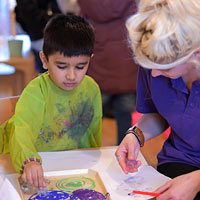 Babies and children are, of course, given a huge variety of sensory-based play opportunities at Little Cedars Nursery in Streatham in south west London. There are multi-sensory areas and equipment throughout the setting. For example, there is a separate area with multi-sensory equipment for babies. Children aged from 12 months to 2 years are also introduced to sensory activities, which include listening to music. Our toddlers aged between 2 and 3 also have a sensory zone of their own to explore and to learn new skills from. Our indoor and outdoor areas also have lots of sensory-based activities for the children to enjoy and learn from.
If you are interested in a childcare place for your baby, toddler or young child under five, we currently have a few places available in our Streatham Nursery, so do get in touch. The nursery is near to Streatham Hill, Streatham Common, Streatham Park, Upper Tooting, Tooting Bec, Tooting Common, Furzedown & Balham. Click one of the buttons below to get started …
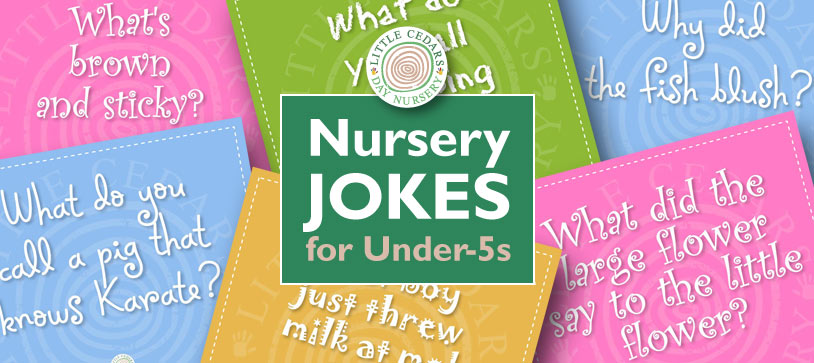













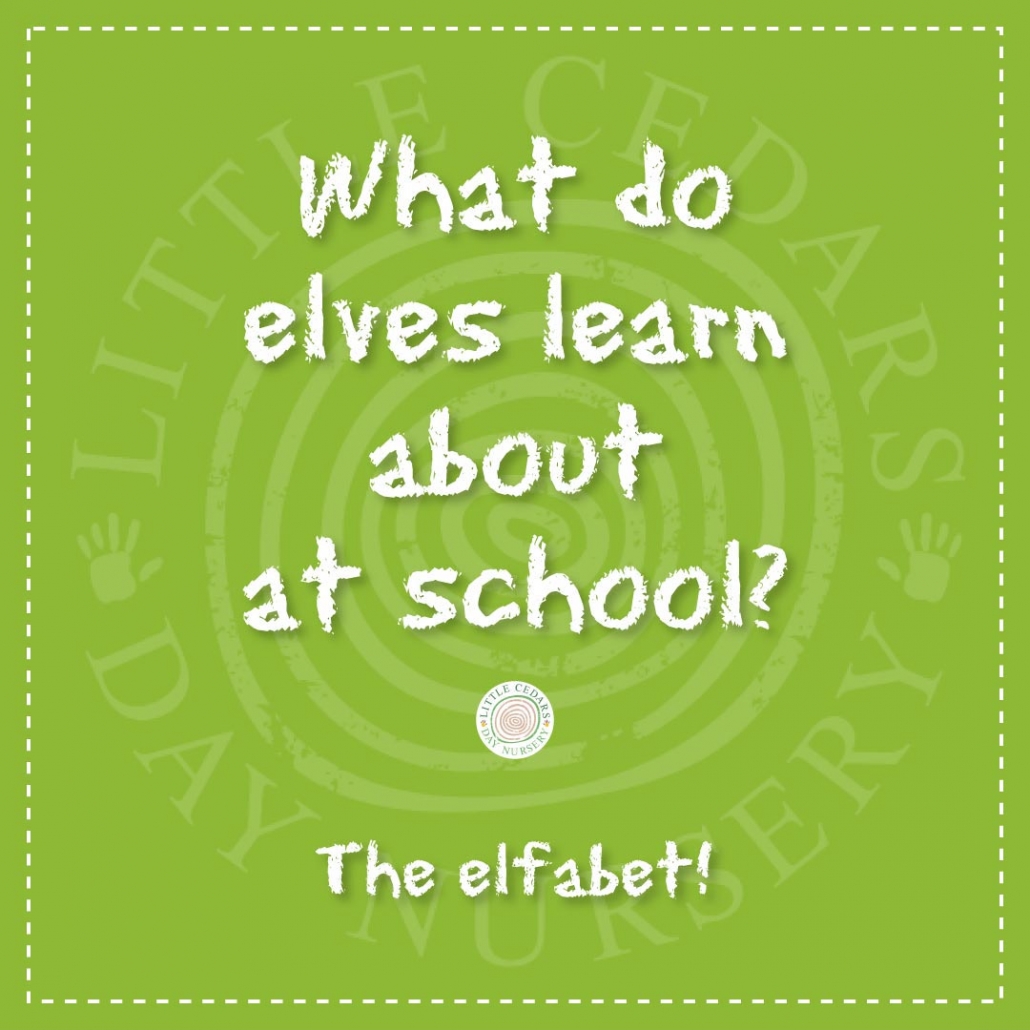






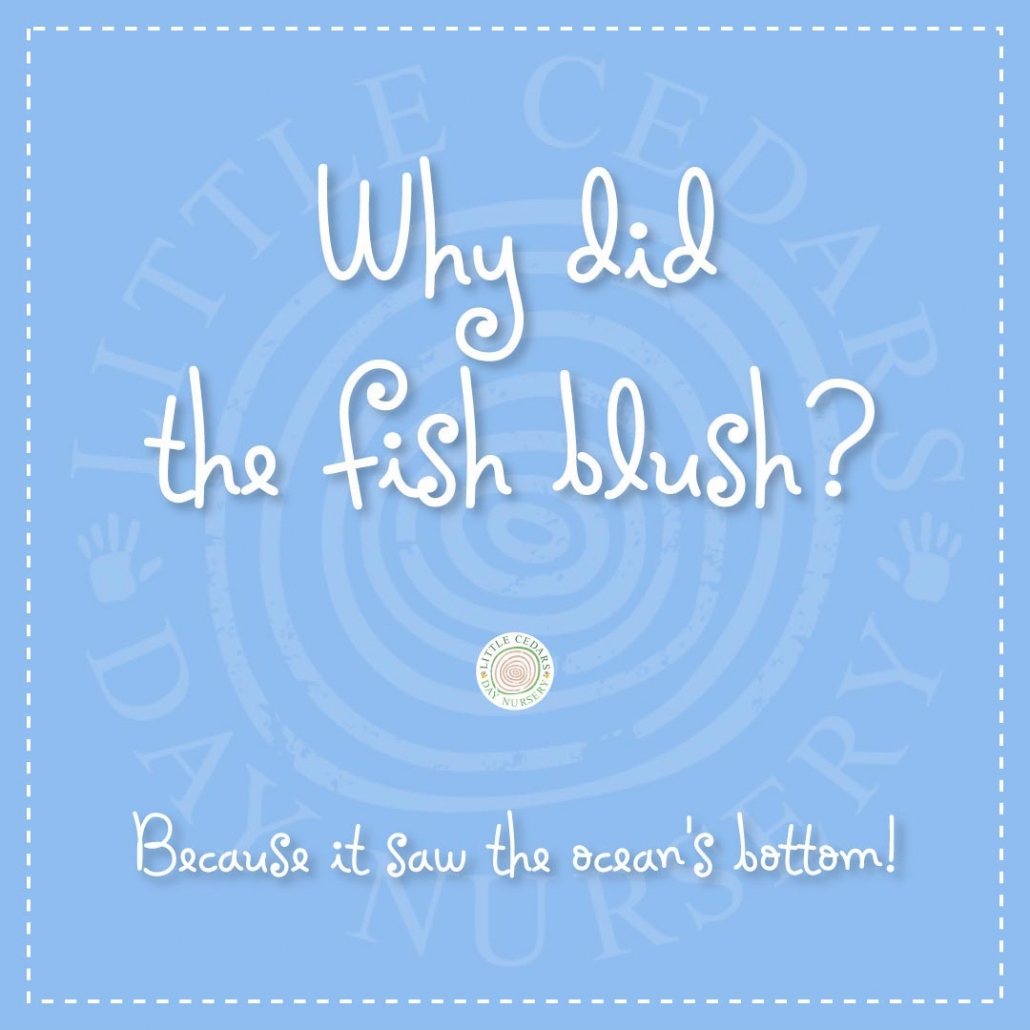




 Let’s first go back to the beginning. A sense of humour is apparently a learned aspect of a person’s character, to a fair extent. It’s something that develops and changes as a child gets older, rather than something they’re born with as a result of their DNA. As such, it’s important that babies and young children are given every opportunity to enjoy laughter and, while doing so, have fun with those around them. Laughing also is also closely linked to happiness, and being happy is, of course, priceless.
 Laughing helps children to develop better self-esteem;
 Improves mental health;
 The staff at
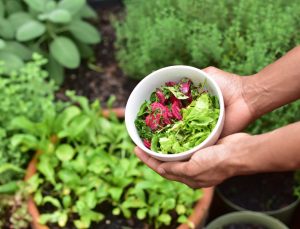 It may surprise some to learn that you can buy some vegetables and herbs just once and never have to buy them again. The secret is knowing which, and how to re-grow them. It turns out that it’s pretty easy, so we encourage parents to help youngsters get started. Once they see growing shoots or roots and, later, vegetables or herbs that the family can actually eat, they’ll be so pleased that they made this little miracle possible. What’s more, it will have taught them something about where food comes from, how to grow it sustainably and how to look after the living plants. If you’re really lucky, it may even encourage them to take things a step further and get involved in food preparation and cooking later on. It’s amazing, actually, where such a simple, fun, activity can lead!
 It’s possible, and indeed fairly easy, to grow your own produce even without a garden. So long as you look after your plants and give them water, soil and light as a bare minimum, they will grow. If you don’t have a garden, perhaps you have a small courtyard or patio where you can grow in containers. If you don’t have any outside areas at all, you can grow in flower pots and other containers on window sills, balconies, under skylights and so on. This makes growing produce possible almost anywhere, including in urban London in high-rise flats. After all, it’s in a plant’s nature to want to grow.
 Children could start with green onions or spring onions. These are particularly easy to ‘re-grow’. Later, perhaps, the children can apply the same approach to celery, lemon grass, Cos lettuce and Pak Choy (a type of Chinese cabbage). Simply save an inch or so thick section of your shop-bought root vegetables (perhaps the last you will ever need to buy), which includes the bottom part at the root end. All your children need to do is to place that section, root end downwards, in a glass of water. Leave them in the water and, after somewhere between 1 and 3 weeks, roots will start growing. Children will love monitoring this process each day and they will enjoy looking after and caring for a living thing. Once the roots are substantial enough, children can take them out of the glass and re-pot them in soil, ideally with a bit of compost if you have any. This can be in containers, appropriately sized flower pots or in the garden if you have access to one. Before long, your plants will give your children more, free herbs and vegetables that you can all enjoy.
 Garlic cloves are also incredibly easy to regrow in a similar way. Perhaps at some point you’ve unintentionally allowed your shop-bought garlic cloves to ‘sprout’. Well, that’s how to start off. Rather than discarding them, your children can put them in water and allow roots to grow. Then, they should plant them out in soil and eventually they’ll end up with more, free, garlic cloves. What’s more, they will tend to taste more mild and delicate than shop-bought garlic — children will probably appreciate that. It’s the same with ginger roots, but allow months rather than weeks in their case.
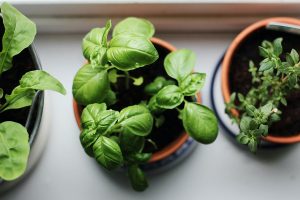 Herbs like Coriander, Rosemary and Basil can also be re-grown. Children can simply take scraps or clippings (4 inches long in the case of basil, 2-3 inches in the case of Rosemary) and place them in glasses of water in a well-lit spot on the windowsill. Once they have sprouted roots of about 2 or so inches long, these young ‘plants’ can be transplanted into soil or compost in pots. Your child will then be able to watch the plants flourish and grow into new herbs that can be harvested for food later on. The children will also soon discover that each of these herbs has a wonderful and distinctive taste and smell.
 Later, when growing sprouts reach the surface, the child should keep those covered with soil (this is called ‘hilling’). Get your child to keep the soil moist but not over-saturated over the subsequent weeks. If planted in the spring, your children should be able to harvest potatoes in the summer.
 Then, of course, your children can also experiment with nursery bought, or mail order seeds. Although not free, they’re reasonably inexpensive and also fun for children to grow if you follow the instructions and timing suggested on the seed packets. Beans of various kinds and sugar snaps are particularly easy to grow and usually result in an excellent crop. They will benefit from being in a garden or outdoor patio area, ideally, due to the space they require. They will need more vertical space than horizontal space, however, so even balcony planting may be possible if you have suitable grow bags.