 There are compelling reasons why under-fives should attend early years education and childcare settings like nurseries or pre-schools, or their equivalent — before starting school. Missing this crucial stage in their early years education and development may disadvantage the child — a fact that’s backed up by various studies.
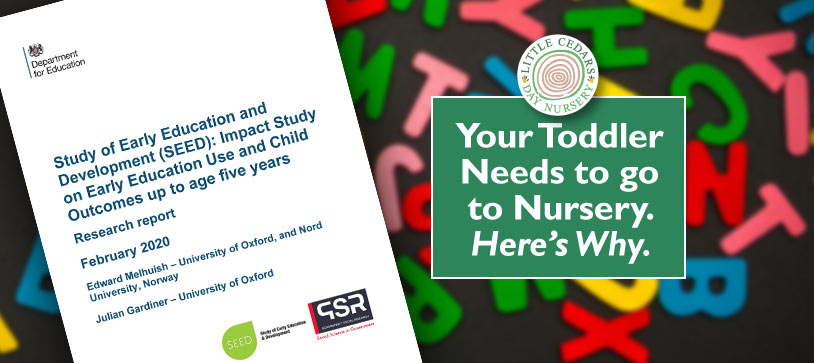
Results of a Department for Education (DfE) study released in February 2020 highlight the benefits of attending early childhood education and care, all in incredible detail. We took a look at their 145 page report and picked out some of the key findings.
Benefits of attending Early Childhood Education & Care (ECEC)
- Note: the term ‘Early Childhood Education & Care’ (ECEC for short) refers to non-parental childcare and early education that occurs before school. There are several different types, including nursery settings, pre-schools, registered childminders and so on, so the Organisation for Economic Co-operation & Development (OECD) and the European Commission have adopted this term to encompass them all.
According to the DfE study, early childhood education and care has both short- and long-term positive effects on the educational, cognitive, behavioural and social outcomes of children. That’s no mean feat. A good educational grounding for under-fives is also shown to result in more positive social behaviour, better behavioural self-regulation, lower instances of emotional issues and less peer problems.
“Research … indicated that the benefits of high quality early education exist from as young as two years of age.” (Sammons et al., 2002)
 Some of these benefits are even more pronounced for disadvantaged children who start to attend formal ECEC sessions no later than the age of two. The DfE impact study shows that 2-year-olds benefit most if they receive early education and care for an absolute minimum of 10 hours per week by the age of two. Three- and four-year-old children from disadvantaged backgrounds benefit most from no less than 20 hours per week thereafter in the run-up to the start of primary school at age 5. Children who follow this approach have better verbal abilities when they start school and are also much more likely to achieve expected levels of personal attainment during reception year at school. The studies show that, with ECEC’s highly appropriate, structured preparation beforehand, children are able to hit the ground running once they transition to school.
It’s also interesting to note that, for children from households with the poorest home learning environments, there was a marked enhancement of verbal ability in year one of primary school for those who followed the above attendance approach prior to starting school. The early years education and care was clearly seen to have evened up the playing field in this respect.
Longer-term benefits of early years education & care
“15-year-olds who had attended some pre-primary education outperformed students who had not by about a year of achievement. ” (OECD report, 2011)
 As well as having a positive effect on children’s readiness for school, there is also compelling evidence that early years education at good nursery/pre-school type settings has a marked, positive effect on children’s long-term attainment levels there – and indeed on their lifelong outcomes. As such, early years education and care represents an extremely solid foundation for children’s futures in general.
“ECEC interventions also boost children’s confidence and social skills, which provides a better foundation for success at school, and subsequently in the workplace.” (Sim 2018)
These are all profoundly important findings. Long-term studies have also revealed that educational success is likely to result in better success in employment during adulthood, improved social integration and even a general reduction in levels of criminality.
Benefits for families & society in general
Early childhood education and care doesn’t stop at benefiting children; it also benefits their families and society in general, in deep-seated ways. For example:
- it allows parents to work, or re-enter the labour market after maternity leave;
- it allows parents to develop their careers;
- it helps to improve family income levels;
- it may increase the potential for upward social mobility;
- it reduces poverty;
- it reduces welfare dependency;
- it reduces crime rates;
- and, of course, it ultimately improves the lives of children.
 Are you looking at nursery/pre-school options for your baby or toddler?
 Are you looking at nursery/pre-school options for your baby or toddler?
In England, around 94% of 3- and 4-year-olds receive Government funding of some kind for childcare and early years education. For babies and children aged up to 2, it’s closer to 40% at last count. However, beginning any kind of education before attending primary school is not always a given; for one reason or another, there are a few children who only begin their education once they start primary school around the age of 5. For those who have the option for an earlier education but whose parents are unsure, we hope this article has helped to highlight just some of the many benefits of under-fives attending nurseries, pre-schools and childcare settings like Little Cedars Nursery, Streatham before the age of 5. The good news is that we support the Government-funded options for 15/30 hours of free childcare per week for eligible families. For those who are not eligible, our nursery fees are very competitive. We’re based in Streatham, London SW16, so are also convenient for those looking for early years childcare around Streatham Park, Tooting Bec, Tooting Common, Furzedown and Balham. For more information or to apply for a place at the nursery, call us on 020 8677 9675, send us a message or book a visit here. We’d love to tell you more and to show you around!
 Following on from our post last month about
  Last month we published
  However, regular exercise has many other potential benefits aside from the management of physical weight and body mass. These include:
 The Government launched its ten year ‘Plan for Action’ to fight childhood obesity back in 2017 and has continued to expand the scheme since then. This initiative was timely in light of the strain that obesity puts on the NHS, made only worse by the arrival of the coronavirus pandemic in 2020. As well as raising awareness of the issues surrounding childhood obesity, measures include things like the so-called ‘sugar tax’, where soft drinks are subject to a levy in order to persuade manufacturers to move towards healthier, reduced-sugar alternatives (a 20% reduction in sugar is a key aim). A similar campaign is being applied to sugar in foods, particularly those that appeal to children. For example, biscuits, confectionery, breakfast cereal, cakes, ice cream and suchlike. The aim is to eventually set caps on the amount of sugar and/or calories per 100g of product. Public Health England (‘PHE’) will monitor manufacturers’ responses to their campaigns and will apply additional “incentives” to improve should they be found wanting as time progresses.
 At Little Cedars Nursery in Streatham, we take physical development of children very seriously, so physical education is something that all children have available to them. All children are encouraged to be active, and interactive, so as to remain fit and to be able to hone their physical and motor skills. Indeed, this is a core element of the Early Years Foundation Stage (EYFS) framework that forms the basis of our curriculum.