
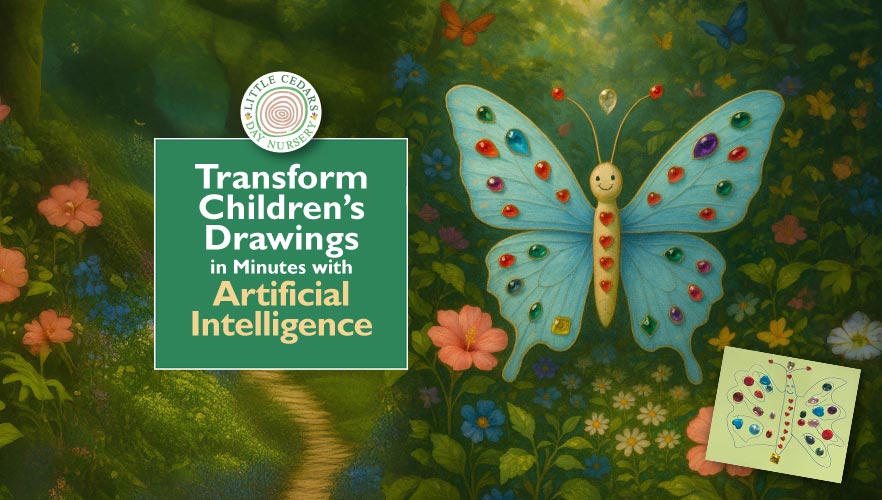
Today’s activity is one that’s fabulous fun for children and parents alike. It’s all about showing children how quick and easy it is to transform their drawings, paintings, and art using Artificial Intelligence (‘A.I.’). With help from a parent, magical results take just minutes to accomplish, and each transformation is often incredible. It’s also clear that the finished results truly honour children’s creations, while simultaneously elevating them to new, highly professional digital art imagery. What’s more, the tools that achieve this are freely available to families via desktop computers and smartphone apps.
Let’s dive in, then, to see how children and parents can take children’s art to magical new heights — easily, and in just minutes. We’ve also included some ‘before’ and ‘after’ images to exemplify what’s possible using the right approach. Parental or adult supervision is, of course, essential, particularly for the youngest children.
Why Introduce A.I. Digital Art Transformations to Children
This activity will encourage children’s art, communication and creative skills, and boost their understanding of today’s world. While some may be nervous about introducing youngsters to A.I., it’s a technology that’s ubiquitous — embedded all around us on computers, smartphones, and countless other devices. Indeed, today’s children are likely to grow up with it being a normal part of their lives. Many will grow up using A.I. daily at home and in the workplace, and some may even end up in a career that involves it. So, what better way to introduce artificial intelligence to little ones than via a responsible parent who has their best interests at heart? Such a parent can closely supervise them and ensure they use A.I. safely and responsibly. With that in mind, today’s A.I. art activity is a simple but fun way to help them see the technology’s potential, and to generate digital art that they can call their own and be proud of. Bringing their art to life in this way will also demonstrate that their imaginations, ideas and creations have enormous potential, are valued, and therefore matter.
Bringing children’s art to life will demonstrate that their imaginations, ideas and creations have enormous potential, are valued, and therefore matter.
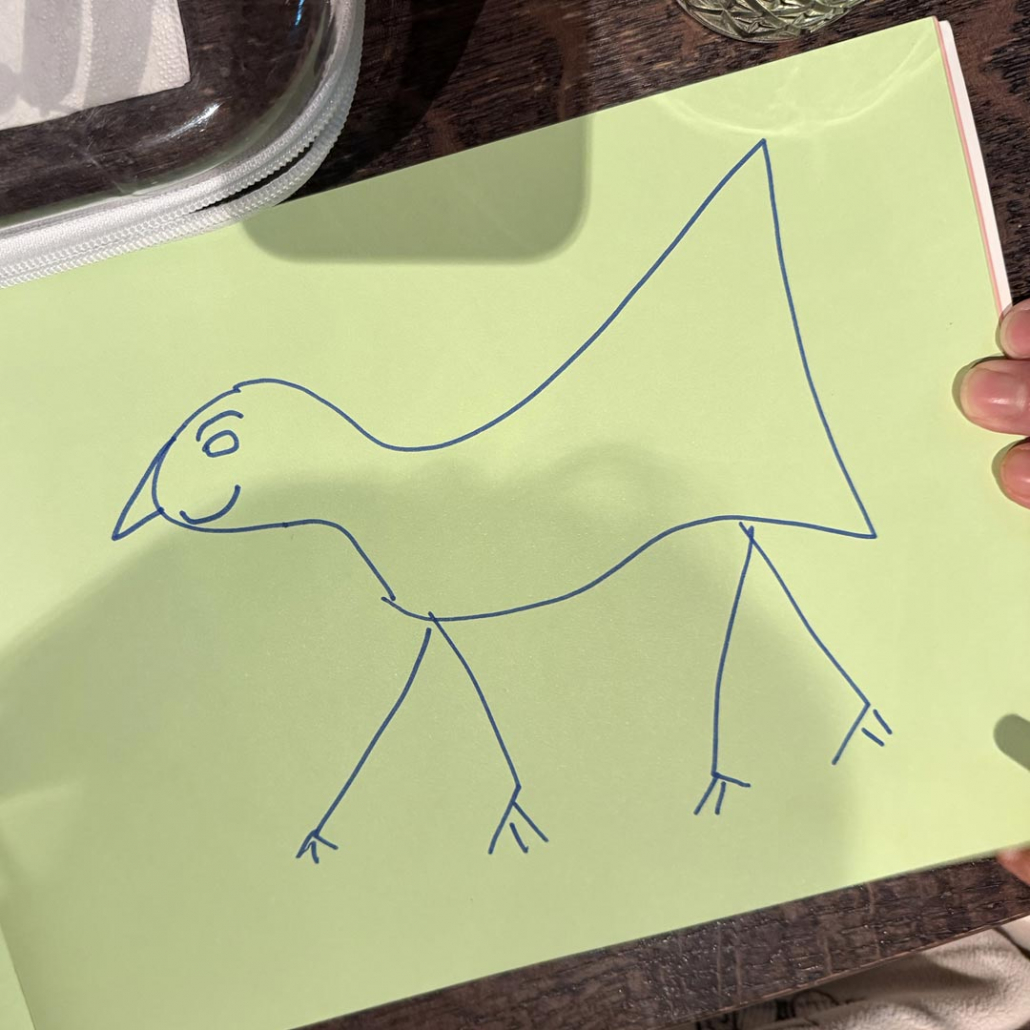
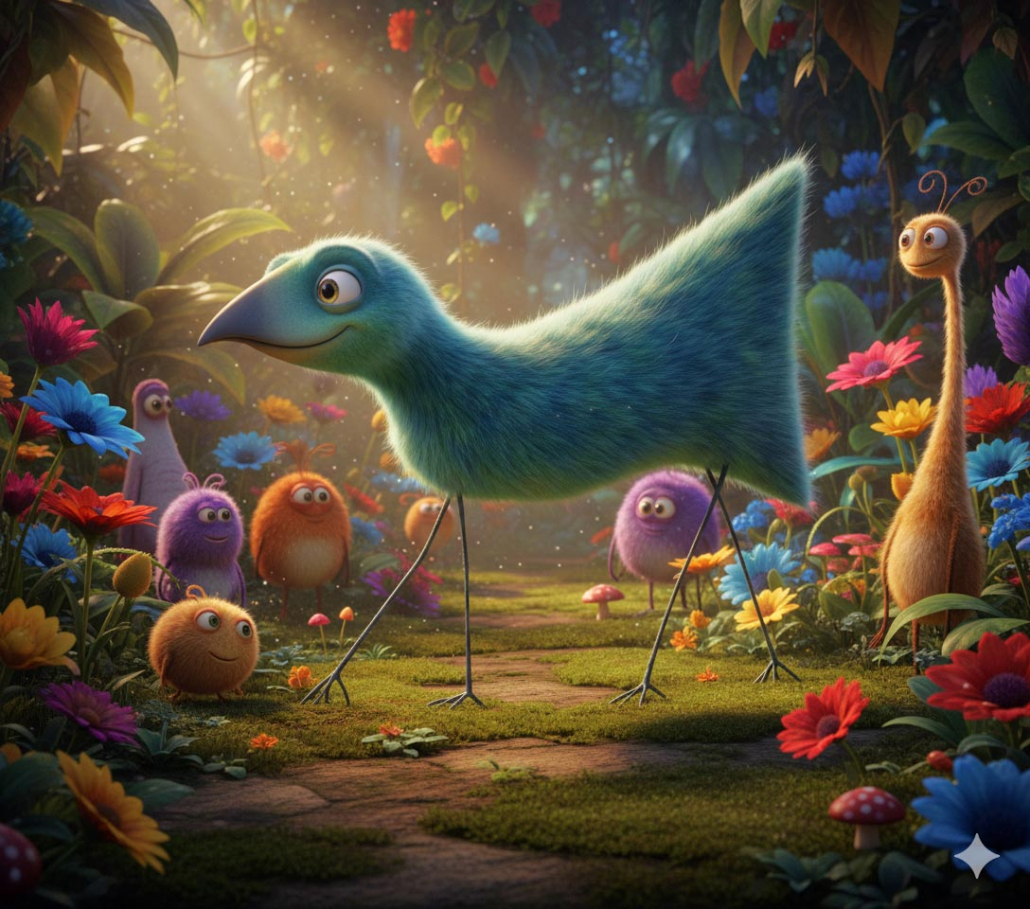
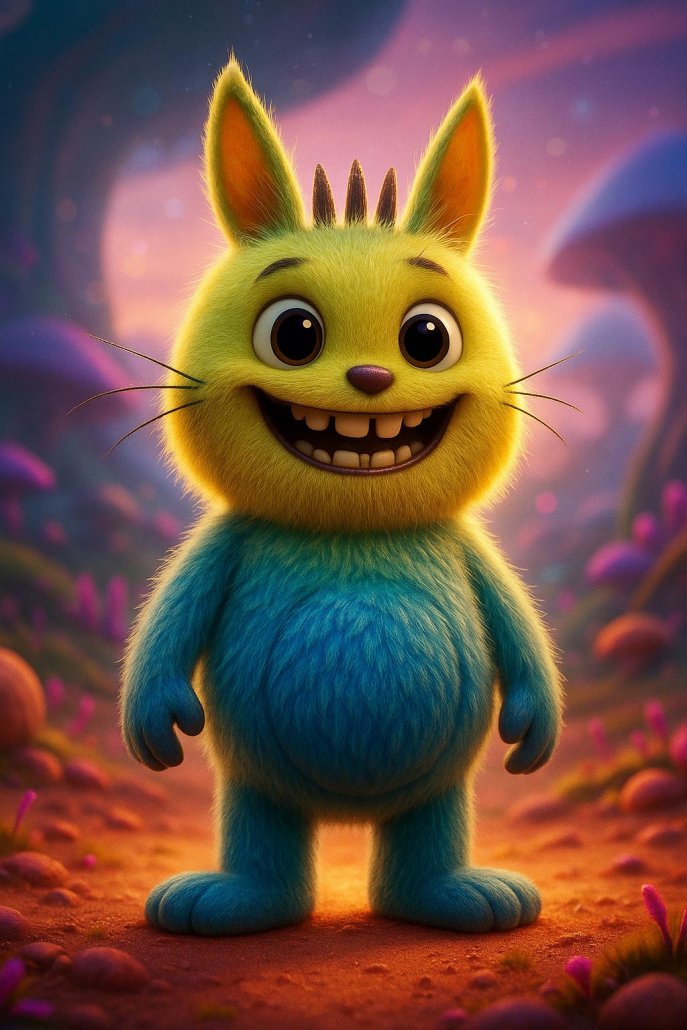
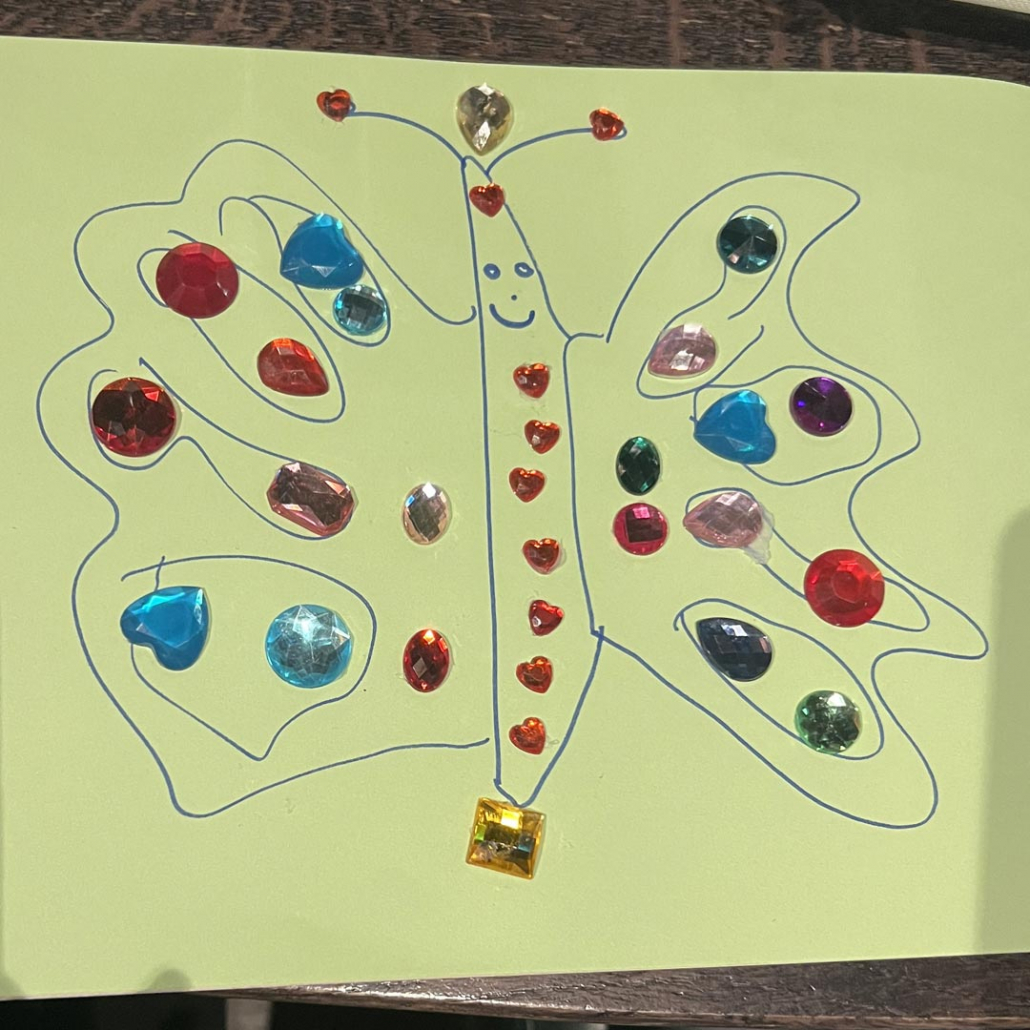
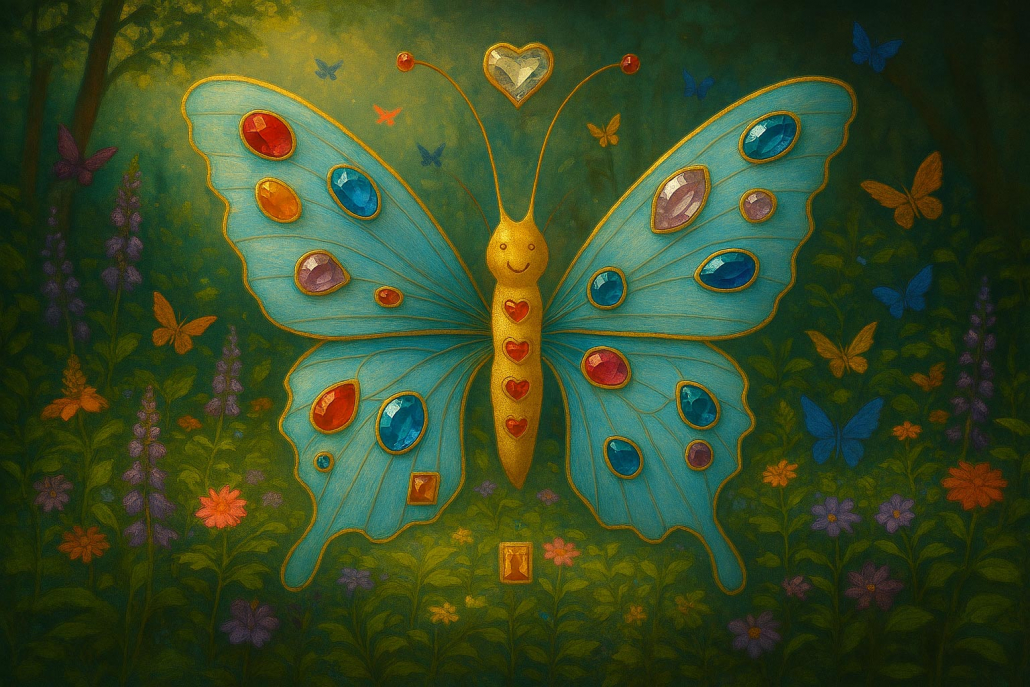
Here’s a clickable gallery showing what’s possible when you ask an A.I. tool to transform a child’s art:
Steps to Incredible A.I. Transformations
Step 1: Make a Drawing or Painting
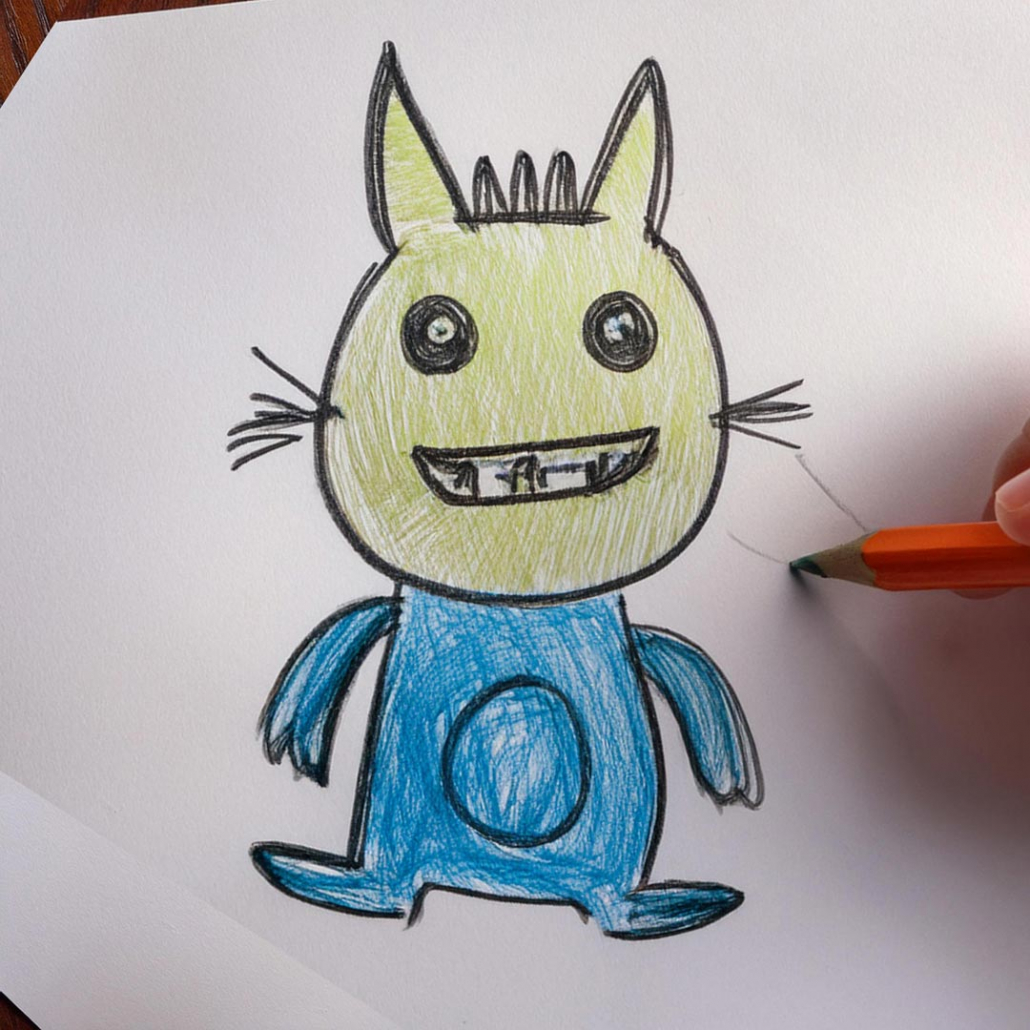
Step 1 is for children to do what they often do best: draw or paint something on a sheet of paper. If they need some ideas, an image of one or more people, animals, monsters, robots or what they might imagine to be aliens would be a good place to start. They can include anything they like around the main character or focus of the piece, be it a background of a home, forest, mountain scene, alien landscape, or indeed nothing at all — because asking the A.I. tool to insert some kind of background is also something they can do (see Step 4).
Step 2: Photograph or Scan Your Child’s Art
Once the child is happy with their drawing or painting, the parent should scan or take a smartphone photo of the image from above and save it, noting where it’s been saved. Try to avoid casting any shadows across the art when you photograph it, and ensure the results are clear before moving to Step 3.
Step 3: Upload it to the A.I. Tool
The next step is to upload the saved photo to the A.I. tool. For most A.I. tools, this is usually done simply by clicking the + symbol in the chat window of your chosen A.I. tool (more about those below) and selecting the appropriate instruction (upload, or add photos/files, as appropriate). Then, ideally, include your instructions for the A.I. tool within the same prompt or, failing that, immediately after it in your next prompt. See Step 4 below for our recommendations.
Which A.I. Tool?
There are many different A.I. image-generating tools available to families, including powerful ones that are free to use, within certain limits. ChatGPT is perhaps the most well-known and has a fabulous image-generating tool, directly available from the chat prompt via the paperclip symbol (whether via its website or its smartphone app). However, ChatGPT has fairly stringent limitations on the number of image transformations it will produce per hour or day, particularly when the system is busy, and transformations may be a little slower than with some other A.I. tools (paid upgrades are available to reduce some of those limitations).
A good alternative for families to start off with is an A.I. tool that’s less stringent yet more accessible. ‘Copilot’ would be an excellent choice on Windows 11 PCs because it’s embedded into that operating system. Another good alternative would be Google Gemini, which is accessible directly via any web browser by clicking our bold, blue link.
Either way, an image can be uploaded from the A.I. chat prompt by clicking the + symbol, subsequently choosing ‘Upload’ for Copilot, ‘Add photos & files’ for ChatGPT, or ‘Upload files’ for Gemini.
Other A.I. tools are available, but the suggestions above are a good starting place. Parents will need to do their own research around functionality, any image generation limits, possible fees if they want to upgrade, privacy, image ownership, etc.
Step 4: Give the A.I. Instructions
Once your image has finished uploading to the A.I. chat prompt, the next step is to write your instructions, ideally in the same prompt window or, failing that, in the very next prompt that you make. Such instructions tell the A.I. tool what you want it to do with the image you have uploaded. You can give it some simple instructions, which will allow it flexibility to make many of its own decisions, or feed it highly detailed instructions that give you much more control on the final output. Your child can be involved in such instructions, of course, and this can all be a part of the creative fun! Such an option may work best once they’ve learnt what the A.I. tool is capable of doing, having perhaps transformed their first few pieces of art.
What Can You/Your Child Ask the A.I. For?
What you can ask the A.I. tool to do with your child’s drawing or painting is only limited by your (or their) imagination! For example:
- You could ask them to transform it into a cartoon style if you want to keep it simple (for example, in the style of SpongeBob SquarePants or The Simpsons).
- You could ask the A.I. to transform a scribble of a robot into a high-definition one that takes the same form but looks every bit like it’s made of painted metal and resides in a futuristic city.
- You could request a transformation in the style of a Pixar movie. For example, with the main character(s) having shaggy fur, bright colours, all set in the interior of an imaginary spacecraft with illuminated buttons and futuristic furniture.
- Another option would be to request the output to be in the style of clay characters of the kind you’d see in a Wallace & Gromit animated movie.
- Or ask for the final image to be in the style of a wooden puppet, a fabric soft toy like you’d see in a child’s nursery, or indeed something that looks like it is from Toy Story.
- You could perhaps ask for something that looks like your child’s drawn character comes from Sesame Street or The Muppets.
- Be aware that you can also specify the type of lighting (soft, hard, backlit, etc.), what the background should be, what the location is, what style of image it should be, and even whether any elements of the child’s original drawing should be ignored, adapted, or substituted. If you/your child has something in mind, simply tell the A.I. tool.
Step 5: Wait for the Amazing Results!
Once your child’s drawing or painting has been submitted along with the appropriate instructions, it’s a case of waiting a minute or two for the results. Be prepared for a “WOW!” from both yourself and your child when the generated image appears, because the results are usually incredibly impressive. The A.I. tool will have taken the essence of your child’s creation and elevated it to incredible new heights.
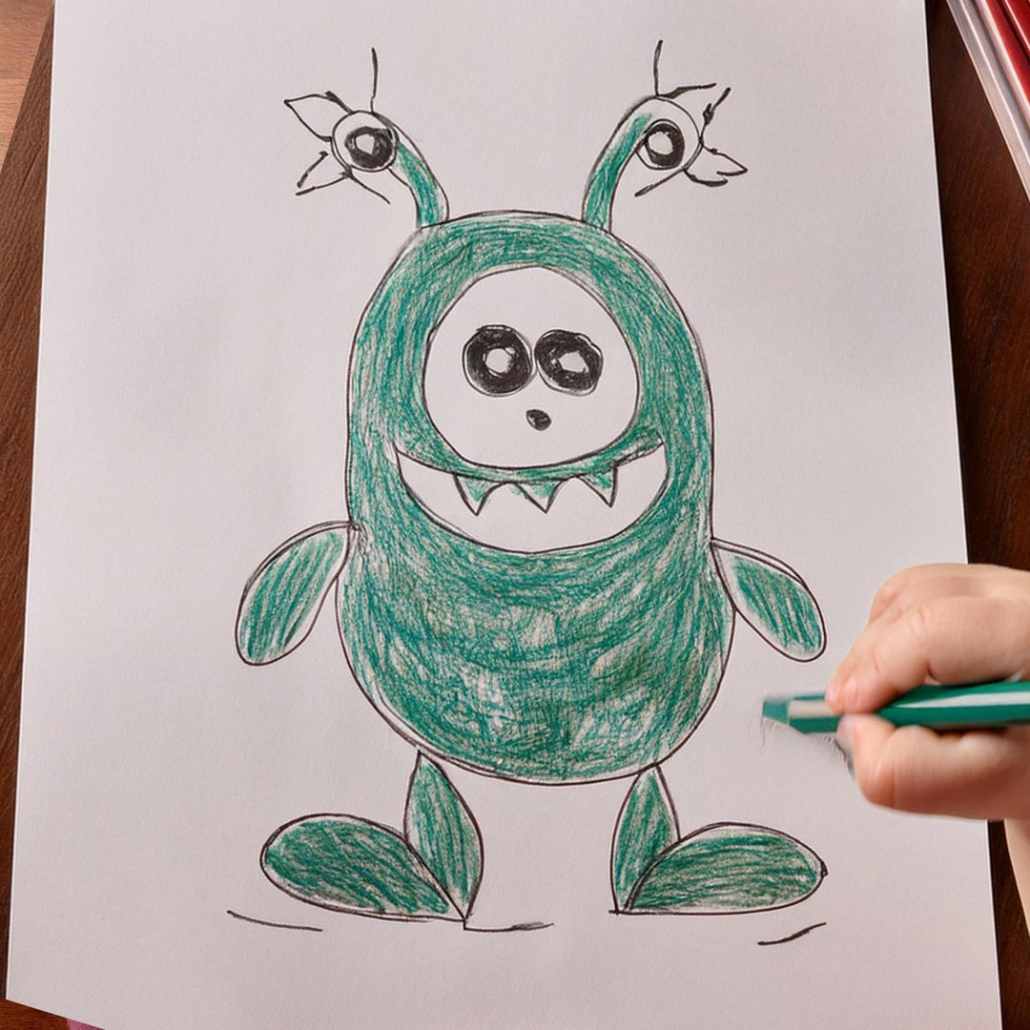
Here are a few more examples, which are clickable for a larger view:
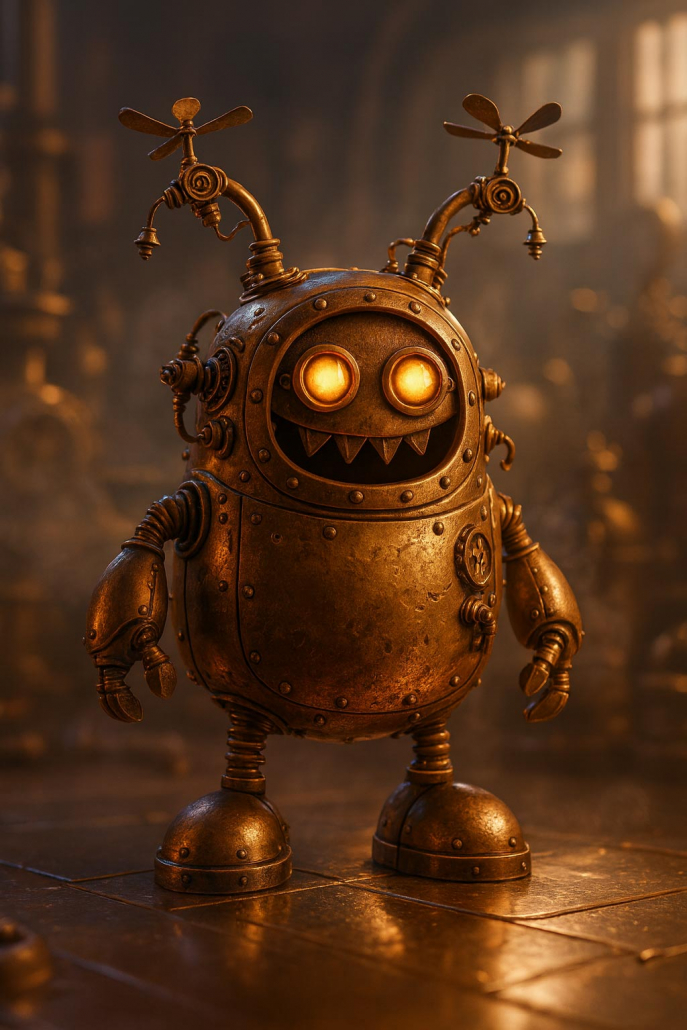
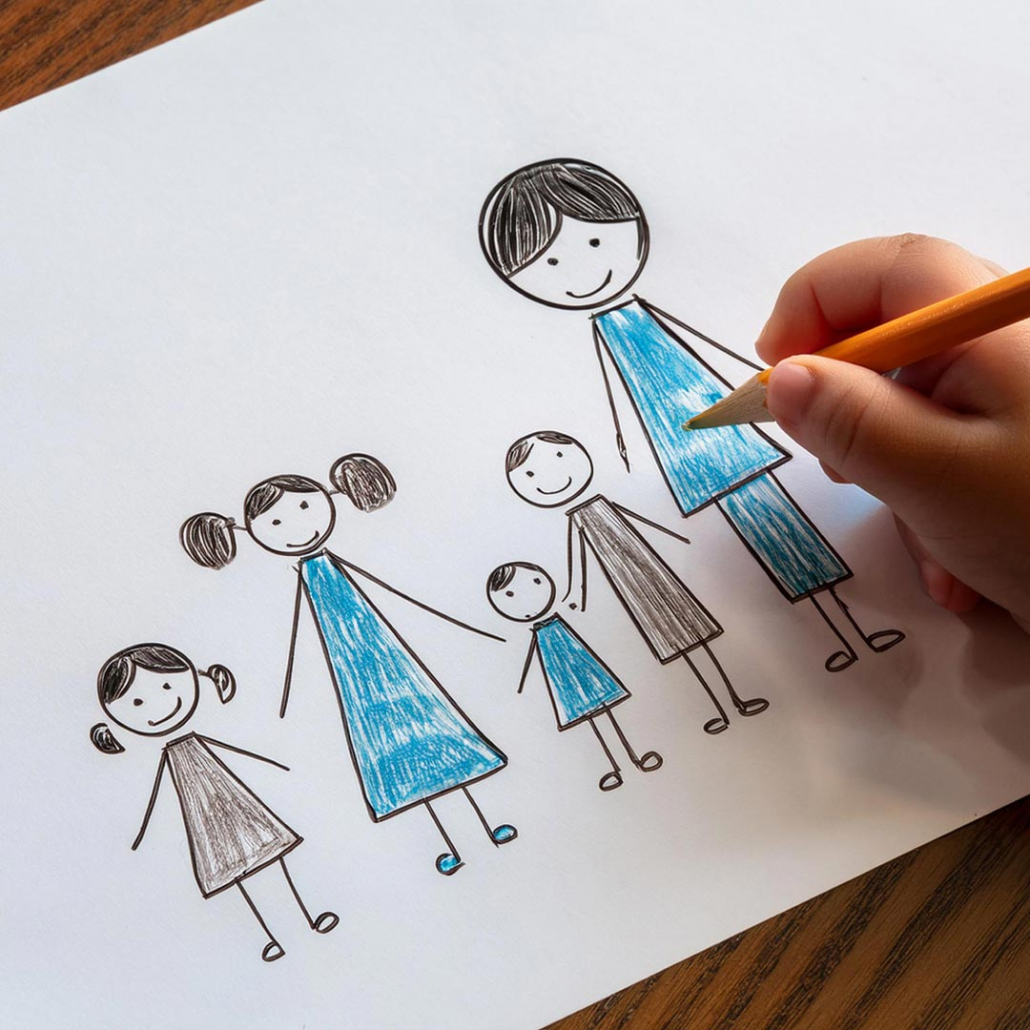
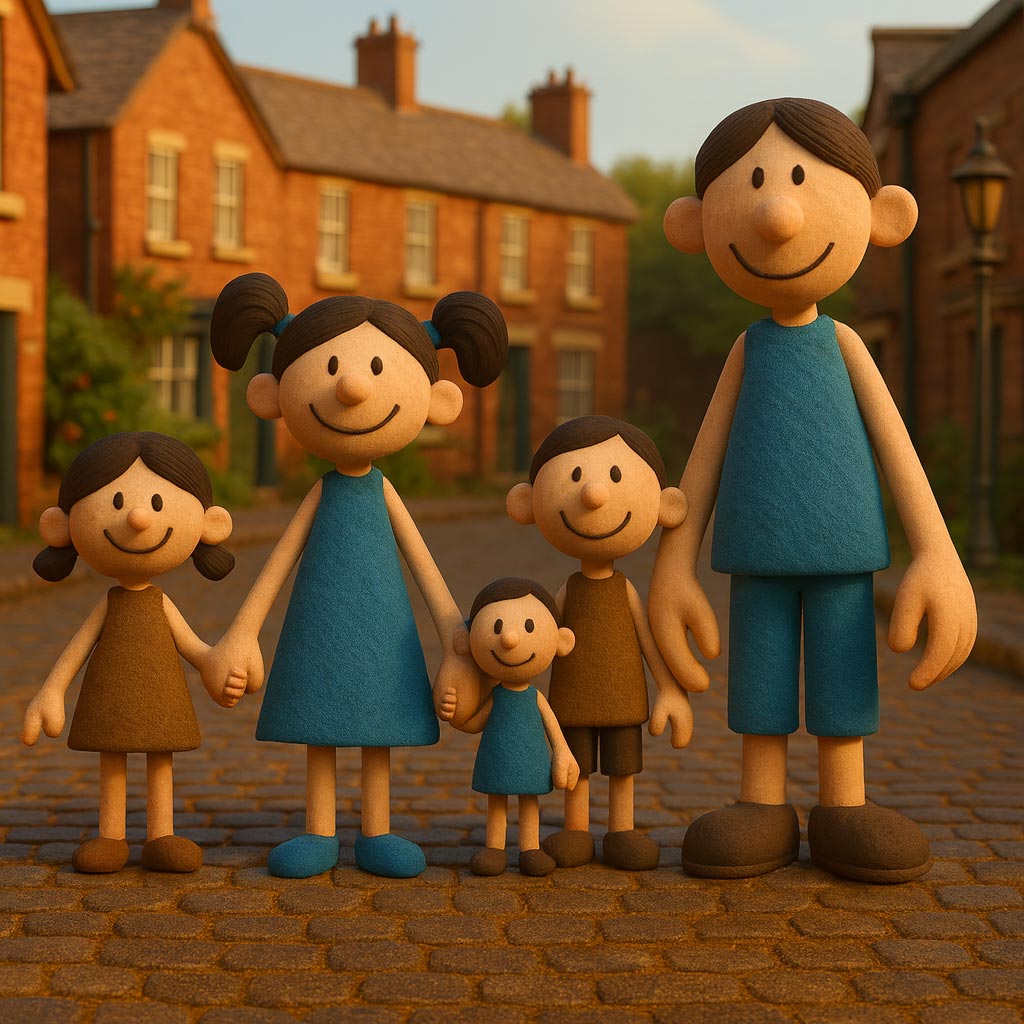
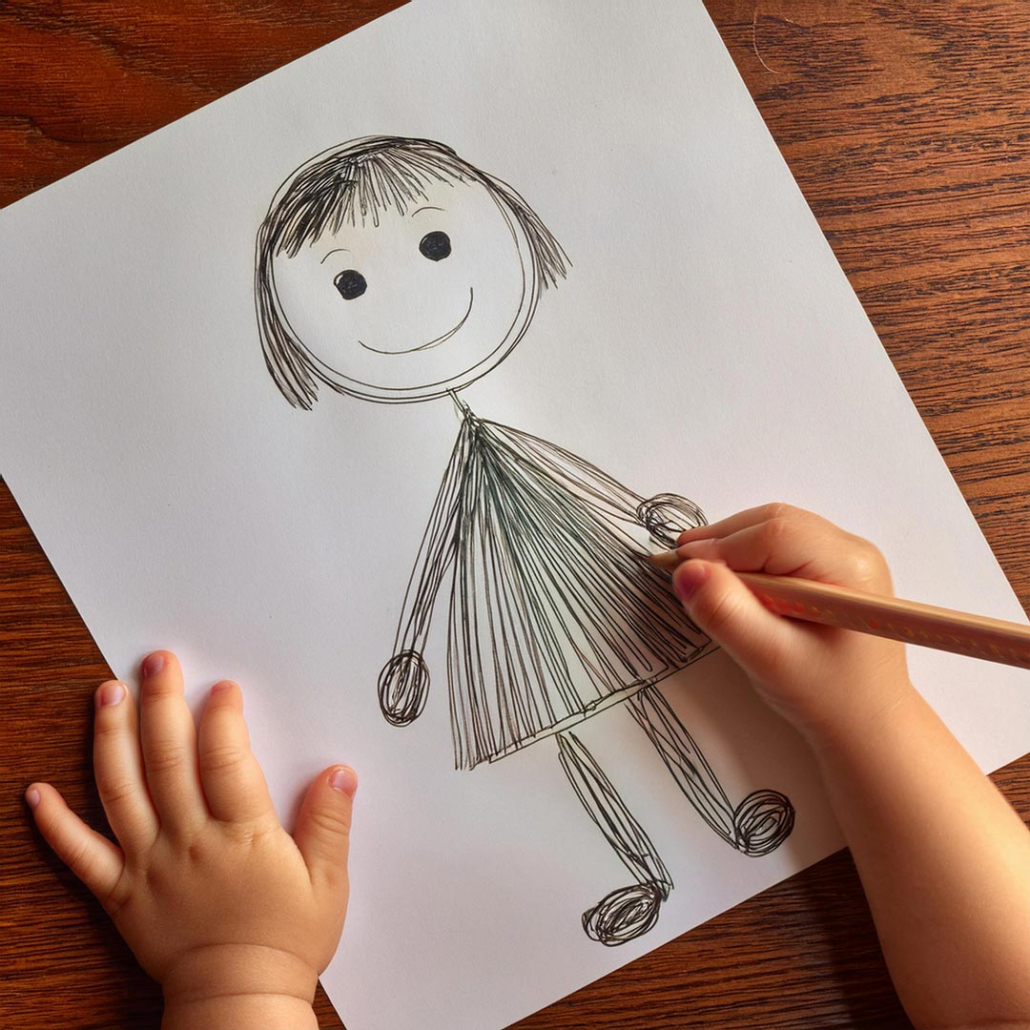
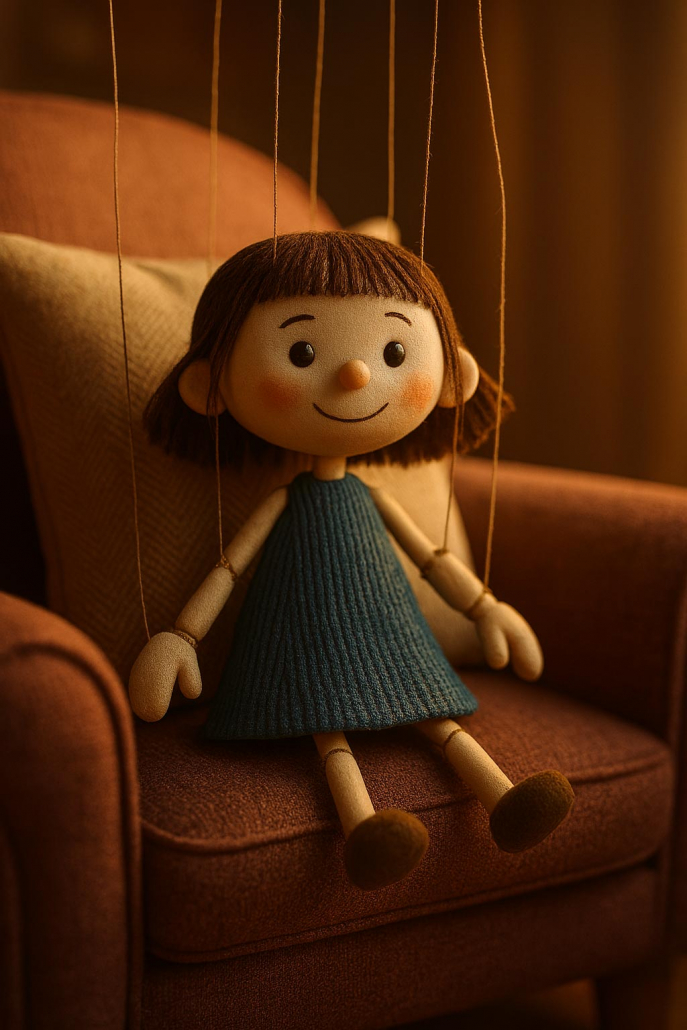
We had the most fun creating today’s post! And, if it’s fun for adults, just imagine how enjoyable children will find the activity. With the help of a parent or carer, they’ll see their creations come to life in incredible ways. They’ll be able to see how simple drawings can be absolutely transformed into high-resolution, highly detailed, professional-looking imagery that would not look out of place in an art gallery, on TV, or in a cinematic movie. What’s more, they can let their imaginations strive for new heights by suggesting exactly how their images should be enhanced. Would they like their drawing to look like a character from The Smeds & The Smoos, something from a Minions movie, more akin to a cartoon character like Peppa Pig, or something that would look at home in a soft toy shop? With today’s A.I., they can let their imaginations run riot, wield truly powerful tools, and reach for the stars to transform their art into truly magical results. It takes just minutes — and can be achieved totally free of charge. After printing out the results or saving the images digitally, children will end up with something they can be proud of. More importantly, though, they will come to understand what magic is possible from something they have imagined and created.
A High-Quality Childcare Service in Streatham
Little Cedars Nursery — Weekday Childcare for Under-5s

 Little Cedars Nursery is a wonderful childcare service in Streatham. The setting may also suit those searching for a good nursery/preschool near Streatham Common, Streatham Hill, Streatham Park, Tooting, Furzedown, Balham, Norbury, or Colliers Wood. Little Cedars Nursery is rated as a good provider by Ofsted, so you know your child will be in good hands. The nursery is warm and welcoming, with a home-from-home environment where children and babies feel safe, nurtured, loved, and valued. We have wonderful, caring staff and all the facilities, equipment, and resources that will ensure under-fives get the best start in life. By doing so, they’ll become the best versions of themselves and will be ready to thrive! Little Cedars Nursery supports free/funded childcare schemes for eligible children and babies.
Contact Little Cedars Nursery today to learn more, register for a place, or book a guided tour:
 With warmer weather and plants and trees flourishing wherever we look, it got us thinking about some creative children’s activities, inspired by nature. One simple starting point is the humble leaf, which can lend itself to a surprisingly wide range of creative activities for children to enjoy. Such activities will not only draw children’s attention to
  The first thing children will need is, of course, a selection of suitable leaves. To give them enough scope for a wide range of creative activities, we suggest families forage a variety of different sizes and shapes. We suggest focusing primarily on tree leaves as these are likely to be fairly robust, come in lots of different forms, and often have well-defined ‘vein’ structures. Oak leaves, sycamore, beech, hawthorn, horse chestnut, lime, sweet chestnut and silver birch would represent a nicely varied selection, for example. Download our
  One of the most straightforward activities using leaves is for children to simply paint them. The youngest will love painting one side of each leaf in a different colour — or even adorn them with patterns like spots, zigzags, hearts, and stripes. Once the paint is dry, the leaves can be used in a variety of different ways. For example, they could be glued into an attractive design on a sheet of paper/card and displayed in a frame, made into a garland for the wall, bunched together to form an attractive hand-held fan, glued to a circle of paper or card to form an attractive crown, or glued to an upturned stick or tree sprig to represent a colourful tree. These are just a few ways they can be used once painted and, indeed, coming up with ideas is all part of the fun and creativity for children!
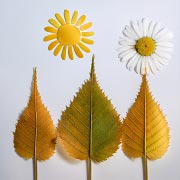 Collages made from leaves can also be very easy for children to accomplish; they just need a base card or paper, child-safe glue, some leaves and perhaps some flowers too. Ideally, leaves should be flat and, even better, dried. This can be achieved through pressing, which is explained later. For added beauty, add fresh or pressed flowers of different colours too — perhaps even other items like stars and glitter. Children can then gradually build up an attractive design (rather like organic wallpaper) or a simple picture like our example. It will result in a fascinating piece of leaf and flower art that can be displayed in the home — something for children to be proud of!
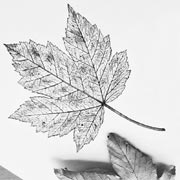 A freshly painted leaf can also be used to make leaf prints. When the paint is still very wet, children should simply turn their leaves over and press all areas of them against a sheet of paper or card. Doing this by hand is OK but if you have a roller, even better! In this way, the paint is transferred to the sheet and will typically show the leaf shape and all the structural veins of the donor leaf. And, by repeating the process with one or more leaves and colours, a design or picture can be gradually built up on the sheet. This might be as simple as a repeat pattern or as complex as a pictorial scene. By adding other media like painted or drawn lines, leaf prints could, for example, represent a forest on a hillside. Add little figures of people and perhaps little dogs underneath each ‘tree’ and it’ll start to come to life!
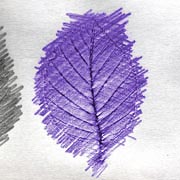 A leaf-rubbing activity is also fun and intriguing for little ones. Find a flat surface like a table or rigid sketch pad and place a thin sheet of paper over one or more leaves. By rubbing a thick wax crayon, charcoal stick, or soft-leaded pencil repeatedly over the sheet where there is an underlying leaf, the leaf’s form will gradually reveal itself. Children will be able to see the structural veins that form the leaf, along with leaf edges as they scribble. Children can experiment with different media, colours, and types of leaves to get different creative results.
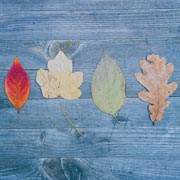 eaves and small, non-bulky flowers can be dried and flattened through the process of pressing. All that’s needed is the leaves and flowers and a thick book of paper sheets — a large sketch pad is perfect or, alternatively, sheets of unprinted newsprint or blotting paper. Manually place single flowers and leaves between the leaves of the paper and then place something large, flat, and heavy over the entire thing and leave it for anything from a couple of days to a couple of weeks. How long will depend on the type of leaves and flowers involved (and how dry and flat they were to begin with). Once ready, the flowers and leaves will be thin and dry, ready to use. They could, for example, be used individually as mementoes or bookmarks, or assembled with glue into ‘pictures’ via a collage, as explained earlier.
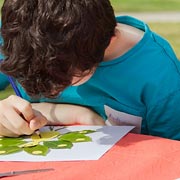
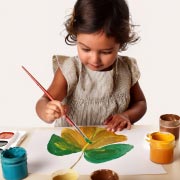 Another creative activity involving leaves is simply to represent them in pencil, paint, or other media of a child’s choice. Encourage them to look carefully at the leaf’s shape and detail, so they can try to mimic them in drawn or painted form. Drawing and painting are highly useful skills for children to develop and mastering such skills will prove useful throughout their educational years. If you, as a parent, are good at drawing or painting, perhaps join in the activity too. By doing so, you can show your child what is possible with some close attention to detail and carefully placed lines and strokes. As you build up your own picture, perhaps explain how you are achieving the results, so they can learn from your approach. And — who knows — perhaps you’ll discover that you have a budding artist in the family!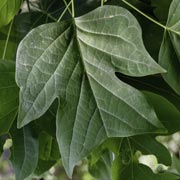
 Whether dried, painted, or simply picked as they are, leaves can also be made into other objects, characters, and so on. Some leaves can look like other items, for example, a particular type of tree (the Tulip Tree a.k.a. Yellow-Poplar) has individual leaves shaped rather like t-shirts! Children could look out for these and perhaps paint them in their favourite football team’s colours, draw in legs, arms and a head to make people and — hey presto — they’ve created a person! Similarly, there are several leaves shaped like hearts which, once painted in a suitable colour, can be useful when making greetings cards for birthdays or Valentine’s Day.
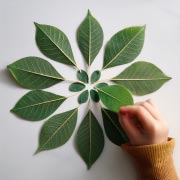
 Another example of how leaves can represent other things can be illustrated by simple leaves like beech leaves. Each of these looks rather like the shape of a classic flower petal. So, perhaps a child can be encouraged to fan several around in a circle, almost tip to tip, to look like a big flower head. Children can paint the circle in the middle or glue a circle of coloured paper or wool there to represent the centre of the flower. And, if they start with a paper large enough, they could create several of these and make a picture of multiple flowers made of leaves. Use thin twigs, wool, or drawn crayon lines for stems and perhaps longer, thinner leaves to make the flowers’ leaves.
 The activity ideas above are just a starting point and there are plenty more that are possible with leaves. Whether it’s dried leaves painted, glued and varnished onto pebbles to form paperweights, dried leaves gently sprayed with perfume to form pot-pourri, or suspended leaves that form a mobile, the possibilities for leaf art are almost endless! We hope our ideas today inspire children to use their imaginations and make some beautiful creations — all with simple, humble leaves.
 In addition to being fun and creative, these activities all support the Early Years Foundation Stage curriculum for under-fives. EYFS areas supported by the activities include:
 Transform your living room into a mini adventure zone. If you don’t have existing adventure equipment, perhaps use cushions and make tunnels from blankets draped over furniture. You can also create masking tape ‘routes’ on the floor to mark out an exciting course for little ones to navigate, crawl through, jump over, and balance along. You can add a timer to make it a fun race or include challenges like hopping on one foot or crawling backwards. This is a great way to build gross motor skills while having loads of fun.
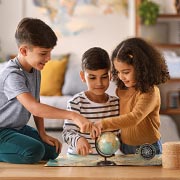 Hide small toys or objects* around the house and give your child simple clues or a checklist to find them. This activity encourages problem-solving and keeps them engaged in an exciting mission. Perhaps introduce themes, for example, a pirate treasure hunt with a ‘treasure map’ or a nature scavenger hunt using items like leaves or toy animals.
 A few sheets stretched over furniture, with blankets, pillows, and child-safe* LED fairy lights below, can create a cosy hideaway. This can be used for storytelling, imaginative play, or simply a quiet space to relax. Encourage your child to bring their favourite books and stuffed animals inside, to make it their own secret retreat. Den building helps encourage creativity, teamwork, and a sense of independence.
 Let your little ones dress up as pirates, fairies, princesses, or superheros and encourage them to act out their own stories. Role-playing helps boost their imagination, creativity, and confidence. Provide props like child-safe* toy swords, wands, or kitchen utensils as pretend play items to expand their stories. Acting out different scenarios enhances communication skills and self-expression.
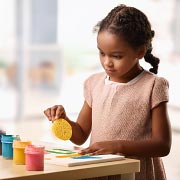 Swap traditional paintbrushes for sponges, cotton pads, or even cut vegetable fingers or potato ‘stamps’. Using unusual tools to apply paint allows children to explore different textures and get creative with their masterpieces. You can also use things like leaves, or child-safe kitchen utensils, to achieve different effects. Let them mix colours and discover new shades while experimenting with new application techniques.
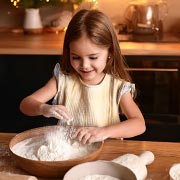 Help your child make their own salt dough with flour, salt, and water. Moulding and shaping salt dough is a great sensory and motor skill activity. While supervising children for safety, provide cookie cutters, rolling pins, or stamps so they can make different shapes and imprints. You can also add child-safe food colouring for extra sensory fun.
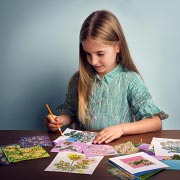 Give your child a mix of stickers, old magazines, and child-safe glue sticks to create their own collage artwork. This is a great way to develop fine motor skills. Set up themes such as Under the Sea or Space Adventure to inspire their creativity. When finished, perhaps display their artwork on the fridge or a wall to encourage pride in their work and nurture their sense of achievement.
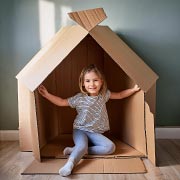 A large cardboard box can become a rocket, a car, or a house with just a little imagination. Provide crayons or water-based markers and stickers for decoration and let their creativity take over. You can cut out* windows, and doors, and even make a steering wheel for them. Encourage storytelling by asking them where their box creation will take them.
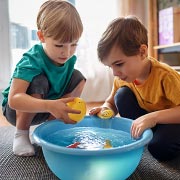 Closely supervising* children for safety, fill a washing-up bowl with water and let them guess whether different objects will sink or float. This simple science experiment is both educational and fun. You can extend the activity by discussing why some things float and others sink, teaching basic physics in an engaging way.
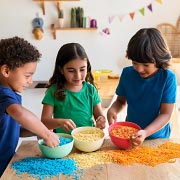 Dye dry rice or pasta with child-safe food colouring for a colourful, ‘scoop-able’ sensory play activity. Once the dye has dried, provide spoons, cups, and small containers for pouring, scooping, and mixing. This activity helps develop fine motor skills while being visually stimulating.
 (While supervising children*): mixing flour with baby oil or vegetable oil will create a soft, mouldable
  Freeze fruit like strawberries, orange segments, or suitably sized small toys in ice. Once you have removed them from the freezer, let children “rescue” the fruit and objects from the ice by using warm water and spoons. This activity promotes patience and problem-solving skills with a scientific twist. You can add child-safe food colouring to the water before freezing for a more visually engaging experience.
 Provide ready-made bases, tomato sauce, cheese, and toppings for kids to assemble* their own mini pizzas. Encourage them to arrange toppings into faces, pictures, or patterns, making the activity both fun and delicious.
 Applying icing and sprinkles to cookies or biscuits makes for a fun and tasty decorating activity. Let children experiment with different patterns and colour combinations, encouraging creativity and hand-eye coordination.
 Let children choose their ingredients and blend* fruit with milk or yoghurt to make delicious and nutritious drinks. If they’re old enough, are closely supervised, and it’s safe for them to do so, let them help with mixing. Once the smoothie mix is ready, use fun paper straws or cups to make it feel like a special treat.
 Play your children’s favourite tunes and have a dance-off! A dance party is great for burning off extra energy indoors and it’s immense fun. Children can swirl paper ribbons or strands of coloured tissue paper for added fun and movement when they dance. Dancing helps children stay fit and is also good for honing coordination, balance, and motor skills.
 Musical statues and musical chairs are classic games that never fail to bring laughter and excitement to a rainy day. Add fun challenges like dancing in slow motion or pretending to dance like a robot and it’s sure to be a big hit with kids!
 Create shakers using rice or dried pasta in bottles — or use pots and pans as drums, perhaps using a wooden spoon. Encourage your child to form their own mini band. Different materials and a range of cardboard boxes or Tupperware-style tubs will allow children to experiment with a variety of possible sounds. It’s very creative!